
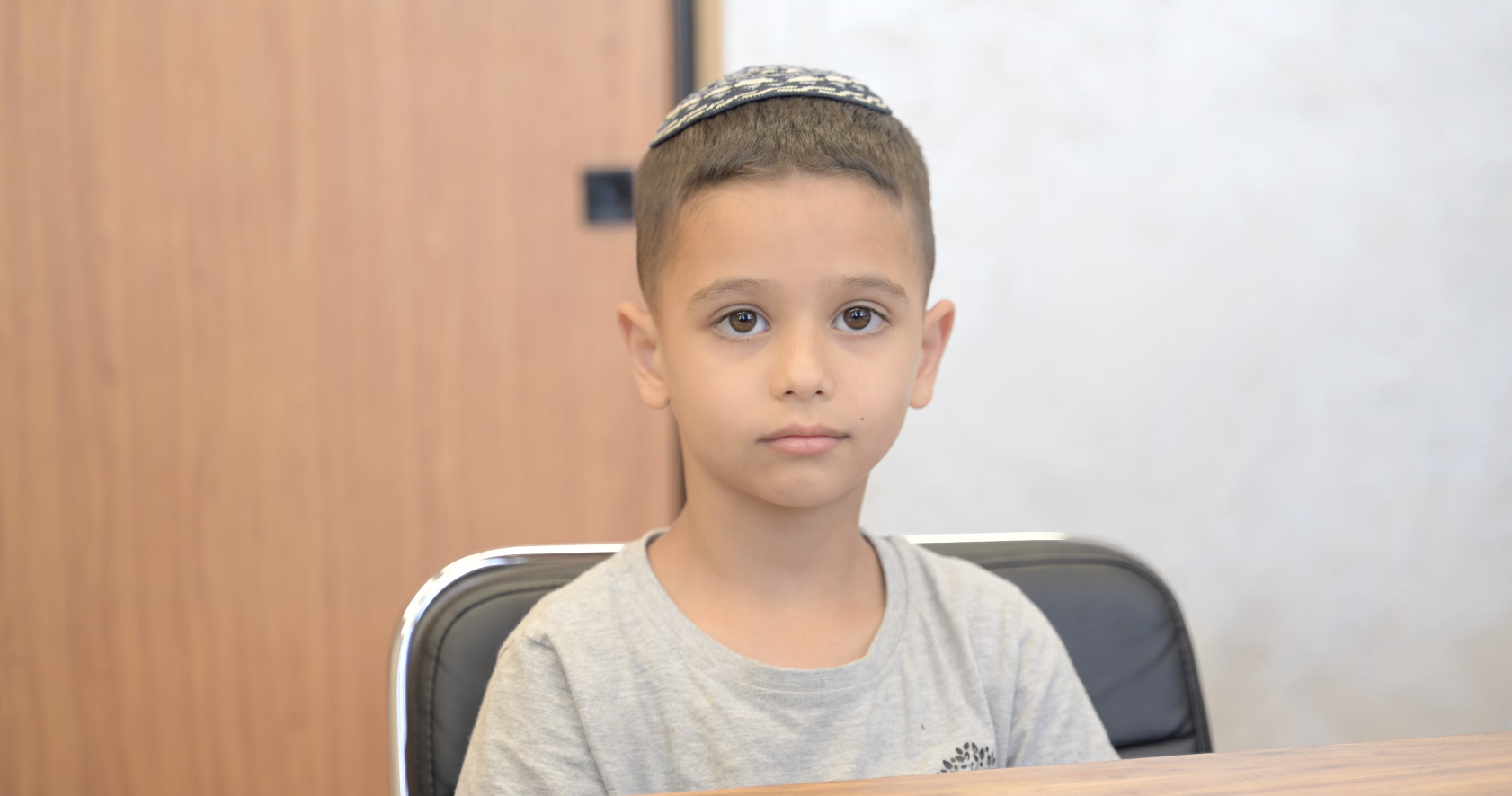
In one Beit Shemesh classroom supported by JOIN Israel, an elementary school student tried to explain what the war years had felt like.
“There was a war,” he said softly. “And I got scared… a little bit. It was hard. And frightening. And there were a number of sirens… one after the other.”
Later, reflecting on those months, he added quietly: “My friends were all sometimes sad too, I think.”
The children interviewed for this article were in first through fourth grades at a Beit Shemesh school whose educational and emotional-support programs are supported by JOIN Israel. Some had lived through months of repeated missile sirens. Two had lost their homes and were living in small rentals.
Elroy, six years old, was living in the town of Eshtaol when a missile struck. His family had left to go to a park, “I convinced them to go,” he said. When the siren came they found a bomb shelter, but Elroy saw the missile strike his home. The house he had left was destroyed.
“It’s scary, those bombs,” he said quietly.
Another 4th grader, David’s family had been shopping when a missile struck next door to their home in Beit Shemesh. Nine people were killed in the very bomb shelter that was normally their place of safety. The school sat one street away. Windows shattered. The force of the blast blew open the school’s main entrance door.
A third child, Avi, whose older brother serves as an army officer, described the morning of October 7 with the matter-of-fact directness children sometimes use for things they have not fully processed. His brother was at home when the sirens began. By that evening, he was called up to many months of service.
“He’s been in the bunker most of the time,” the boy said. “There could be a war, but right now there’s a ceasefire, I think.”
Avi is 9. He was describing this as ordinary life.
What stood out most across these conversations was not dramatic expressions of trauma. The children spoke quietly, sometimes hesitantly, often with the matter-of-fact directness of people who have absorbed a reality they did not choose. They talked less about politics or the war itself and more about what had helped them continue feeling safe.
“What made you feel better?” one child, Kira, was asked.
“Being with my friends and with my family.”
Eden described the long stretches spent mostly indoors during waves of sirens and school disruptions: “We stayed home. Just with family.”
Asked what helps children feel safe Nadav answered: “Being with their friends and family… and being with their pets.” He then described a siren during which he had found himself alone in the house.
“Oreo, my dog, helped me feel safe.”
Avi put it differently. He had been alone at home when a siren sounded. Asked how it felt, he paused.
“When there are people, everyone is talking, and you can’t hear the things,” he said. “When you’re alone, you hear — and your heart stops.”
Children rarely described their experiences in clinical or psychological language. Instead they spoke through fragments of ordinary childhood: boredom, missed friends, books, games, safe rooms, the presence of family.
“When things are scary,” one child said, “I like to read a book.”
Another said what children need most is “happiness and love.”
Educators who work with these children recognize the gap between how they present and what they are carrying.
Esther Ackerman, who has served as principal of the Beit Shemesh school for nearly thirty years, described children who largely continue functioning outwardly — learning, socializing, playing — while quietly carrying levels of stress and fear that don’t always show themselves.
“The children continue functioning,” she said. “They come to school, they smile, they play — but underneath, many are carrying stress and fear that doesn’t always fully show itself.”
Teachers have observed changes in concentration, emotional regulation and social dynamics following repeated periods of war, sirens and instability. Some children became more withdrawn. Others needed additional reassurance, structure or emotional support. Teachers found themselves placing greater emphasis on movement breaks, creative expression and helping students identify areas of strength rather than deficit.
One child, Ackerman recalled, had clung to his parents on the first day back at school after the violence, unable to let them leave. His parents stayed with him for a while, then for a little while less, and gradually he returned to himself — though she noted that he still remembers. The shock, she said, does not simply pass.
The school itself is not affluent. Families choose it less for its facilities than for the emotional culture it intentionally creates: warmth, close teacher-student relationships, and what Ackerman described as a refusal to tolerate violence, ridicule or belittlement in any form.
“The biggest mistake adults make,” she said, “is to criticize a child before you understand what brought them to what they’ve done or said. Now, more than usual, if we criticize them too harshly, we can crush them. If we understand them — from that understanding, everything becomes possible.”
That environment appeared visible even during the interviews themselves. The children listened attentively to one another. No child mocked or dismissed another’s fears. The atmosphere in the room did not feel emotionally heavy so much as subtly altered — as though childhood itself had quietly adapted around prolonged instability.
Dr. Larry Genstile, an American-born psychologist who has worked in Israel for nearly forty years — including with trauma survivors, children and adults returning from combat — is not surprised by what the children describe.
He notes that children often absorb stress indirectly, through emotional atmosphere and disruption to routine, rather than through any explicit processing of events. They do not always understand or articulate what they are carrying. But they experience it.
“The anxiety is so high,” he said. “And every time you hear an ambulance, even then, people have a flashback.”
He described children waiting for the next siren, tracking radio announcements of missile alerts, their anxiety building even during quiet periods. Some needed the physical protection of a parent — the feeling of being held — just to get through daily life.
What worries him most, he said, is not the immediate crisis but its duration. Israeli children have now lived through Covid, multiple rounds of conflict, extended school closures, and the ongoing reverberations of October 7.
“Resilience is a major issue in Israel nowadays,” he said. “We’ve just gone through so many wars. When you’re having five or six years straight through with so many issues, it’s hard. I don’t know how long it will take Israeli children to rebuild.”
He described one patient, a fifteen-year-old boy, whose first and second grades were stable and happy. From third grade onward came Covid, then the war, then more disruption. He now wants to quit school. It is, Genstile emphasized, not the boy’s fault — but the accumulated cost of years of fractured continuity is real and not easily repaired.
He is emphatic about what helps: openness. Talking about it — not in a way that amplifies fear, but matter-of-factly, with space for questions, laughter when possible, and the honesty children need.
“Secrets raise anxiety,” he said. “Talking about it in a scary way raises anxiety. But talking about it in a matter-of-fact way, making space for children to ask questions and share their fears — that is very healthy. And I think parents should be doing the same at home. It needs to be an open topic.”
He is less sanguine about whether this is happening at scale. The knowledge exists, he said. The implementation has not kept pace.
“Everyone says we need to do A, B, C, D. But nobody is doing it on a wide basis. Little groups do it. Individuals do it. But it hasn’t touched people broadly.”
When the children in Beit Shemesh were asked to complete sentences — to put into words what they most needed, what had helped them, what they wished adults understood — their answers were brief and consistent.
Eden, whose parents are divorced and who spoke with a quiet precision unusual in a nine-year-old, offered the following:
“During stressful times, children need a safe place. Somebody to understand them.”
“What helped me most was family, friends and a safe place.”
Then she paused.
“I want adults to know how I feel.”
School, several children said unprompted, had been part of what helped. Not the academic content, but the presence of friends and trusted teachers, the structure of a day, the normalcy of a classroom. One child said that during the periods without school, things were simply harder. Another put it plainly: “School helps children — having friends with them.”
This is not a small thing. For children in under-resourced communities, whose families may lack the economic and social buffers available to more affluent households, school is often the most stable emotionally supportive environment available.
Israeli children grow up with an unusual familiarity with uncertainty. Reserve-duty call-ups, missile sirens, security procedures and disrupted routines become woven into the texture of ordinary life. Children here learn early that the world is not entirely safe, that fathers and brothers sometimes disappear for months into situations that cannot be fully explained, that the sound of an ambulance can trigger something in the adults around them.
That normalization of challenge may partly account for something educators and therapists frequently observe in Israeli children: not the absence of fear, but a capacity to keep moving through it, supported by routine, connection and one another.
The children in these interviews did not sound emotionally shattered. They sounded like children working to remain children — adjusting, absorbing, continuing.
Principal Ackerman said the thing that surprised her most was that they were still doing it.
“I was a child in Jerusalem during the Six Day War,” she said. “I still have a reaction when I hear a siren. And I think about my students — what they’ve been through. The real surprise is that they’re still here. Still learning. Still happy, even. That’s the nature of a child. They want to be happy. And so even with all the fears behind them, they come to school, they take part, they laugh. That is, honestly, a miracle.”
Since October 7, JOIN Israel — a nonprofit that has worked for 35 years supporting under-resourced schools and vulnerable children — has significantly expanded its focus on emotional resilience and mental health. What had been primarily an educational enrichment mission now includes expanded counseling access, Big Brother and Big Sister mentoring, psychological assessments, and therapeutic interventions designed to help children process prolonged instability.
Much of this work happens quietly, through frameworks children already know and trust, outside the reach of headlines.
The school in Beit Shemesh, Ackerman said, has tried to adapt: smaller group sessions, art therapy, movement, space for children to speak before attempting to teach. Teachers — many of whom are managing their own children at home and their own fears — have had to become something more than instructors.
“The connection, the relationship to the teachers — that stabilized the children,” she said. “The parents and the kids love the teachers. And the teachers really play a big role in their strength and happiness.”
Dr. Genstile is clear about what more is needed: early intervention, open conversation, community involvement, and the understanding that what looks like functioning may be concealing something that will, over time, need attention.
“If you can deal with the trauma immediately, and not let it develop into post-traumatic stress syndrome, you’ve saved a lot of agony,” he said. “It needs to be an open topic. Children need to feel free to ask questions. And if they have fear, they should be able to talk about it.”
What gives him hope, after nearly four decades in this country, is something he did not expect: that it has become, at last, something people will say out loud.
“People in Israel didn’t talk about mental health issues until the last couple of years, since October 7th,” he said. “That it’s now an open topic — that people can share their fears — I think that’s very healthy.”
Eden, with her quiet precision was asked one last question.
“What does hope mean to you?”
She thought about it for a moment.
“Hope means no more war.”