


A U.S. sailor watches a Tomahawk missile launch from the deck of a destroyer in the U.S. Central Command area of responsibility on Mar. 5, 2026. CENTCOM said Sunday that it had conducted self-defense strikes against Iranian radar and command and control sites for drones in Goruk and on Qeshm Island over the weekend. (U.S. Central Command)
The U.S. and Iran traded another volley of strikes over the weekend, the latest in a series of clashes that threaten to derail a fragile ceasefire and broader peace negotiations.
U.S. Central Command said late Sunday that it had struck radar and command and control sites for drones in Goruk and on Qeshm Island, two Iranian locations along the commercially critical Strait of Hormuz.
The strikes, which CENTCOM characterized as self-defense, were carried out by unspecified fighter aircraft in response to “aggressive Iranian actions,” including the shootdown of an MQ-1 Predator drone operating over international waters.
No U.S. service members were harmed in the operation, CENTCOM said.
Iranian state media said Monday that the Islamic Revolutionary Guard Corps had attacked the U.S. air base from where the strikes originated, though it was not clear which base was targeted.
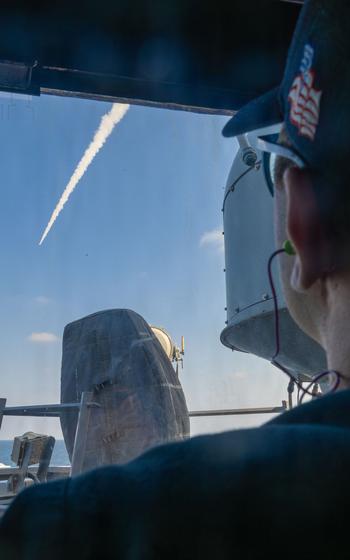
A U.S. sailor watches the launch of a Tomahawk missile from a destroyer in the U.S. Central Command area of responsibility on March 3, 2026. Despite ongoing ceasefire negotiations, Iran and the U.S. launched strikes at each other’s military infrastructure over the weekend, according to CENTCOM and Iranian state media. (U.S. Central Command)
In Kuwait, which is home to several U.S. installations, local military officials said early Monday that they were fending off a wave of Iranian drone and missile fire. Residents were encouraged to seek shelter.
An earlier strike on Kuwait injured several Americans and damaged at least two MQ-9 Reaper drones at Kuwait’s Ali Al Salem Air Base, a major hub for U.S. air operations in the Persian Gulf, Bloomberg reported Friday.
CENTCOM did not respond to a request for comment on the reported injuries and has not confirmed the attack.
The skirmishes highlight the fragility of the temporary U.S.-Iran ceasefire struck in April and could undermine efforts to permanently end the war.
A key flashpoint is the Strait of Hormuz, where Iran has repeatedly targeted commercial and naval vessels. The waterway is a major artery for global oil transport, and the war between the U.S. and Iran has wreaked havoc for Americans at the gas pump and in airlines’ jet fuel supplies.
The U.S. military has been quietly guiding ships through the strait, The New York Times reported over the weekend.
While the U.S. isn’t directly escorting ships, a CENTCOM official told the paper that the command continues to communicate and coordinate with commercial ships seeking to transit the strait.
The U.S. briefly launched an effort last month called Project Freedom to support commercial ships moving through the strait, but it was halted after just one day.
Headlines have suggested for weeks that the U.S. and Iran are making progress on a peace deal, though disagreements remain on key issues, including control of the strait and continuation of Iran’s nuclear program.
Trump indicated late last week that he was prepared to sign off on an agreement but has since reportedly toughened the terms of the proposal.
In a Truth Social post late Sunday, Trump said Iran “really wants to make a deal,” but he criticized “political hacks” who keep “negatively ‘chirping’” about the peace process.
“Just sit back and relax, it will all work out well in the end – It always does!” Trump added.
A return to full-scale hostilities could bring further harm to U.S. installations and personnel in the Middle East. Iran fired thousands of drones and missiles across the region at the start of the war, damaging military sites across seven countries.
Thirteen American service members have been killed in the war, including six airmen who died in a crash in Iraq and six soldiers who were killed in a drone strike on Port Shuaiba in Kuwait. Another soldier died from injuries sustained in an attack on U.S. forces in Saudi Arabia.
As of Friday, a total of 409 service members had been wounded in action throughout the operation, known as Epic Fury, according to Pentagon figures.
The conflict has also raised concerns about the U.S. stockpile of missile defense munitions, which have been heavily used to combat the swarms of Iranian drones and missiles across the region.
A recent analysis by the Center for Strategic and International Studies determined that the U.S. has enough munitions for any plausible scenario in the Iran war, but it said the depleted inventory could create vulnerability for a conflict in the Pacific.
It will take three or more years to return the number of Terminal High Altitude Area Defense systems, Patriot air and missile defense batteries and land attack missiles to prewar levels, CSIS said.
Naval missiles, such as the SM-3 and SM-6, were not used as heavily and will take around two years to replenish, according to the report.