
Playoff series are not won merely with talent. The secret sauce is in the matchups.
So, with the NBA Finals approaching, let’s run through three matchups to keep an eye on after the New York Knicks and San Antonio Spurs tip off:
Guarding Goliath
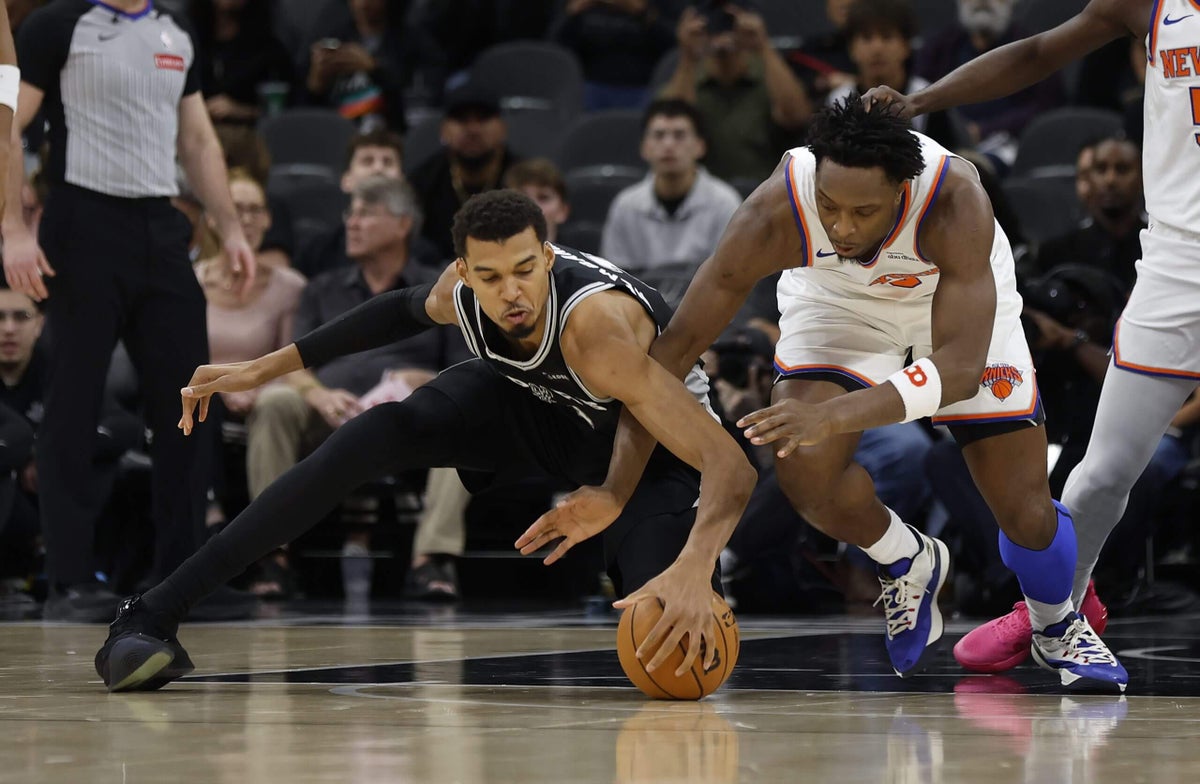
The Knicks are now forced to answer the question that three Western Conference teams dreaded earlier this spring: What are they to do with Victor Wembanyama, the 7-foot-4 giant whose presence somehow seems even taller than the height at which he’s listed?
The trendy answer to that question has come on the perimeter. The Knicks could place their all-defensive wing, OG Anunoby, on Wembanyama, which would represent a noticeable size difference but also present issues for the Spurs. Wembanyama isn’t always so hot against shorter but still stout, physical wings.
Had he been healthy in the Western Conference finals, Oklahoma City Thunder forward Jalen Williams would have received the Wembanyama assignment. OKC tried a point guard, Alex Caruso, on Wembanyama in Game 1. By the end of the series, it had gone most to its center, Isaiah Hartenstein. But the preference, if a team can manage, is often the wing — and it’s the type of wing in Anunoby’s archetype, one like Williams: broad, agile, strong, smart and unafraid of bucket getters.
At 6-foot-7, 240 pounds, Anunoby may be the best wing in the league at pushing larger defenders away from the paint before they catch passes in the post. The skill is especially important against Wembanyama, who can drop in effortless finger rolls from distances that no human should be able to reach.
Turn Wembanyama into a jump shooter, knock him off his spots when he cuts to the rim, shove him away from the block when he muscles down low, dart to the ideal defensive location when he screens and rolls, taking away those horrifying lobs, and a defender has done his job against the NBA’s best young star. But there is a trickle-down effect from putting Anunoby on Wembanyama.
To show it, let’s rewind to the third time these two teams played, back on March 1. Anunoby had manned Wembanyama for parts of the NBA Cup final in mid-December. Two weeks later, he took Wembanyama for essentially an entire game. But at the beginning of March, he did not guard the All-NBA center much. Instead, 7-footer Karl-Anthony Towns took Wembanyama to start. Backup center Mitchell Robinson spent time on him, too. The Anunoby possessions were sparse — because the Spurs had changed.
By March, forward Harrison Barnes had exited San Antonio’s starting lineup. Julian Champagnie had replaced him. Putting Anunoby on Wembanyama would have meant handing Towns, a more lumbering big man who has played the best defense of his life during the Knicks’ dominant postseason run, a difficult assignment. When Barnes was there, Towns could sag off the vet, who doesn’t move or drive much, and get back to him in time to close out. Towns guarding Champagnie would leave the Knicks a tad more vulnerable.
Champagnie will let 3-pointers fly, as New York learned firsthand on New Year’s Eve, when the Spurs came back to topple them by two points — behind 11 made long balls from Champagnie. Placing Towns on Devin Vassell, another sharpshooter, could present similar issues for the Knicks defense, though it would enable them to stick Anunoby on Wembanyama.
Surely, the Knicks will use Anunoby on Wembanyama at times. They will also mix in Towns and with Robinson, whose gravity as a rebounder should be massive in this series — as long as he’s able to catch the basketball with a broken pinky. But cross-matching with Anunoby turns the Knicks’ defense a smidgen more fragile than it might prefer.
Towns would be guarding one corner. Brunson would be guarding the other. If Wembanyama broke free, it’s possible none of the Knicks’ wings — Anunoby, Mikal Bridges and Josh Hart, the backbone of New York’s defensive success — would be present to stop his path to the hoop.
Never hacking
Bridges did not defend Stephon Castle much during the regular season. Consider this a plea for him to do so — even if Castle did not shoot well during the three games against the Knicks this season.
To explain, let’s reach back to a play Bridges pulled off in Game 1 of the Eastern Conference finals, one on which he had no business sticking so close to James Harden.
With the Knicks down double digits, mired in a rare troublesome stretch for a team that has not lost a game in more than a month, the wing chased after the former MVP. Harden, in all his efforts to unglue himself, could not do it.
In the fourth quarter, he inbounded a pass from the sideline, then darted for the ball. Bridges danced around a pick to stay with him. But watch what occurs next — or better yet, watch what doesn’t actually happen. Bridges’ hands never come close to Harden’s arms.
This is the type of moment when Harden can take control. His defender is off-balance, racing in his direction. The opponent might stretch a hand out toward him, an effort to keep up with the rest of his body after his feet have lagged behind. These advantages are Harden’s sweet spot. They’re when all those infamous free throws sprout to life.
The 36-year-old Harden’s greatest days might be behind him, but he is still a demon of trickery. No player can lead the league in free-throw attempts seven different times and not retain those rinky-dink moves that got him to the line so often. Bridges defended Harden for all four games of the conference finals. The main reason? He is a master at defending without fouling.
This play above is yet another example of why.
Check out Bridges’ right palm as he catches up to Harden. It’s pressed against his left hip, reminding him not to leave a hand in the cookie jar. Extend a palm out as Harden dribbles to the hoop, and the driver will detect as soon as it lingers above the ball. Harden will rise quickly and smack a stray hand, garnering a couple of free throws.
Bridges never did that. Not here. And essentially, not all series.
The inside hand is on his opposite hip. The outside hand is up and out, deterring a shot. The play is so well defended that Harden actually picks up his dribble, a rare choice. Normally, he’ll launch himself at the rim, and either go up or kick out to a 3-point shooter from there. But Bridges has him frazzled.
Harden can’t free himself with a pivot. Bridges goes vertical instead of out when Harden jumps. And not only has he earned a stop; he’s also avoided fouling Harden.
The Bridges that showed up in the past two rounds of the playoffs, the one who defended Philadelphia 76ers firecracker Tyrese Maxey in Round 2 and the more prodding Harden in the conference finals, is not the one Knicks fans got used to during the regular season. The version of Bridges from the first 82 games was a magnificent defender away from the basketball but one who struggled at the point of attack.
He would let up early against a screen. Physicality could hinder him. If a guard was quick, he often found himself steaming past the Knicks wing. But this Bridges — the one who has clamped down on All-NBA talent each night while also shooting 59 percent on mid-range jumpers in the playoffs — is the guy for whom the Knicks traded five first-round picks. His defining trait has been his control.
He manned Harden for the entire series. During all that time, he committed one shooting foul on the free-throw maestro. One. All series. It was a reach-in on a 3-pointer Harden attempted with the Knicks about to close out a Game 1 victory. He did not commit another shooting foul on Harden, who couldn’t catch a rhythm. And thus, neither could the Cavaliers.
It will be fascinating to see how the Knicks deploy Bridges once the finals begin. The Knicks and Spurs played three times (including their NBA Cup matchup) during the regular season. More often than not, Bridges manned All-Star point guard De’Aaron Fox. But considering how Bridges has fared during the postseason, sliding him over to Stephon Castle could be the move.
Castle is the most unrelenting foul-drawer who occupies the Spurs’ perimeter. He absorbed 108 fouls on drives to the hoop during the regular season, which ranked 10th in the NBA, according to Second Spectrum. He is a stylistic mix of Maxey and Harden, boasting Harden’s size and change of pace with the speed and lift to blow by most defenders.
If Bridges were to take Castle, then Hart could move to Fox. The beauty of the Knicks’ wing trio is its interchangeability. New York can cycle through matchups. And it can do so understanding that Bridges can control himself against anyone.
Manning Brunson
The Spurs’ defense is not missing much, but even after it just stifled two-time reigning MVP Shai Gilgeous-Alexander, it lacks the ideal stopper for another shifty guard, Brunson.
You can bet that Castle will begin the series working the head of the Knicks’ offense. During the regular season and NBA Cup, the Spurs tried De’Aaron Fox on him, too. But Castle is the strangler atop San Antonio’s elite defense, the man who just stifled Gilgeous-Alexander, who Brunson isn’t as tall or quick as, for the first six games of the Western Conference Finals. But Brunson has a tool Gilgeous-Alexander does not.
He can and will pull up from 3-point range, which helps negate Wembanyama’s work around the paint. And more importantly, no Brunson stopper, no matter how dominant in a vacuum (and Castle is as good as any other guard patrolling the perimeter), is under 6-foot-7.
Brunson’s greatest struggles come against length. He doesn’t as easily get to his spots against the Atlanta Hawks’ Dyson Daniels. The Detroit Pistons’ Ausar Thompson has the arms and vertical to leap into his space after he attempts his crafty spins that usually open up 12-footers. A couple of years ago, even Kelly Oubre — not a defender of Daniels’ or Thompson’s or Castle’s caliber but a high-effort, long-armed energizer — gave him trouble for the first two games of the playoffs.
The tanks like Castle or Dylan Harper, guys more of the Jrue Holiday mold, don’t have as easy a time with Brunson, who can still slither into an off-balance jumper that looks difficult but is actually the type the point guard hunts.