
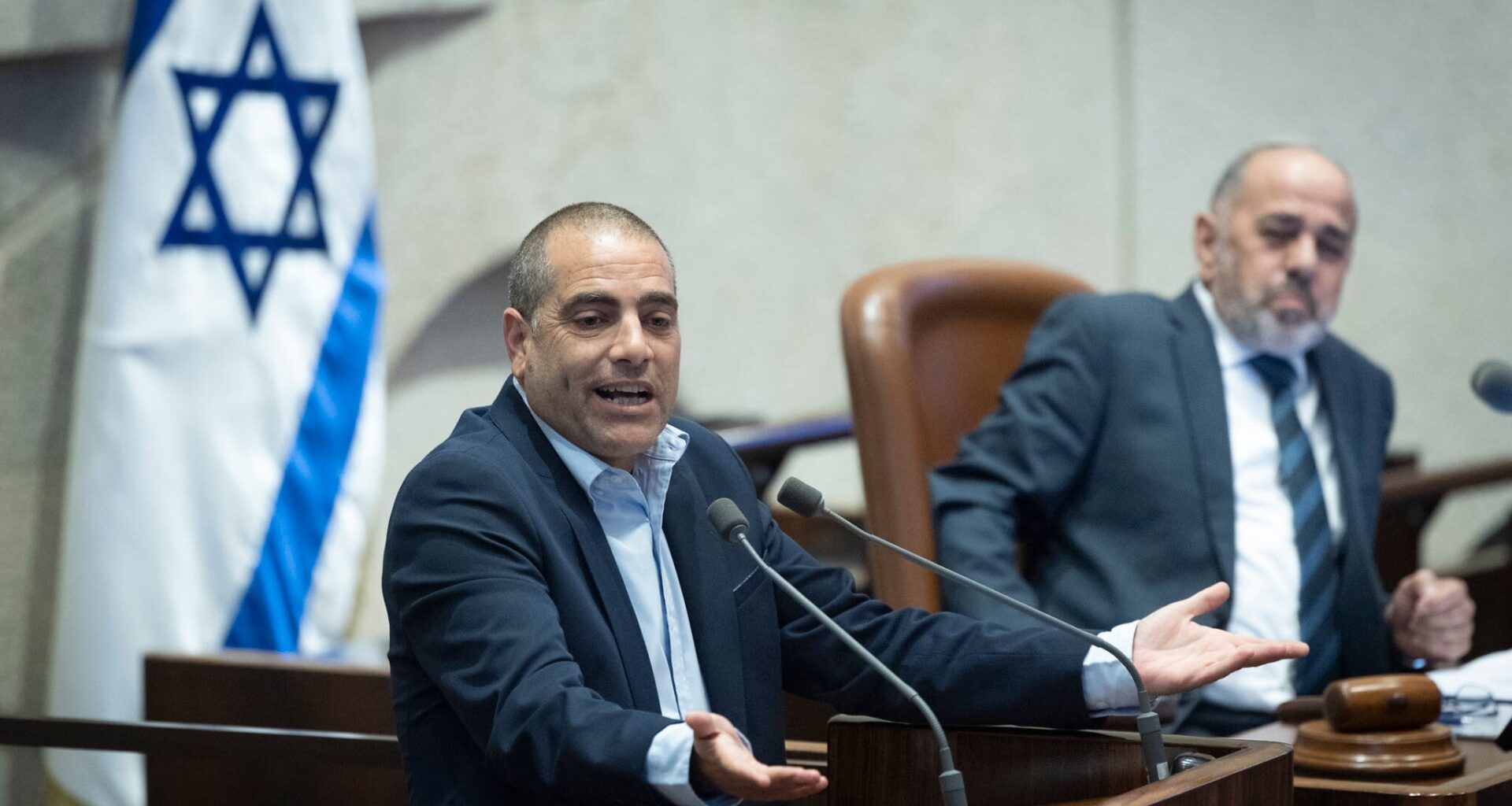
Following a lengthy Knesset debate, lawmakers early Tuesday voted 106-0 in favor of the first reading of a coalition bill to dissolve the Knesset, potentially triggering early elections.
The dissolution bill, which must pass three readings in the plenum to pass into law, had been approved for its first reading in the Knesset House Committee on Monday morning and was immediately referred to the plenum for a vote. No date has been set for the final readings of the bill.
Due to internal coalition disagreements, committee chairman and coalition whip Ofir Katz advanced the bill without specifying an election date, stating that it would be inserted into the legislation only prior to its final two readings. In the meantime, Katz only said that the range of dates will be somewhere between September 8 and October 20.
“We completed four years [in office]… we practically made it to the end,” Katz said in a statement after the vote, hailing the coalition’s time in power.
The election must be held within five months of the law’s passing, which would mean mid- to late October at the latest. The Knesset’s ultra-Orthodox parties reportedly favor an election date in early September during the run-up to the High Holidays. Regardless of this legislation, elections must in any case be held by October 27.
Get The Times of Israel’s Daily Edition
by email and never miss our top stories
By signing up, you agree to the terms
Prime Minister Benjamin Netanyahu has reportedly urged the ultra-Orthodox parties not to force early elections in September, warning in private conversations that such a timeline would “endanger” the right-wing bloc’s chances of winning.
Ultra-Orthodox revolt
The decision to advance the bill came after the United Torah Judaism (UTJ) party announced last month that it would seek to dissolve the Knesset and trigger early elections, citing the coalition’s failure to pass a law enshrining the decades-old exemption of Haredi yeshiva students from military service.
UTJ, which has seven Knesset members, made its move after Netanyahu told Haredi MKs that the coalition currently doesn’t have the votes to pass the draft exemption legislation, and reportedly asked them to agree to shelve the bill until after the elections.

Degel HaTorah chair Moshe Gafni (R) and United Torah Judaism party chair Yitzhak Goldknopf attend a plenum session at the Knesset in Jerusalem, January 14, 2026 (Yonatan Sindel/Flash90)
The legislation — which would ostensibly increase military conscription in the Haredi community, but ultimately enable continued exemptions for full-time yeshiva students — is widely seen as legally dubious and laden with loopholes. It has generated intense resistance even among members of Netanyahu’s coalition and was briefly taken off the table in March with the outbreak of the US-Israeli war with Iran.
In response to UTJ’s move to dissolve the Knesset and in an effort to control both the legislative process and the timing of the elections, Katz submitted his own legislation last month calling for new elections to be held, and announced last week that members of the committee would deliberate the bill Monday.

Prime Minister Benjamin Netanyahu (left) and coalition whip Ofir Katz seen in the Knesset, March 29, 2026. (Yonatan Sindel/Flash90)
Government of ‘many disasters’
Addressing reporters ahead of his Yesh Atid party’s weekly faction meeting before the vote, Opposition Leader Yair Lapid welcomed the upcoming election as a chance to move on from what he described as one of the worst governments in Israeli history.
“The Knesset will vote today in its first reading on dissolving the Knesset and heading to elections. We are taking another step toward ending the tenure of this government… Even coalition supporters will have to admit that there has never been a government with so many disasters to its name,” Lapid declared. He slammed Netanyahu for failing to win in Lebanon, Gaza and Iran; for overseeing unprecedented increases in violent crime; and for the “decline of Israel’s international status to a low point that has never been seen before in the country’s history.”
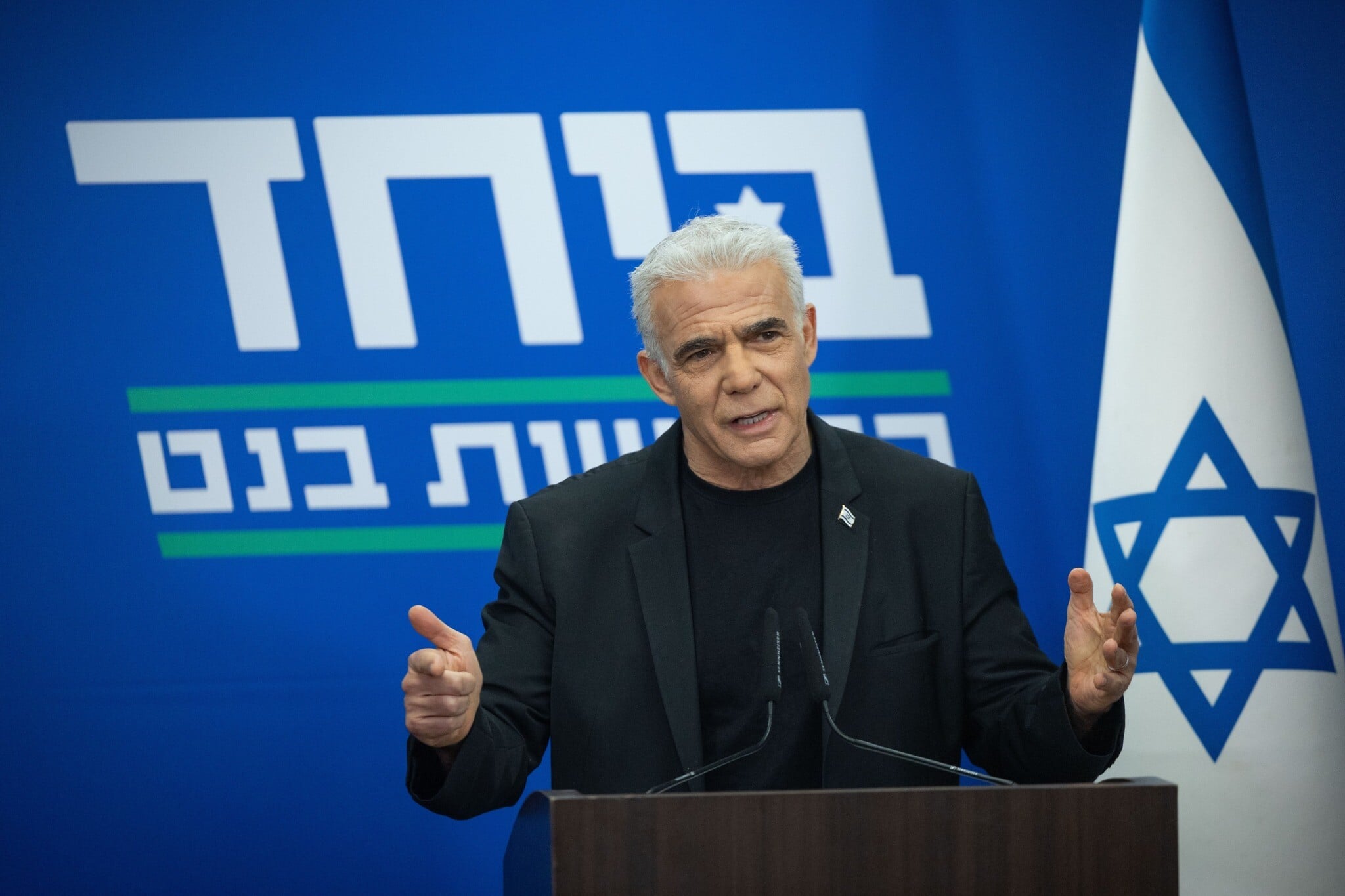
Opposition Leader Yair Lapid speaks during a press conference at the Knesset in Jerusalem, June 1, 2026. (Yonatan Sindel/Flash90)
Lapid also reiterated his call for Yashar chairman Gadi Eisenkot to join his and former prime minister Naftali Bennett’s united Together slate, insisting that “we need to unite the camp to win the elections, not waste long months now on everyone tearing each other apart.”
Bennett, he said, “is the right man to lead, and we need to unite the entire camp behind him and behind Together to win the elections. Anything else will simply lose the elections for the camp, and we can and must win.”
According to Channel 12 news, Eisenkot recently proposed to fellow opposition leaders that they all agree to recommend the head of the largest allied party as prime minister following the upcoming election, a move that has generated pushback from within the bloc.
Addressing party activists on Sunday evening, The Democrats chairman Yair Golan insisted that he does “not promise that we will endorse the leader of the largest party, but rather whoever agrees to our values.”
Speaking with reporters ahead of his own Yisrael Beytenu party’s faction meeting on Monday afternoon, Avigdor Liberman declined to back Bennett as prime minister, stating that he does not subscribe to the argument that the opposition will lose unless it unites behind the former premier.
Addressing Eisenkot’s proposal, Liberman — who has presented himself as the best candidate for prime minister — said a decision would be postponed until after the elections.
Legislative implications
While the Knesset will be able to continue passing laws even after it dissolves until the next parliament is formed, early elections are likely to complicate the coalition’s legislative efforts.
After voting to dissolve the Knesset, lawmakers were set to hold the first readings of a pair of controversial bills that would curtail the power of the attorney general and make it harder to indict high-ranking government officials.
However, if the bills advance through their first readings without being passed into law, the coalition will be able to vote in the next Knesset to apply “continuity” if it wins the election, allowing lawmakers to resume legislative work without starting from scratch.
In addition to shortening the time available to the coalition to pass its legislative agenda, according to the Israel Democracy Institute, “after the dissolution of the Knesset it is customary for the committees to convene only with the approval of the Arrangements Committee (a committee established during an election recess, whose members include the chairperson of the coalition and a member of the faction of the leader of the opposition).”
That being the case, the coalition is currently speeding ahead with a series of controversial moves targeting the media, including legislation that would place the Kan public broadcaster’s budget under government control and overhaul broadcast media.
You’re a dedicated reader

That’s why we started the Times of Israel – to provide discerning readers like you with must-read coverage of Israel and the Jewish world.
So now we have a request. Unlike other news outlets, we haven’t put up a paywall. But as the journalism we do is costly, we invite readers for whom The Times of Israel has become important to help support our work by joining The Times of Israel Community.
For as little as $6 a month you can help support our quality journalism while enjoying The Times of Israel AD-FREE, as well as accessing exclusive content available only to Times of Israel Community members.
Thank you,
David Horovitz, Founding Editor of The Times of Israel