
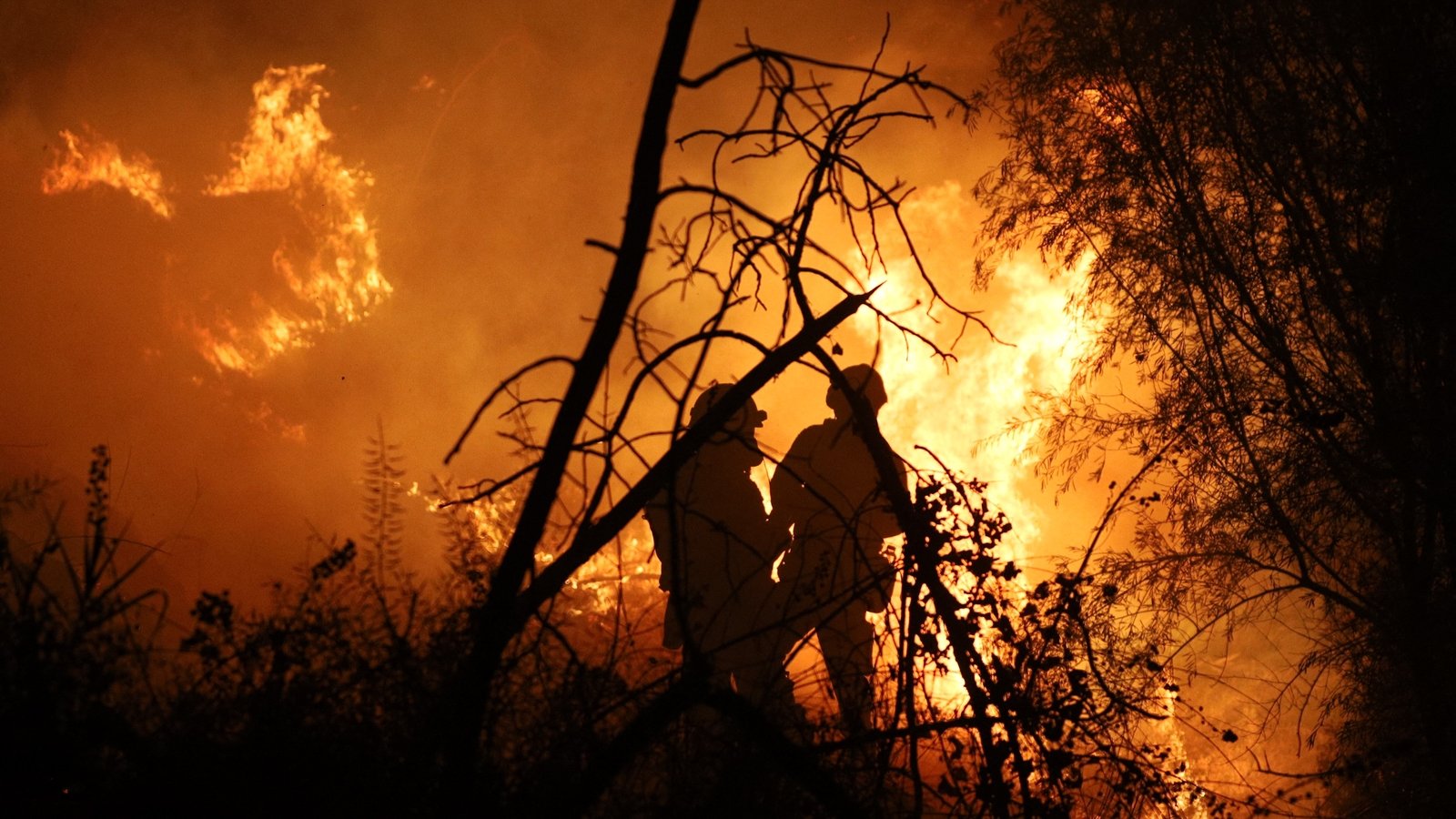
Thousands of people have been evacuated as wildfires continue to rage across parts of Greece and Spain, as high temperatures and strong winds create difficult conditions for firefighters.
Firefighters battled to contain a wildfire menacing Greece’s third-largest city Patras, one of over 20 blazes that have forced the country to appeal for EU help.
Fierce winds and dry conditions have fuelled fires across the country in a week where a heatwave has baked southern Europe, with Spain, Portugal, Montenegro and Albania also fighting blazes.
Since dawn, 4,850 firefighters and 33 planes were mobilised across Greece, fire service spokesman Vassilis Vathrakogiannis said.
Greece was faced with “a very difficult day”, with 15 firefighters taken to hospital after battling fires on various fronts, he added.
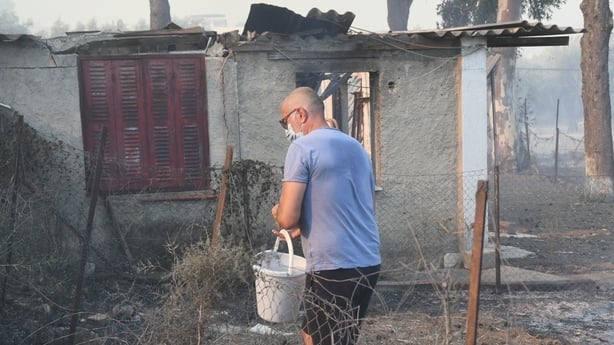
A man attempts douse embers with a bucket of water as fires threaten Patras in Greece
The situation improved outside Patras but a new fire near the ancient archaeological site of Voudeni threatened forested zones and homes, and the area is covered by a thick cloud of smoke.
In the western Achaia region in the Peloponnese, to which the coastal city of Patras belongs, around 20 villages have been evacuated.
“The catastrophe is very big,” the mayor of West Achaia, Grigoris Alexopoulos, told Greek news agency ANA.
Other fronts were burning on the popular tourist island of Zante and the Aegean island of Chios, scarred by a huge wildfire in June that ravaged more than 4,000 hectares.
The Greek coastguard said it had helped evacuate nearly 80 people from Chios and near Patras.
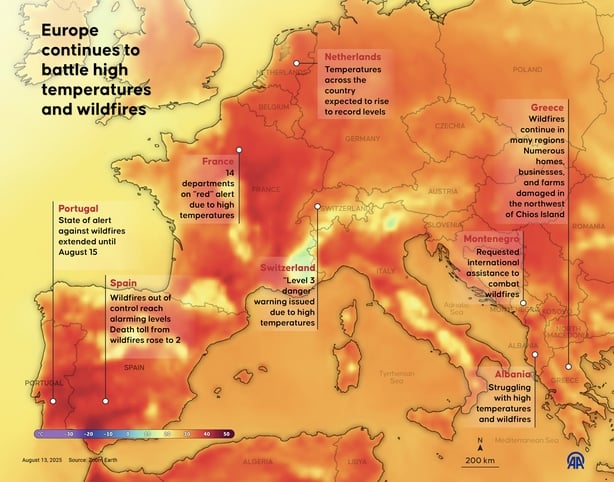
Temperatures are due to come close to 40 degrees Celsius in parts of western Greece, including the northwest Peloponnese, national weather service EMY forecast.
Greece has requested four water bombers from the EU Civil Protection Mechanism to bolster its resources.
Yesterday, “82 fires broke out, a very high number which, combined with violent winds, drought and high temperatures, has created huge difficulties in the extinction efforts”, he added.
Winds reaching up to 88km/h per hour have lashed the country since last week, fanning a wildfire south of Athens in which one person died.
More than 22,000 hectares have burned in Greece this year, according to the European Forest Fire Information System.
Volunteer firefighter dies as wildfires rage across heat-stricken Spain
In Spain, a firefighting volunteer died from severe burns, while several people were hospitalised as dozens of wildfires fuelled by strong winds and scorching heat continued to rage across the country.
At least six large wildfires were still out of control, according to regional emergency services.
The victim, a 35-year old volunteer, had been attempting to create firebreaks near the town of Nogarejas, in the north-central Castile and Leon region, when he became trapped in the blaze, regional officials said.
The fire had two active fronts that were still out of control, as weather services forecast another day of strong winds and electric storms.
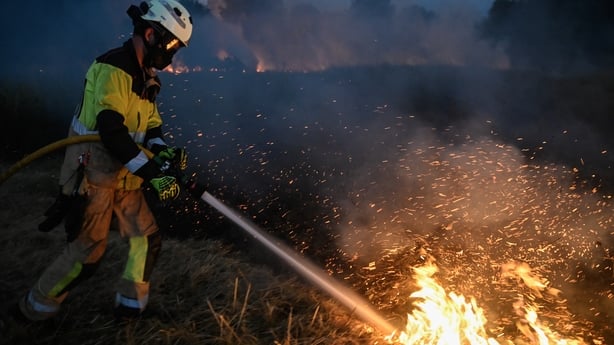
A firefighter works to extinguish a wildfire near Vilaza, in Verin, Ourense province, northwestern Spain
Over 5,000 people have been evacuated in the region, which is Spain’s largest, and efforts were being concentrated on preventing the flames from reaching smaller towns.
Environment Minister Sara Aagesen told SER radio station that many fires across the country were suspected to be intentionally caused by arsonists due to their “virulence”, but that it was too early to quantify these.
On Monday, another fire had killed a man working at a horse stable on the outskirts of the Spanish capital Madrid and reached some houses and farms before it was contained.
Northwestern Galicia’s regional leader Alfonso Rueda said the situation there was “complicated” and that the weather “isn’t helping”, as six active fires affected a combined 10,000 hectares in Ourense province.
Weather agency AEMET forecast “extreme” risk of wildfires across Spain today.
European satellite to step up monitoring of extreme weather
Separately, the Ariane 6 rocket blasted off this morning carrying Europe’s next generation satellite for warning against extreme weather events.
The European Organisation for the Exploitation of Meteorological Satellites (EUMETSAT) said its MetOp-SGA1 satellite will give “earlier warnings to help protect lives and property from extreme weather”.
“Metop-SGA1 observations will help meteorologists improve short- and medium-term weather models that can save lives by enabling early warnings of storms, heatwaves, and other disasters, and help farmers to protect crops, grid operators to manage energy supply, and pilots and sailors to navigate safely,” the agency added.
The rocket carrying the four-tonne satellite took off from France’s Kourou space base in French Guyana. MetOp-SGA1 was to be put into an 800km high orbit.
It will be Europe’s first contribution to a US-led programme, the Joint Polar System, putting up satellites orbiting between the north and south poles.
The six monitoring instruments on the satellite are twice as precise as the agency’s existing satellite, IASI. It will monitor ocean and land temperatures, water vapour and greenhouse gases in the atmosphere, the amount of desert dust and cloud cover.
The lift-off was the third by Ariane 6 since its inaugural flight in July last year.
The Ariane company said that it had 32 launches planned from Kourou in coming years and that it was aiming to carry out nine or ten launches each year.