
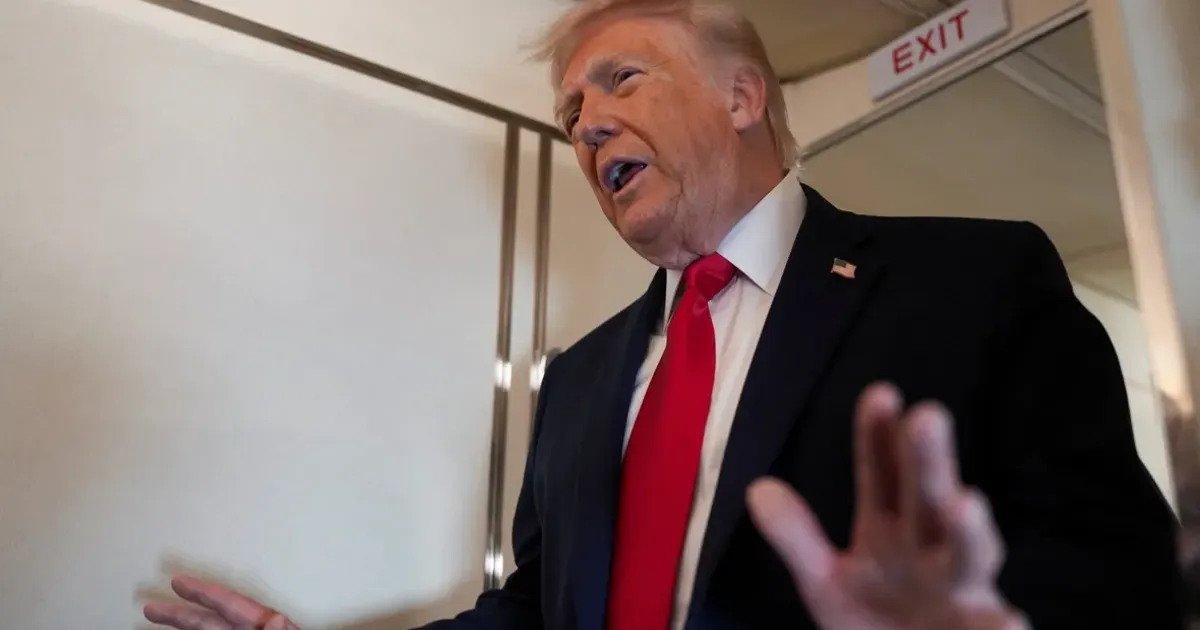
President Donald Trump said on Sunday that Prime Minister Benjamin Netanyahu “won’t have any choice” but to accept a U.S.-negotiated Iran cease-fire, The Financial Times reported following a phone call between the U.S. and Israeli leaders, with Trump adding that he calls “all the shots.”
In an interview shortly after Iran fired several missile barrages toward Israel for the first time since a cease-fire was negotiated in April, Trump also told Fox News that he would instruct Netanyahu to refrain from retaliating against Iran, contradicting Israeli military statements.
Trump told Fox that an Iran cease-fire deal would have been signed “on Monday, Tuesday or Wednesday and now this takes place,” adding that he is “not happy” about Israel striking Beirut earlier on Sunday. He said that strikes were not coordinated with the United States, adding that Iranian missile fire is “certainly not going to help negotiations.”

 Close
Close
The IDF intercepted Iranian missiles fired on Sunday. Credit: Gil Eliyahu
The IDF intercepted Iranian missiles fired on Sunday. Credit: Gil Eliyahu
“I would suggest to Iran: You’ve shot your missiles, that’s enough. Get back to the table and make a deal,” Trump said.
Trump added that the U.S. military is “on alert.”
Following a conversation with Netanyahu on Sunday evening, Trump told the Financial Times that Iran’s missile barrage had not changed his goal of reaching a U.S.-Iran interim cease-fire agreement: “It’s not going to have any impact on the deal,” adding, “The deal may make it on its own merit, or not, but this will not have any effect on it.”
“We’ll see how it ends up. But they [the missile strikes on Israel] were attacks that did not kick at all. It’s one of those things that’s been going for 3,000 years, or 47 years, depending on how you count.”
“I think the deal is going on,” he said. “We’ll see what happens.”
Asked what would happen if cease-fire negotiations failed, Trump said he would consider deploying troops for a U.S. ground operation in Iran.
“It means [one of] two things,” he told FT. “Number one, it would mean that possibly we would go in and take care of the rest of the place that we didn’t take care of militarily. Or it would just mean that we would keep the blockade on Iran because the blockade has been probably more powerful than any attack that was ever made on that country.”
Trump’s comments follow an Axios report last week that Trump had reportedly told Netanyahu, “You’re fucking crazy. You’d be in prison if it weren’t for me. I’m saving your ass. Everybody hates you now. Everybody hates Israel because of this.”
 Close
Close
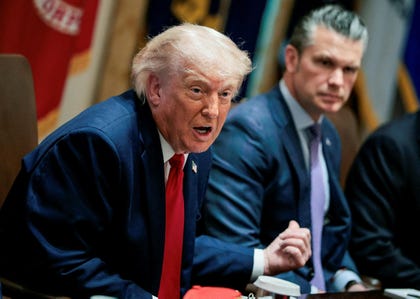
U.S. President Donald Trump speaks next to Defense Secretary Pete Hegseth during a cabinet meeting in the Cabinet Room at the White House, in Washington, D.C., U.S., Wednesday. Credit: Evan Vucci/Reuters
U.S. President Donald Trump speaks next to Defense Secretary Pete Hegseth during a cabinet meeting in the Cabinet Room at the White House, in Washington, D.C., U.S., Wednesday. Credit: Evan Vucci/Reuters
Trump also told Axios on Sunday that he was calling Netanyahu to tell him not to retaliate against Iran following the barrage.
“I am going to call Bibi right now and tell him not to retaliate. Each of them had their fun. Israel had its strike, and Iran had its strike. We don’t need another one,” Trump said, adding that “The Iranian strikes didn’t hurt anybody.”
“We are very close to a final deal with Iran,” Trump told Axios. “It is going to be a good deal. I don’t want it to blow up because of what is happening now.”
Tehran said the missile launches were a response to an IDF strike on southern Beirut’s Dahiyeh suburb, which Israel said came in response to Hezbollah firing at northern communities.
Iran called its strike a “warning,” adding that any Israeli action against it or Lebanon would be met with “an overwhelming response.” The IDF chief of staff said that Israel “will strike the enemy with determination as soon as the order is given.”