
Your support helps us to tell the story
From reproductive rights to climate change to Big Tech, The Independent is on the ground when the story is developing. Whether it’s investigating the financials of Elon Musk’s pro-Trump PAC or producing our latest documentary, ‘The A Word’, which shines a light on the American women fighting for reproductive rights, we know how important it is to parse out the facts from the messaging.
At such a critical moment in US history, we need reporters on the ground. Your donation allows us to keep sending journalists to speak to both sides of the story.
The Independent is trusted by Americans across the entire political spectrum. And unlike many other quality news outlets, we choose not to lock Americans out of our reporting and analysis with paywalls. We believe quality journalism should be available to everyone, paid for by those who can afford it.
Your support makes all the difference.Read more
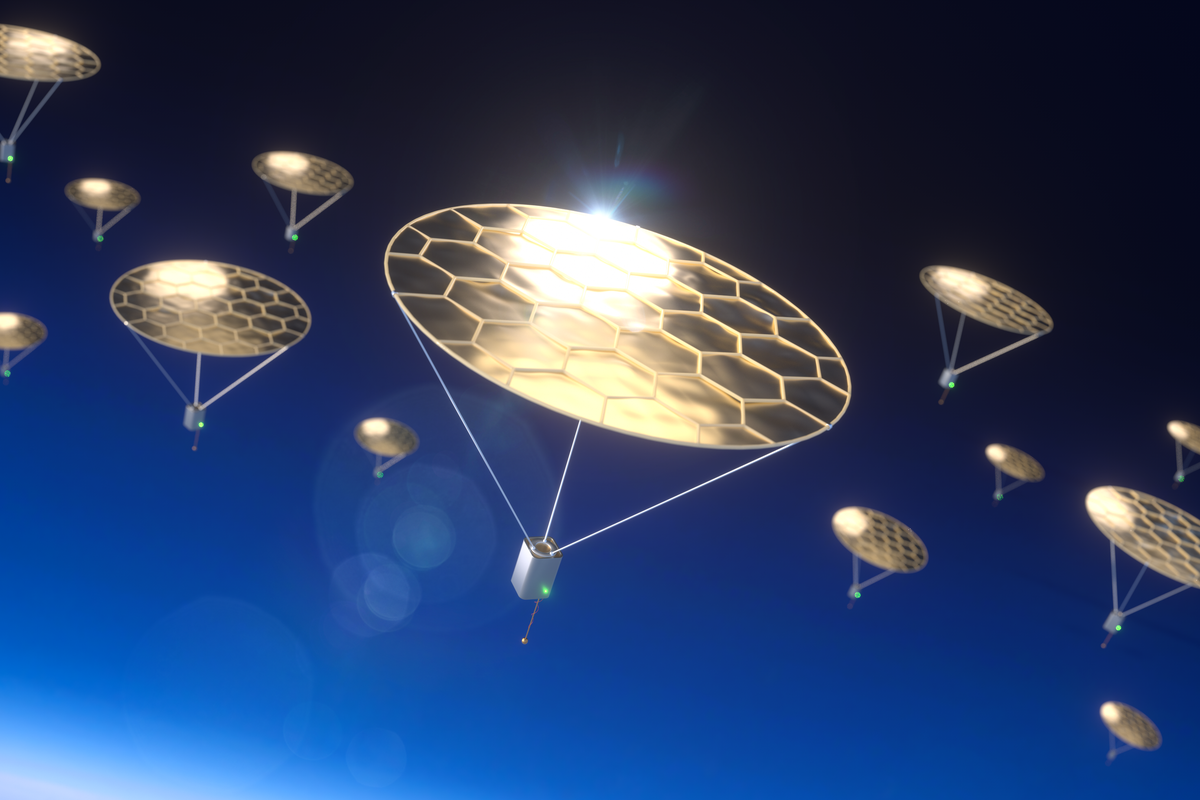
Scientists want to send tiny, solar-powered spacecraft to examine difficult-to-reach parts of Earth’s atmosphere – and eventually other planets too.
The small devices are able to float in the air and could carry sensing instruments to monitor our climate as well as explore Mars, the researchers behind them suggest.
Unlike conventional spacecraft, they do not need fuel to stay floating in the atmosphere. Instead, they use energy from light, through a process known as photophoresis that has been used to make objects levitate for 150 years.
Despite that long history, the practical use of photophoresis has been limited to truly tiny objects or very powerful artificial light, and practical devices have not worked out. Now, however, researchers believe that they have made a centimetre-long flying device out of perforated sheets that can use natural sunlight to stay afloat.
The flying structure is made from two thin, perforated membranes that are attached together by tiny supports. They can be used to create a tiny disc that is then able to leveitate.
They could be sent up to the upper layers of the Earth’s atmosphere. If they can be scaled up slightly, they would be able to carry antennae and circuits that would allow them to be used to monitor the atmosphere and for other science work.
Eventually, the same design could be taken to other planets, they suggest. It is currently almost prohibitively expensive to send satellites to Mars, for instance – but doing so with the tiny spacecraft could allow researchers to monitor conditions on that planet, they say.
“If the full potential of this technology can be realized, swarms or arrays of such photophoretic flyers could be collecting high-resolution data on the temperature, pressure, chemical composition and wind dynamics of the mesosphere within the next decade,” Igor Bargatin from Penn University wrote in an article accompanying the new research.
The work is described in a paper, ‘Photophoretic flight of perforated structures in near-space conditions’, published in the journal Nature.