
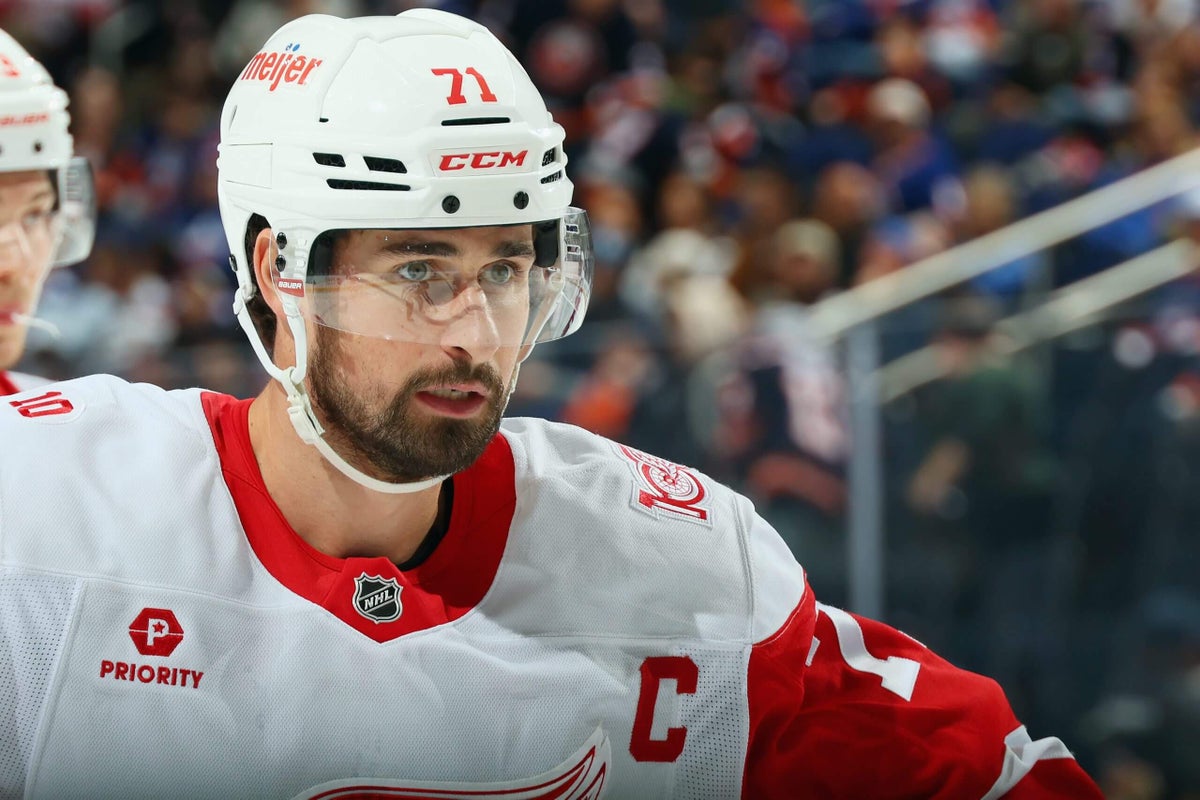
What can the Red Wings get in return for Dylan Larkin?
That’s suddenly the most important question in Detroit right now, with news emerging last week that the Red Wings captain has requested a trade. But really, the answer depends on another question: Where is Larkin willing to go?
With a full no-trade clause giving Larkin control in the process, The Athletic’s Pierre LeBrun has reported that Red Wings general manager Steve Yzerman has been given a “short list” of teams. That’s not ideal for Detroit: The more teams in play, the more potential for the Red Wings to recoup sufficient value for their captain.
Which teams are on the list is just as important as the list’s length. Do the potential trade partners have stocked farm systems and draft capital? Or will they be straining to come up with the necessary pieces to complete a deal?
If we presume Larkin, who has endured 10 straight seasons outside the playoffs in Detroit, wants to go to a contender, it could very well be one of those teams trying to cobble together a deal. If that’s the case, putting together a suitable deal could take some creativity.
To see what that actually looks like, The Athletic’s Max Bultman and Corey Pronman assessed six potential Larkin trade packages. To choose the teams, we focused largely on organizations that are clear-cut contenders (many in tax-advantaged U.S. states, where players tend to like playing), plus a couple of other teams that could have the need and the assets for Larkin.
Minnesota Wild
Detroit gets: G Jesper Wallstedt, F Danila Yurov, F Charlie Stramel
Minnesota gets: F Larkin, G Sebastian Cossa
Pronman: This is the most complicated package, but Minnesota’s best future asset is a goalie, while Detroit is already dealing with a hard decision on what to do with Cossa, who will be waiver eligible. This deal would also require a dose of humility from Detroit, which had its choice of the first-round goalies in 2021 and opted for Cossa.
Minnesota parts with three A-level young assets but gets one back in Cossa, who is a very good young goalie. Yurov and Stramel both project as long-term third-line centers or second-line wingers with different play styles: Yurov is more of a skill player, and Stramel is big and highly physical.
Bultman: Yes, Detroit’s goalie situation is already complicated, but Wallstedt is the best young piece the Red Wings could realistically get back from Minnesota. He would at least give them a true headliner in the deal.
This kind of package would come with some natural follow-up questions — namely, what would it mean for Red Wings goaltender John Gibson? But given that the Wild seem like they’ll be one of the key suitors, Detroit may need to consider ways to get creative in a deal with them, and this fits that definition.
Carolina Hurricanes
Detroit gets: D Alexander Nikishin, 2026 1st-round pick
Carolina gets: F Larkin
Pronman: A few years ago, Nikishin looked like a true elite prospect coming out of the KHL. He hasn’t quite looked like that in the NHL, but he has still looked very good as one of the better rookies this past season. He’s big, mean and mobile with good (not great) skill. He projects as a very good top-four defenseman. Detroit doesn’t get any center help in this deal, but Nikishin is a major young asset.
Bultman: Nikishin would figure to slot right into Detroit’s top four and fits the same age window as Moritz Seider and Simon Edvinsson. Detroit would still be left searching for a long-term top center, and Carolina’s pick (which will be either 30th or 31st) likely won’t help with that. But it’s still a solid future asset, and Nikishin could really help further solidify the Red Wings’ defense corps.
It’s not the sexiest return, but it still yields a talented young player at a premium position.
Florida Panthers
Detroit gets: No. 9 pick in 2026 draft, F Eetu Luostarinen, F Sandis Vilmanis
Florida gets: F Larkin
Pronman: This would be the hardest reset for Detroit fans to stomach. Luostarinen is a good roster player who is very athletic and plays both ways. Vilmanis hasn’t made the league yet, but he was a top player at the World Championship and is tracking as a middle-six winger. The No. 9 pick could turn into a very good young center, such as Viggo Björck, but it would mean a lot more patience from Red Wings fans.
Bultman: The ninth pick would be an appealing headliner for those wanting the Red Wings to embrace a retool. Whether it’s Björck or one of the top five defensemen in the class, there should be a compelling talent available at that spot. Björck would be the one with a chance to help the center issue, though, and he did just play on a line with Lucas Raymond for Sweden at the World Championship.
Meanwhile, Luostarinen could help address some of the Red Wings’ issues in the bottom six in the short term, and with one year left on his deal, could even become a trade chip himself after what he’s done for the Panthers in the playoffs in recent years.
This package would require a longer view, and trading Larkin within the division could be fraught. But the ninth pick is a very compelling headliner.
Tampa Bay Lightning
Detroit gets: F Sam O’Reilly and F Conor Geekie
Tampa Bay gets: F Larkin
Pronman: This may be one of the most intriguing offers for the Red Wings. Neither O’Reilly nor Geekie is a premier prospect, but both are very good young players who project as middle-six centers. O’Reilly is the younger one, coming off a huge OHL season, and plays a likable two-way game. Geekie has been up and down, but has legit size and skill. This would be an all-in move by Tampa Bay, but the Lightning have shown they are willing to make such moves to maximize their shrinking competitive window.
Bultman: Divisional factors apply here, too, and I would worry a bit about the Red Wings adding more middle-six talent to the picture. They already have a couple of top center prospects with middle-six projections in Marco Kasper and Nate Danielson.
That said, more center prospects means more potential for one (or two) to surpass expectations, and Geekie (who was picked just three spots after Kasper in 2022) put up more than a point per game in the AHL this past season. Both are nice prospects, and O’Reilly’s winning history as a three-time OHL champ and two-time Memorial Cup winner is especially appealing.
Dallas Stars
Detroit gets: D Thomas Harley
Dallas gets: F Larkin
Pronman: On talent, this is a fair one-for-one. On a depth chart, it’s tough to stomach for Detroit, which adds a high-end young defenseman but leaves this deal depleted at forward. In this scenario, the Red Wings would have to figure out how to deploy an extremely talented blue line of Harley, Seider and Edvinsson that becomes the envy of the league.
Bultman: Harley is from the same draft class as Seider, so he fits into what figures to be the new competitive timeline for Detroit in a post-Larkin world. Though this deal doesn’t help the center depth, creating a bona fide strength on the blue line is a good consolation.
Harley, who turns 25 in August, had a down year going into his pricey $10.587 million AAV extension kicking in next season. But he’s shown true high-end ability and is the best overall player discussed in any of these returns. If Detroit wants to keep pushing for the playoffs rather than take a step back and retool, this could be compelling.
Utah Mammoth
Detroit gets: F Tij Iginla, F Barrett Hayton, 2027 first-round pick
Utah gets: F Larkin
Pronman: Utah can clearly offer the most compelling package to Detroit, given its plethora of premium young assets. We didn’t include Caleb Desnoyers or Dmitri Simashev, as it would be tough to get Utah to include them, but center Cole Beaudoin could certainly be in this deal. Iginla is a legit projected top-six scorer, and Hayton is a quality NHL center.
Bultman: If Larkin deems Utah an acceptable destination, its system is by far the best of the teams listed here, which makes it an appealing partner for Detroit.
Desnoyers would, of course, be the ideal, but Iginla is still an intriguing young scorer for the top six. Hayton isn’t splashy, but he’s a plug-and-play pivot with some runway to find more production. The 2027 first isn’t locked into a draft spot, which could be a pro or a con, considering the Mammoth would be much more dangerous with Larkin.