
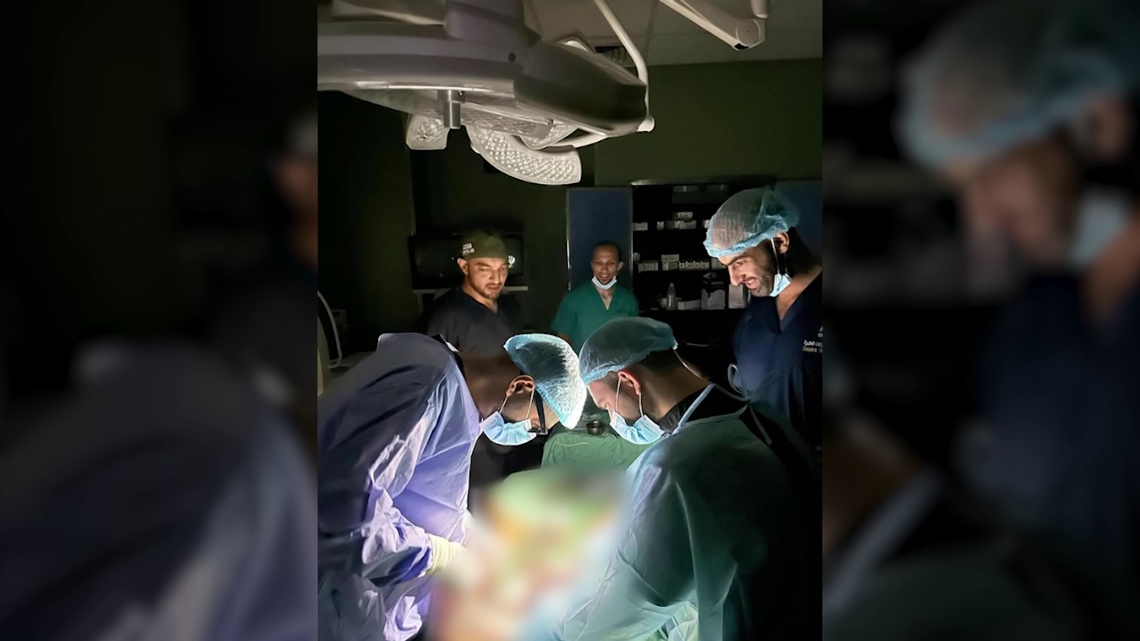
North Texas doctors in Gaza confront blackout surgeries, scarce supplies, and deadly violence at aid sites.
FRISCO, Texas — A North Texas spine surgeon is performing life-saving work in the middle of one of the world’s most dangerous conflict zones, with almost nothing to work with.
Dr. Mohammed Khaleel, a spine surgeon from Frisco, is in central Gaza for his third mission trip to the region. He’s joined by three other North Texas physicians: Dr. Umar Burney from Rockwall, an orthopedic surgeon; Dr. Ifan Ali, an anesthesiologist from Southlake; and Dr. Waqas Ali, an emergency medicine specialist from Forney.
The team’s trip is sanctioned by the World Health Organization (WHO) per Khaleel. But unlike the hospitals they work in at home, there is no reliable electricity there, per Khaleel, and food is hard to come by aside from what they packed for themselves and their patients. Khaleel told WFAA that during a nighttime hospital shift, the group is relying on protein bars from their suitcases.
All this is happening as Israel plans a new offensive in the region that has been met with backlash from global leaders.

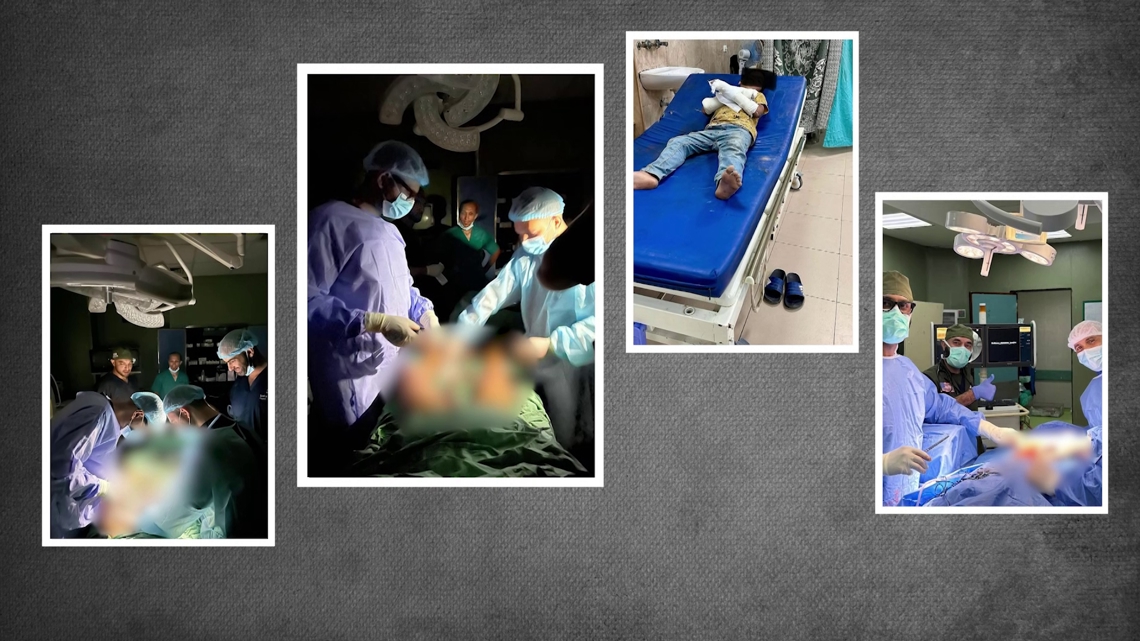
“We learn quite a lot on these trips. Things are done very differently than how we would treat patients in the U.S. because the availability of equipment is so strained here,” Khaleel told WFAA.
There are also reports, documentation, and photos of widespread starvation, and what Khaleel calls the highest shortage yet of food and water that he’s experienced. Much of the trauma they see now is from people trying to get basic necessities.
“Most of the injuries we are seeing are patients that have gone to aid distribution sites and have suffered gunshot wounds or are being run over by trucks,” Khaleel said.
On Instagram, the doctors have documented the stories behind those injuries through the group they’ve formed, ‘Gift of Disability Alleviation’: a 12-year-old left paralyzed after being shot in the neck near an aid site, and another man struck by a tank shell in the same area are just some of the cases.
Khaleel performed a triple-limb amputation on the man hit by a shell, but he didn’t survive.
The violence at aid locations is so frequent that Khaleel says, “going to the aid distribution site is known to be a risk for death or injury.” European and US doctors are primarily sharing that startling revelation while performing their volunteer work.
The team plans to return to Dallas on August 22 — and, Khaleel admits, it will feel like another world.
“One of the local doctors told us he feels recharged when we come here; that seeing help come from all over the world made him feel like he could breathe through our actions. To be able to offer somebody that level of help and hope, that’s the reason I got into medicine,” he said.