
Unlock the Editor’s Digest for free
Roula Khalaf, Editor of the FT, selects her favourite stories in this weekly newsletter.
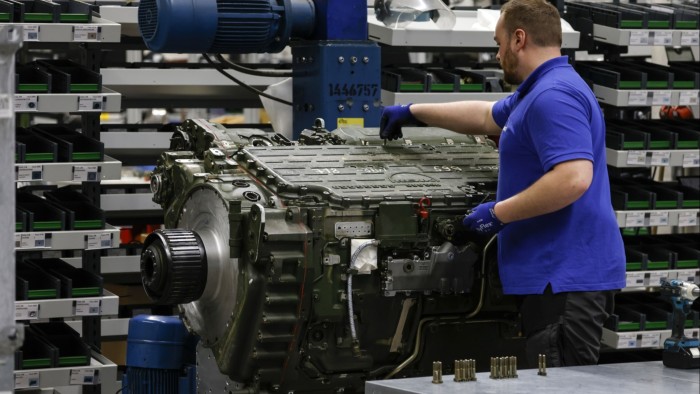
German defence contractor Renk has threatened to shift some of its production abroad so it can continue selling parts for Israeli tanks after Berlin announced an export embargo.
The boss of the Bavaria-based group, which makes gearboxes used in Israeli tanks and armoured vehicles, said it had a “responsibility” to ensure the country can “maintain its deterrence capabilities”.
Chief executive Alexander Sagel told the Financial Times that Renk was still trying to understand the consequences of Chancellor Friedrich Merz’s announcement last week that he would suspend the sale of military products that could be used in Gaza.
Sagel said that, as a German company, Renk would comply with the country’s laws and regulations.
But he added that the company, which has a market capitalisation of €6.3bn, was considering other ways of fulfilling its contracts if the ban was confirmed by Germany’s security council.
“It is also clear that we are discussing a plan B. The plan B is that we relocate production of these specific transmissions to the US,” said Sagel, who earlier told analysts that Israel accounted for 2 to 3 per cent of Renk’s sales.
Asked about the morality of supplying tank components to Israel, which has been accused of widespread human rights abuses in the war triggered by Hamas’s October 7 2023 attacks that killed 1,200 people, Sagel said that it was “a difficult discussion”.
He added: “Of course, we see all the discussions about the Gaza Strip. But from the German point of view, we have a responsibility to ensure that Israel is able to maintain its deterrence capabilities. These are not only needed in Gaza but also at other borders.”
Sagel declined to say how many gearboxes Renk must still deliver to Israel, but he told analysts that the company had a contract to supply “hundreds” of the products.
Israel has depended heavily on tanks and armoured personnel carriers in its military offensive in Gaza, using them to punch through a dense urban environment.
Its looming invasion of Gaza City will rely on the armoured corps again, with satellite images already showing tanks being massed on the Gaza border.
Renk on Wednesday reported that its revenues rose to €620mn in the first half of 2025, a 22 per cent increase on the same period last year, as it benefited from a surge in European defence spending. Adjusted earnings before interest and tax rose 29 per cent to €89mn.
Sagel said that if the embargo went ahead, it was likely to hit Renk’s operating profit by an amount in the mid single-digit millions of euros in the second half of the year.
Germany’s decision to limit the export of military equipment came amid a growing international backlash against the actions of Israel’s government.
Norway’s $2tn oil fund said this week that it had sold out of a fifth of the Israeli companies in which it owned stakes and cut ties with Israeli fund managers in response to a wave of public concern that it was helping to finance the war in Gaza.
Armin Papperger, chief executive of Rheinmetall, told the FT that his company, whose products include tank ammunition, was not exporting any weapons to Israel.
Merz, who has long cast himself as a staunch supporter of Israel, said last week that his decision to halt some weapons sales to the country was a response to the Israeli government’s plan to expand military operations in Gaza — a step that could result in a full reoccupation of the enclave.
He said that “even tougher military action” in the strip would make it harder to reach a ceasefire with Hamas and secure the release of hostages held by the militant group.