
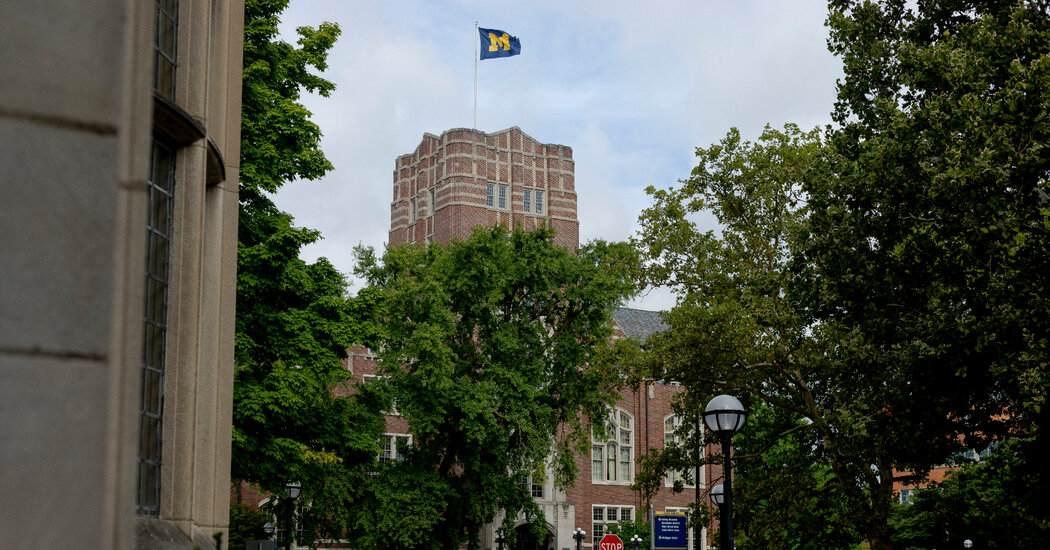
Eight people who federal prosecutors said had ties to the University of Michigan were accused in an indictment unsealed on Wednesday of conspiring to threaten campus leaders and others into severing ties with Israel.
The indictment, in the U.S. District Court for the Eastern District of Michigan, accused the pro-Palestinian activists of crossing the line from campus protest to a series of illegal acts that included threats and vandalism. The eight defendants face varying charges, but the indictment included federal counts of conspiracy to transmit threats, witness intimidation and destruction of property to prevent seizure.
The charges in Michigan, all felonies that carry the possibility of years in prison, appeared to signify an escalation in the federal government’s efforts to crack down on pro-Palestinian activism that had roiled American campuses.
“Their criminal activity included spray-painting threats, breaking windows and throwing glass jars filled with noxious chemicals into family homes,” the indictment said. “They marked their victims with threatening symbols used by Hamas, including red inverted triangles and red handprints. They used the internet and social media to broadcast their message to ensure their threats and commitment to continuing criminal activity were heard by their victims and others who support Israel.”
The Trump administration has taken a hard line against pro-Palestinian protesters, whose activism after the Hamas-led October 2023 attack on Israel and Israel’s military campaign in Gaza led to tumult on university campuses across the country. Until now, the administration had mostly focused on targeting universities themselves over their response to protests, although it did move to strip visas and deport some individual students last year.
Activists had opposed those tactics, saying that the administration was trying to limit free speech and target its political opponents. Critics accused the administration of conflating criticism of Israeli and U.S. policies with antisemitism.
Thousands of people were arrested at the peak of the campus protest movement in 2024, but those cases generally resulted in relatively minor charges in state courts or no charges at all.
Among the most serious charges filed in state court were felonies against Stanford protesters in connection to an episode in which demonstrators broke into the office of the university president and barricaded themselves inside. A California jury deadlocked on those charges this year.
A University of Michigan spokeswoman did not immediately respond to a request for comment. Court records did not make clear whether most of the defendants had hired lawyers, and none of them could be immediately reached for comment. Six of the people charged in the indictment were described by prosecutors as Michigan residents: Paige E. Feyock, 26; Amatullah A. Hakim, 21; Zainab A. Hakim, 23; Mariam M. Odeh, 24; Colin H. Weger, 24; and Jonathan H. Zou, 22. Ahmet K. Korkaya, 28, of Wisconsin, and Alexander M. Sepulveda, 23, of Illinois, were also charged.
At least four of the defendants made initial appearances in federal court on Wednesday and were ordered to be temporarily detained.
Many of the defendants had been publicly associated with campus protests at Michigan in recent years, and some of them had been identified as members of pro-Palestinian campus groups. At least six of the eight defendants had identified themselves online as University of Michigan students, and a seventh had worked as a researcher there. At least two of them appeared to have written opinion pieces in The Michigan Daily, a campus publication, expressing support for the Palestinian cause or anger over university policies.
“The university maintains deep ties with Israeli institutions that fund research and develop technologies for the genocide in Gaza,” said an opinion piece published in December and co-written by Amatullah Hakim.
One of the defendants, Mr. Zou, appears to be the same person who sued the University of Michigan last year over a campus ban for his actions during a pro-Palestinian protest. That lawsuit, filed by the American Civil Liberties Union of Michigan and another group, accused the university of responding with a heavy hand response to campus protests.
“These trespass bans have upended plaintiffs’ daily lives, disrupted their education and work, and are blocking their ability to speak and protest freely on the university’s vast campus,” the lawsuit said.
The indictment described how pro-Palestinian activists at Michigan planned their actions in private messages and posted publicly on social media afterward. Prosecutors described social media posts, including at least some that remained online, as evidence of unlawful conduct.
“Those who engage in coordinated campaigns of threats and intimidation should expect to be held fully accountable under federal law,” said Jennifer Runyan, the special agent in charge of the F.B.I.’s Detroit field office, in a statement.
The indictment mentioned the pro-Palestinian protest encampment in spring 2024 on Michigan’s campus, but it focused on actions that took place after university officials broke up that encampment.
Prosecutors accused the group of traveling at night to the homes of university leaders, as well as businesses and organizations deemed supportive of Israel, and leaving spray-painted messages and threatening notes. In some cases, prosecutors said, protesters “caulked doors shut, bike-locked entryways, broke windows, and threw glass jars” filled with acid and dye into homes.
Among those targeted, prosecutors said, were the university president and provost, a university police officer, a Jewish organization and businesses including Rolls-Royce and Maersk.
The indictment accused some of the defendants of traveling to the home of an elected university regent before 6 a.m. in May 2024. Once there, prosecutors said, those defendants “littered the yard and porch with small tents, sheets wrapped to look like dead bodies, dismembered and bloody baby dolls, and a broken crib.” The group also left a note at the door demanding that the university divest from Israel, prosecutors said.
Though the indictment did not include the regent’s name, it quoted from a social media post that remained online on Wednesday and that included video of several people in masks on the driveway of a home. That post identified the regent as Sarah Hubbard, a Republican.
“I’m very appreciative of the tireless work done by various levels of law enforcement on the University of Michigan campus, in Michigan and across the United States to bring this matter forward,” Ms. Hubbard said in a social media post after the indictment.
Michigan, one of the country’s most highly regarded public universities, was far from alone in seeing heated protests in 2023 and 2024 over the fighting in Gaza. Though there were high-profile clashes at other nationally known institutions — including Columbia University, Indiana University, Northwestern University and the University of California, Los Angeles — the tumult spread to campuses across the country.
Pro-Palestinian protesters on some campuses convinced administrators to agree to certain concessions. The demonstrations also led to accusations of antisemitism in American higher education.
After returning to power in 2025, President Trump and his administration described what they saw as a pattern of policies hostile to Jewish and Israeli students and pressed for changes. The Justice Department has sued some of those universities, though critics have argued that the pressure campaign is motivated in large part by a desire to punish elite institutions seen as hostile to the president’s agenda.