
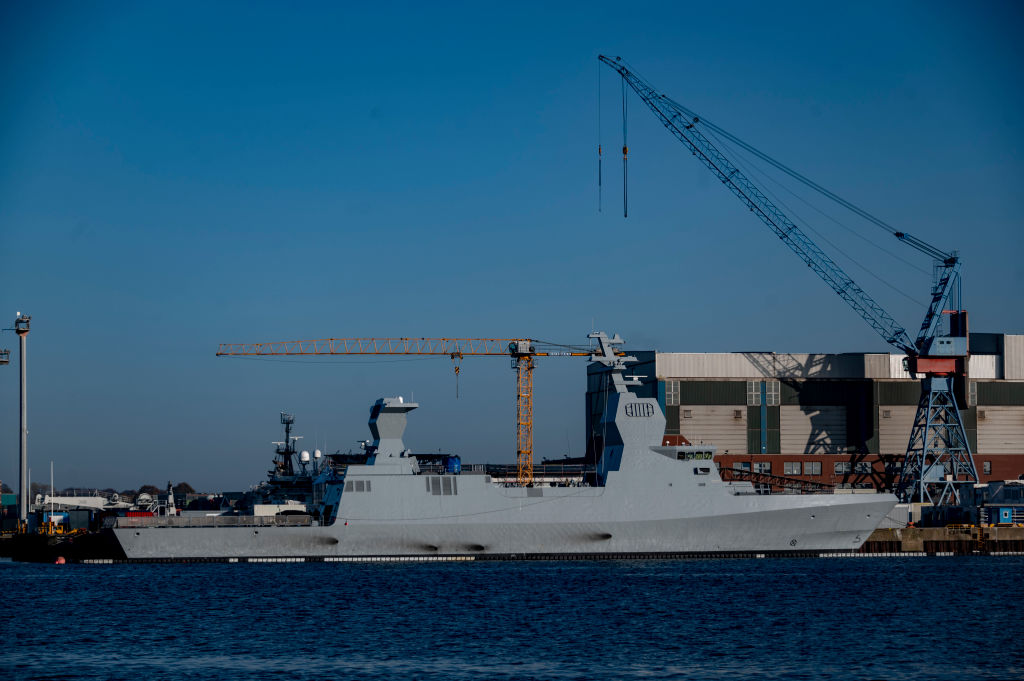
Deep and long-standing ties between German weapons makers and Israel’s military are set to continue despite Chancellor Friedrich Merz’s decision to partly block arms sales for use by Israeli forces in Gaza.
Many high-value exports, including submarines and naval corvettes, are said to be exempt from the ban, which applies only to weapons likely to be used in Gaza. German imports from Israel – including a major deal to buy Arrow-3 missile defence systems – will also remain unaffected.
“It seems unlikely that this will affect defence industrial relations between Israel and Germany in the long term,” said Zain Hussain, an arms export expert at the Stockholm International Peace Research Institute (SIPRI), which tracks the global arms trade.
Germany is Israel’s second-largest supplier of “major arms” after the United States, and Hussain said “Israel will continue to rely on these states for many of its major arms capabilities”.
Scope of the ban
One unanswered question is whether shipments of German-made engines, gearboxes and replacement parts for Israeli armoured vehicles – which have been extensively deployed to Gaza and the occupied West Bank – will continue.
A German government spokesperson on Monday declined to answer questions about tank parts, saying only that each case will be assessed individually. Engine manufacturer MTU, reportedly among the suppliers, said it would comply with export control rules in countries where it operates but would not comment on possible exports to Israel.
Muriel Asseburg, an Israel expert at the German Institute for International and Security Affairs (SWP), said Merz’s restrictions were deliberately framed as limited in scope and duration, making long-term impacts on defence ties unlikely. However, “it still sends a signal when Israel’s second-largest arms supplier imposes a partial embargo,” she said.
She also warned that Israel’s far-right coalition government could “provoke further repercussions”.
German defence industry players also remain in the dark. The chair of German defence industry lobby group BDSV, Hans Christoph Atzpodien, told Euractiv on Monday that they “do not have any information beyond what is publicly available”.
Thyssenkrupp Marine Systems, which produces naval ships for Israel, likewise said it had “no official information from the federal government”.
According to SIPRI, Israeli Sa’ar 6 naval corvettes – partially built by Thyssenkrupp Marine Systems – have been used to strike targets in Gaza.
In an internal paper to critics in his centre-right Christian Democrats, Merz said the ban would not apply to any “air and maritime defence equipment, which is central to Israel’s self-defence”.
German supplies
Details about German weapons exports are largely confidential, with export licences approved in secret by Germany’s cabinet-level national security council. Beyond biannual figures on the total export value of defence products, little is formally disclosed.
Germany issued arms export licences worth around €326 million for Israel in 2023 or almost ten times the previous year, after a prioritised approval process following the 7 October attacks. Another €161 million was approved in 2024.
In the first half of 2025, Germany exported about €90 million in weapons to Israel, according to economy ministry figures. Shipments included firearms, ammunition, weapon parts, special army and navy equipment, electronics and special armoured vehicles, according to information obtained by the left-wing Die Linke party through a parliamentary inquiry.
Asseburg said it is unclear from publicly available information exactly which German-made weapons are used directly in Gaza, but even equipment deployed elsewhere frees up other weaponry for Israel’s military campaign. German deliveries of “corvettes, anti-tank weapons, mechanical parts for armoured vehicles, armoured vehicle ammunition, small arms and ammunition for small arms” are all “significant for Israel’s war in the Gaza Strip,” she said.
She added that Israel’s “extreme dependence on US arms deliveries and financing” makes decisions by US President Donald Trump “decisive” in influencing Israeli conduct.
(bts, de)