
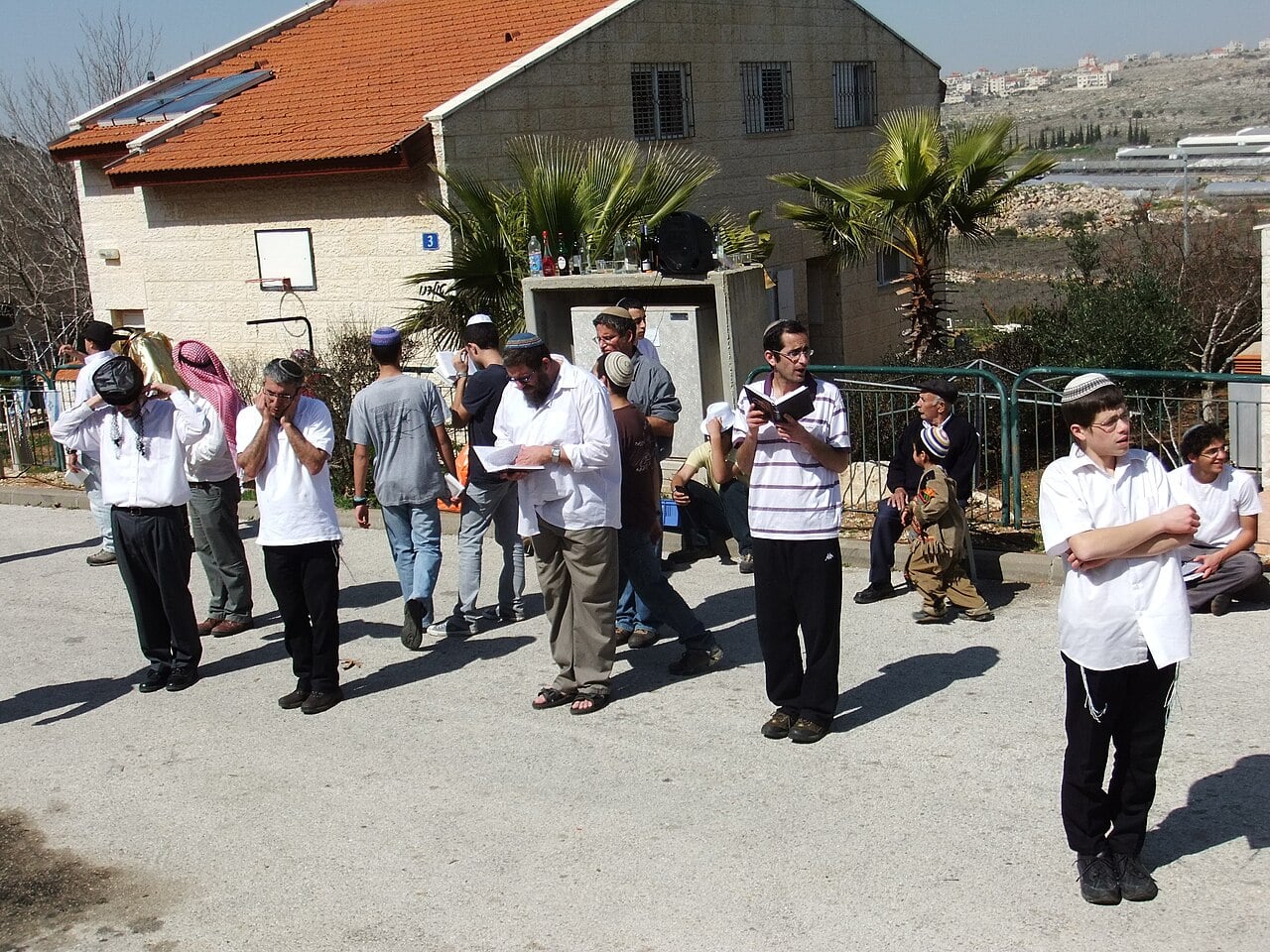
A single word can decide an argument before it begins — and in this conflict, that word is “settlers.”
Words do moral work, and in the Israeli-Palestinian conflict, few words do more of it than “settlers.” In contemporary English, it has become the default label for Israeli civilians who live beyond the 1949 armistice lines. Even Israel Policy Forum notes that the term is now used largely for Israeli communities in the West Bank, and wire services such as AP and Reuters treat “Israeli settlers” as neutral shorthand. But the word does not merely describe an address. It smuggles in an entire theory of the conflict: that Jews in Judea and Samaria are foreign colonists implanted in a land to which they hold no claim but force. That framing is neither neutral nor historically complete.
Let me be clear about what I am not arguing. A serious case for Israel does not require denying Palestinian suffering, national feeling, or political rights. It does require resisting language that quietly erases Jewish peoplehood, memory, and history. If this is genuinely disputed territory claimed by two peoples, then vocabulary that presumes one side is indigenous and the other a colonial trespasser prejudges the case before the argument has even begun.
Jews are not strangers in Judea and Samaria
Start with the point modern discourse works hardest to obscure: Jews are not foreigners in Judea. The word Jew derives from Judah; in ancient usage a Yehudi was a member of the tribe and kingdom of Judah, and Judaea was the southern division of ancient Palestine. The linguistic kinship is not the whole argument, but it captures a civilizational truth in a single stroke — “Judea” and “Jew” share the same root. To call Jews in Judea alien intruders is not historical sophistication; it is civilizational amnesia.
The map of Judea and Samaria is not incidental to Jewish memory. It is one of its main settings. Jerusalem became the capital of the Jewish kingdom around 1000 BCE under David. Shiloh, in today’s West Bank, served as the central sanctuary of the Israelite confederacy in the age of the Judges. Hebron is not a Zionist abstraction but one of Judaism’s oldest holy cities, bound in tradition to the patriarchs and matriarchs and home to a living Jewish community into modern times — until 1929, when sixty-seven of its Jewish residents were murdered in anti-Jewish riots, a massacre that became a defining memory for the later return to the city.
This is why the colonial analogy keeps misfiring. Colonial settlement describes a people arriving on behalf of an external empire in a land unconnected to their own origin story. The Jewish relationship to Hebron, Shiloh, Jerusalem, Bethlehem, and Bethel is the reverse: ancestral, liturgical, legal, and continuous in memory even where violent rupture interrupted physical presence. The honest frame is not foreign implantation but return.
What sovereignty actually existed before 1967
The second problem with “settlers” is legal-historical. The word encourages a casual assumption that Israel planted Jews on land that had plainly been the sovereign territory of a Palestinian state. The record shows nothing of the kind. After Ottoman rule collapsed, Palestine passed not to Palestinian sovereignty but to British administration under a League of Nations Mandate.
That Mandate is one of the central legal documents in this story, and it is routinely omitted from popular commentary. Its preamble recognized “the historical connection of the Jewish people with Palestine” and the grounds for reconstituting their national home there. Article 6 instructed the administration to facilitate Jewish immigration and to encourage “close settlement by Jews on the land,” while safeguarding the rights of other inhabitants. The framework emerged from the 1920 San Remo conference. One may dispute how far these texts govern present claims; one cannot honestly pretend they never existed.
Nor was the West Bank a sovereign Palestinian state before Israel captured it in 1967. The Arab state envisioned by the 1947 UN partition plan never came into being; Jordan annexed the West Bank in 1950, an annexation that drew almost no international recognition — principally Britain and Pakistan. The 1949 armistice agreement itself stated that its demarcation lines were “without prejudice” to future territorial settlements. The Green Line was a military ceasefire line — not a sacrosanct international border conferring permanent Palestinian sovereignty.
International law is argued over, not ended by slogans
None of this makes the legal question simple. It is not. The dominant international view — voiced by the UN Security Council, the ICRC, and the ICJ — holds that the settlements violate international law. UN reporting under Resolution 2334 restates that they have “no legal validity.” The ICRC reads Article 49(6) of the Fourth Geneva Convention as barring an occupying power from transferring its civilian population into occupied territory, and the ICJ’s 2024 advisory opinion called on Israel to halt new settlement activity and evacuate settlers. Anyone writing seriously must acknowledge that this is the prevailing position.
But serious writing must also acknowledge the dispute. Israel’s official position argues that Article 49(6) was drafted against the background of the forced, coercive transfers of World War II and should not be stretched to bar the voluntary movement of Jews into territory that had no prior legitimate sovereign and to which Jews hold deep historical claims. One may reject that reading. One may judge that the weight of international law runs the other way. But to insist there is no argument at all is advocacy dressed up as settled law.
Resolution 242 sits at the center of the debate. Its English text calls for withdrawal of Israeli forces “from territories occupied in the recent conflict” and for every regional state to live within “secure and recognized boundaries.” Jurists such as Ruth Lapidoth long argued that this wording did not require withdrawal from all the territories and deliberately allowed for negotiated adjustments. The Oslo process reinforced the point by reserving settlements, borders, Jerusalem, refugees, and security for permanent-status talks. Final borders were to be negotiated — not pre-decided by slogan.
Why the label feels selective — and historically wrong
There is also a linguistic asymmetry here. In ordinary journalistic and diplomatic usage, “settler” has hardened into a specialized political noun applied above all to Jews living beyond the Green Line. When a word attaches almost exclusively to one side of one conflict, it tends to stop functioning as a neutral descriptor and start functioning as an accusation.
That accusatory charge is amplified by the term’s colonial overtones. Yet Zionism is not a random expatriate venture; it is the Jewish national movement for a state in “the ancient homeland of the Jews,” and “in many ways a continuation of the ancient attachment” of the Jews to that land. After the Holocaust, more than 250,000 Jewish displaced persons sat in European camps, many unable to go home because their communities had been destroyed. Jews returning to the Land of Israel were not the civilian arm of a distant empire. They were a people reassembling itself after exile, expulsion, and genocide.
This dissolves no specific objection to any specific policy. Some communities are strategic, some ideological, some simply affordable housing; some raise hard questions about land, planning, and the future map of a Palestinian state. But once the story is told honestly, “colonial settlers” stops being an intellectually serious catchall. The accurate alternatives are less melodramatic and more precise: Jewish residents of Judea and Samaria, Israeli communities in disputed territory, Jews living in their ancestral heartland.
Security and a negotiated peace still matter
A final reason the word misleads: it flattens strategy into morality play. The uplands of the West Bank descend toward Israel’s coastal plain, where the Tel Aviv and Haifa conurbations hold more than half the country’s population. Israeli security thinking has always been shaped by that topography and by the extreme narrowness of the pre-1967 line at the nation’s heartland. One need not accept every Israeli security claim to grasp that these communities exist in a strategic, not merely ideological, context.
And a serious pro-Israel position should say plainly: Palestinians also hold national rights and deep attachments to the same land. Both Zionist and Palestinian Arab nationalism have long claimed rightful possession west of the Jordan. Any viable peace will require negotiation, compromise, demilitarization, security guarantees, and borders that protect Israel while addressing Palestinian self-determination. None of that is served by a vocabulary that opens by declaring Jews uniquely foreign in the one region whose very name reflects Jewish peoplehood.
A more honest vocabulary
The question of Jews living in Judea and Samaria is politically combustible, legally contested, and morally hard. It is not solved by euphemism and not clarified by propaganda. “Israeli settlers” is not always false in the narrow sense that people have settled there. But as the phrase is actually used, it is tendentious and historically misleading. It conjures strangers in someone else’s country, when the reality is a collision of two national movements in a land central to both — and ancestral, in a unique way, to the Jewish people.
If language is meant to illuminate rather than indoctrinate, better terms are available. Write about Jewish residents of Judea and Samaria. Write about Israeli communities in disputed territory. Write about Jews living in their ancestral heartland. Those phrases do not settle the conflict. They do something more basic and more necessary: they stop falsifying it.
Yaakov Chaliotis is the founder of Group of Verified Intelligence (GVI), a London-based research, due diligence, and verification firm combining AI, data science, quantitative analytics, and algorithmic tools with high-calibre human judgment. GVI delivers rigorous intelligence and advisory work across geopolitics, corporate strategy, and social media and marketing intelligence.
Originally from Cyprus, with roots in Kefalonia, Greece, Yaakov has lived and worked in London for fifteen years. His career spans senior roles in digital communications, strategy, and analytics, supporting CEOs, leadership teams, and UK government ministers with data-driven insight and strategic decision-making.
He previously served as Digital Strategy Manager at the UK National Lottery during the Rio 2016 Olympic Games, worked at the UK Department for Education during the pandemic, and later became Global Brand Analytics Lead at Shell.
Beyond his professional work, Yaakov is an active member of the World Jewish Congress Jewish Diplomatic Corps, focused especially on combating antisemitism and anti-Zionism.