
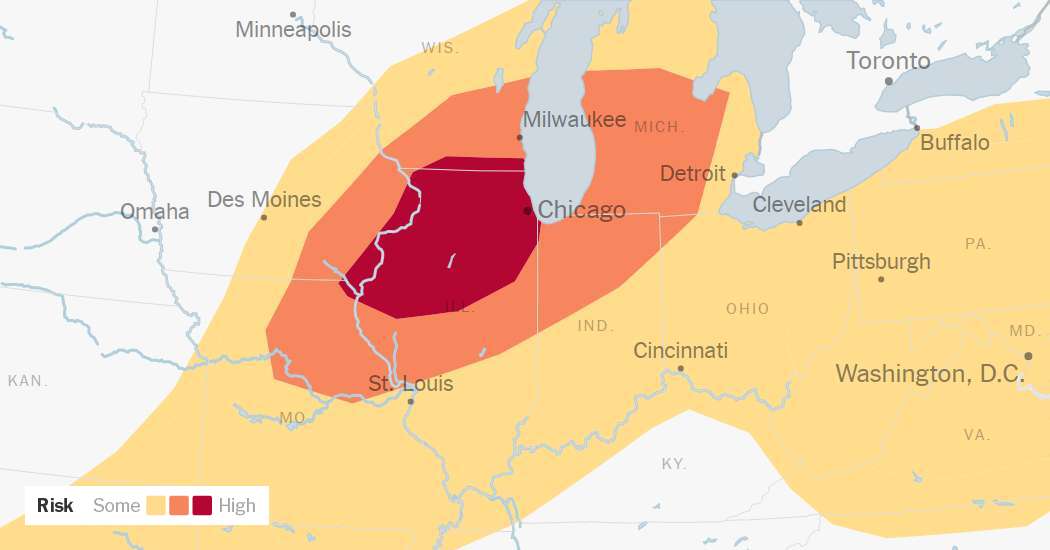
A day after thunderstorms sent pounding rain and high winds across the Midwest, forecasters are warning that another series of potentially destructive storms is likely to hit a part of the United States stretching from Texas to New England on Thursday.
For the second day in a row, the Great Lakes have the highest chance for damaging storms. Areas near Chicago and Milwaukee are again at the center of the National Weather Service’s forecasts. Late Thursday morning, meteorologists at the Storm Prediction Center said the forecast for Chicago, especially, had become more severe.
“Well, this is certainly a complex situation unfolding,” Bill Bunting, the deputy director of the Storm Prediction Center, said Thursday morning. “I’ve seen this before — it doesn’t always pan out, but certainly the potential is there.”
As the storms move into Northern Illinois, he said they could bring a significant risk for strong tornadoes. By early afternoon, brief tornado warnings had begun dotting the landscape, and parts of Illinois were under a high wind warning.
Earlier in the day, more than 250,000 homes and businesses in the Midwest were still without power after severe storms moved through on Wednesday, according to poweroutage.com, which tracks utilities.
The major cities of the Mid-Atlantic and Northeast — including New York, Philadelphia and Baltimore — are also facing an elevated chance of large hail, damaging winds and possibly a tornado as they move across the region on Thursday afternoon and into the night.
A big mass of very warm and moist air is heavily resting on the eastern half of the United States and parts of Canada, creating conditions that Bill Bunting, the deputy director at the Storm Prediction Center, called “a breeding ground for severe thunderstorms.”
Here are the key things to know:
There could be multiple rounds of storms. Mr. Bunting said that at this time of year, the nights are warm enough to still produce morning storms, but the more substantial threats will most likely come in the afternoon and evenings.
The stormy weather is being fueled by the same pattern that is producing the first widespread glimpse of dangerous heat of the year, resulting in a soupy mess for millions of people.
The severe weather will mostly move on from the Midwest by Friday, but storms are expected to linger longer in the Northeast.
Thunderstorms could also produce intense rain rates of one to two inches per hour. If the storms are slow-moving, some areas, especially cities, could face flash flooding, said Bryan Ramsey, a forecaster for the Weather Service in New York City.
At least one man died in connection to the severe weather outbreak. A man was killed after a tree fell on him on Thursday morning in Des Moines, the authorities said.
Just before 8 a.m., officers from the Des Moines Police Department and crews from the Des Moines Fire Department found a 54-year-old man at a homeless encampment who had been critically injured after being struck by a tree. Sgt. Paul Parizek of the Des Moines Police Department said the man, whose identity has not been released, died at the scene.
This is the time of year for severe storms.
“It’s thunderstorm season, so you know, there’s always a lot of risks,” Bob Oravec, a meteorologist at the Weather Prediction Center, said on Wednesday. The biggest threats Thursday and Friday will probably be from the severe thunderstorms and flash flooding, even though heat will still be a risk for the next few days.
Forecasters often know up to a week in advance whether conditions are likely to be favorable for thunderstorms, but their ability to pinpoint exactly where and when those thunderstorms kick off is much more limited. Read more about why forecasting thunderstorms is still so hard.
Scientists have been able to draw links between a warming planet and many types of extreme weather, including hurricanes, heat waves and droughts. But they have not determined whether there is a connection between climate change and the frequency or strength of tornadoes. Read more about tornadoes and climate change here.
How to prepare
Johnny Diaz contributed reporting.