

Israelis sweltered on Wednesday as temperatures soared amid a weeklong heatwave, with electricity usage breaking records and the broiling weather sending many indoors to stay cool.
Israel Meteorological Service (IMS) data showed temperatures in Eilat hitting 48.8 degrees Celsius (119.8 degrees Fahrenheit), with a 70-year-old man in the southern resort city collapsing of heatstroke and later dying.
A second fatality was recorded in the central city of Rishon Lezion, where a man in his 60’s also collapsed with heatstroke and died. A Magen David Adom team was unable to revive him.
In the country’s far north Galilee panhandle, the mercury climbed nearly as high, hitting 46.8°C (116.2°F) in Kfar Blum, south of Kiryat Shmona.
In the Jordan Valley’s Kibbutz Gilgal in the West Bank, the temperature hit a searing 49.7°C (121.5°F) — the highest in the country, according to the IMS. It also set a new record for the Jordan Valley, which had previously stood at 49.3°C (120.7°F).
Get The Times of Israel’s Daily Edition
by email and never miss our top stories
By signing up, you agree to the terms
Temperatures in Jerusalem hit 40.8°C (105.4°F), while in Tel Aviv the highest reading throughout Wednesday was a relatively cool 33.5°C (92.3°F).
The IMS said a number of records were broken in areas of the country, with a new high in Safed of 41.4°C (106.5°F), compared to the previous recorded high of 40.6°C (105°F). Other records were broken in Ayelet Hashachar in the Hula Valley, Ma’aleh Adumim in the West Bank and the southern city of Arad.
Even overnight between Tuesday and Wednesday, temperatures saw record-high readings in parts of the country. The IMS said that at the Sodom weather station near the Dead Sea, evaporation pools only fell to 36.6°C (97.8°F) overnight, the highest daily minimum ever recorded in Israel. The previous record was 35.5°C (95.9°F).
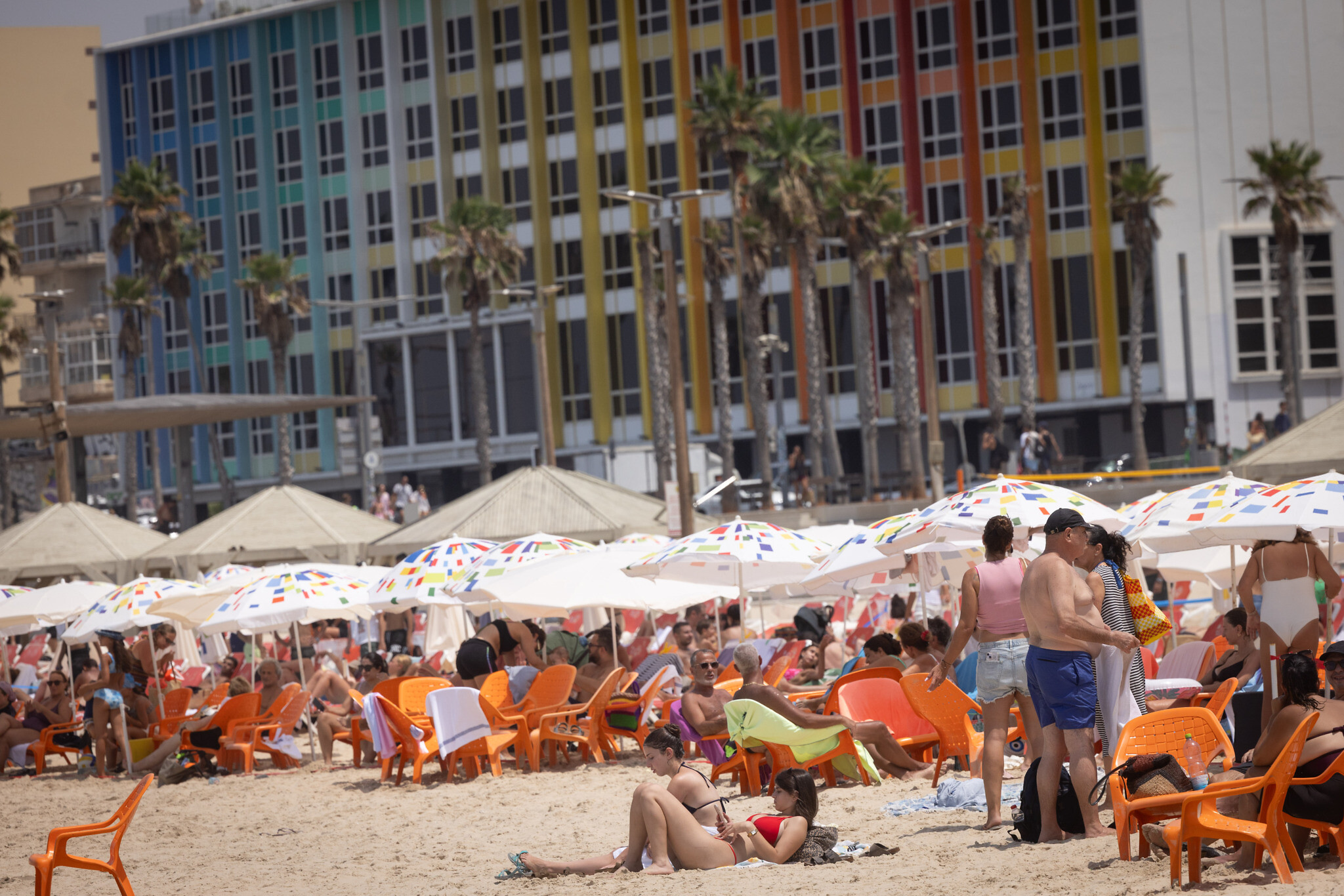
Beachgoers seen in Tel Aviv on a hot summer day, August 13, 2025. (Miriam Alster/ Flash90)
Eilat and Yotvata also experienced record-setting lows, only cooling to 35.8°C (96.4°F) and 33.7°C (92.7°F) overnight, the IMS said.
With Israelis heading indoors and cranking up the air conditioning to stay cool, electricity usage broke all records on Wednesday for the fourth consecutive day.
Israelis used more than 17,000 megawatts for the first time, after surpassing 16,000 MW on Tuesday, according to the Independent System Operator for the electricity industry, known by its Hebrew acronym Noga.
At 3:15 p.m., electricity use hit 17,287 MW.
“Extreme heatwaves are no longer an unusual event, but a reality that will return in the years to come. We are preparing in advance, along with full coordination with electricity producers, smart management of the system and ensuring continuous supply,” said Noga director Shiki Fisher.
Due to the dangerous weather conditions and the risks of wildfires, the Israel Nature and Parks Authority issued a total ban on entry to all hiking trails within national parks and nature reserves through Saturday.

Israelis hike in the Golan Heights during the Passover holiday, April 9, 2023. (Michael Giladi/Flash90)
The Israel Fire and Rescue Services also last week instituted a nationwide ban on lighting bonfires in open areas, in force through the end of the month. A burning vehicle caused a brushfire Tuesday west of Jerusalem that was brought under control after several hours.
Meanwhile, the soaring heat also affected infrastructure in some parts of the country.
Israel Railways announced Wednesday that it had imposed an 80-kilometer-per-hour (50 miles per hour) speed limit on some of its train routes due to the extreme temperatures, which were causing some of the rails to expand.
It said the move would cause some delays and urged the public to check for updates.

Passengers at the Haifa central train station, November 10, 2024. (Miriam Alster/FLASH90)
Temperatures were expected to cool very slightly on Thursday and Friday, before returning to seasonably hot weather on Saturday with highs in Jerusalem forecast as 30°C (86°F) and in Eilat as 40°C (105°F).
The IMS warned Israelis and visitors to stay inside during peak hours, hydrate regularly, avoid prolonged exposure to the sun and wear light colors.
Israel is a climate “hotspot,” where temperatures are rising faster than the global average. In 2020, Israel experienced its hottest recorded day ever, though the hottest ever temperature recorded was in 1942, before the state was established, with a temperature of 54°C (129.2°F) recorded at Tirat Zvi in the Beit She’an Valley.
Last month, the IMS predicted that average temperatures inland and in the mountains could rise by 4.5-5°C on average by the end of the century, and by 3-3.5°C along the coast and in the lowlands.
Is The Times of Israel important to you?
If so, we have a request.
Every day, even during war, our journalists keep you abreast of the most important developments that merit your attention. Millions of people rely on ToI for fast, fair and free coverage of Israel and the Jewish world.
We care about Israel – and we know you do too. So today, we have an ask: show your appreciation for our work by joining The Times of Israel Community, an exclusive group for readers like you who appreciate and financially support our work.
Already a member? Sign in to stop seeing this
You appreciate our journalism

You clearly find our careful reporting valuable, in a time when facts are often distorted and news coverage often lacks context.
Your support is essential to continue our work. We want to continue delivering the professional journalism you value, even as the demands on our newsroom have grown dramatically since October 7.
So today, please consider joining our reader support group, The Times of Israel Community. For as little as $6 a month you’ll become our partners while enjoying The Times of Israel AD-FREE, as well as accessing exclusive content available only to Times of Israel Community members.
Thank you,
David Horovitz, Founding Editor of The Times of Israel