
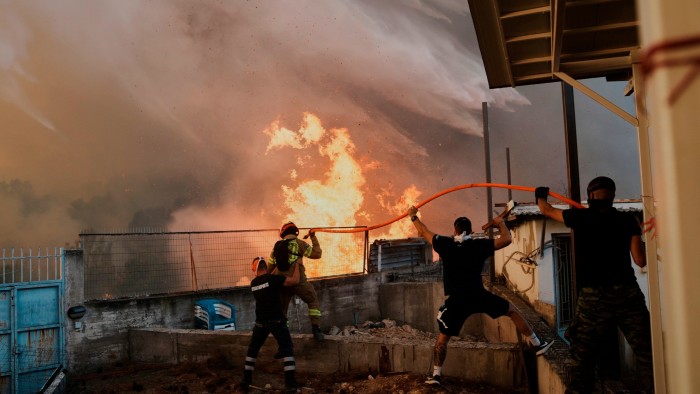
Wildfires have spread dangerously close to capital cities including Madrid, Athens and Podgorica in the past week, as data shows the number of blazes in Europe has jumped by nearly 50 per cent compared with last year.
Firefighters are tackling fires in Spain, Portugal, France, Turkey, Greece and Montenegro as temperatures in parts of southern Europe soar above 40C and countries issue heat warnings.
Thousands of people have been evacuated because of the fires, including from the western Peloponnese region near Patras, and the holiday islands of Zakynthos and Kefalonia in Greece. Officials warned of a “very difficult day” on Wednesday.
More than 8,000 people had to be evacuated in Zamora and León in north-west Spain because of the flames, according to Alfonso Fernández Mañueco, head of the regional government.
In the southern Atlantic region of Atlanterra, some 2,000 people were evacuated from towns including Zahara de los Atunes on Tuesday.
Spain’s interior minister Fernando Grande-Marlaska said during a radio interview on Wednesday evening that he has alerted the EU in case the country needs help.
“We have warned the EU of the need for additional resources, so that it is aware there will be a request at some point if circumstances become even more complicated, or if the resources available to us in Spain, which is one of the countries with the most resources for fighting forest fires, are not sufficient.”
In another radio interview later, he said he had asked the EU for two Canadair firefighting planes, which could “be at the disposal of the State” and could “be sent to those [areas] where . . . they are necessary and a priority”.
“We understand that due to the climate forecasts . . . We want to have those planes in our national territory as soon as possible to be used in case they are needed,” he added.
Officials warned of an “extreme risk” of blazes across several countries over the coming week.
The threat across most of the Iberian peninsula, southern France, Slovenia, Hungary, Greece, Romania, Bulgaria and the rest of the Balkans was “particularly severe”, agencies said.
Europe has grappled with several heatwaves over the summer months that have fuelled droughts and wildfires, as well as putting a huge strain on its energy system.
Akshay Deoras, a research scientist at the National Centre for Atmospheric Science & Department of Meteorology at Reading university, said the heatwaves were drying out soil and vegetation, “turning landscapes into tinderboxes”.
“Heatwaves are becoming more intense and frequent due to climate change, which means climate change is directly fuelling wildfires. What we are seeing across Europe right now is a clear example of how extended hot and dry conditions are making wildfires fiercer and harder to control.”
Data from the European Forest Fire Information System this week showed that more than twice the area across Europe has been burnt by wildfires this year, or some 410,000 hectares compared with less than 189,000ha last year.
About 1,600 individual fires have been detected in the continent so far in 2025, compared with about 1,090 for the same period last year.

Firefighters in Spain alone are tackling 14 big fires that are active across 10 regions including Castile and León, Galicia and Madrid, according to justice minister Félix Bolaños.
“Climate change makes extreme temperatures an obvious risk for fires in our country, which are becoming increasingly devastating and difficult to fight,” he said.
Two people have died, including a 35-year-old volunteer firefighter in Castile and León. Las Médulas, a natural park and ancient Roman mining area in the region that Unesco declared a World Heritage Site in 1997, has been damaged.
The other Spanish victim died after a fire erupted on the outskirts of Madrid.
Sara Aagesen, Spain’s energy and environment minister, said in a radio interview on Wednesday that “the number of fires and their intensity” were making the situation more complicated.
“The wildfire situation remains serious. Taking extreme caution is essential,” prime minister Pedro Sánchez wrote on social media.
Several fires have also broken out in Portugal, while the US embassy in Montenegro warned on Tuesday that a wildfire near the capital Podgorica could spread closer.
Intense wildfires are affecting other parts of the northern hemisphere such as Canada, where officials say more than 470 blazes have been classed as “out of control”. Thousands of people have also been evacuated in California over the past week.
Last month was the third warmest July on record globally, beaten only by 2023 and 2024. The European continent is warming faster than the global average.
Climate Capital
Where climate change meets business, markets and politics. Explore the FT’s coverage here.
Are you curious about the FT’s environmental sustainability commitments? Find out more about our science-based targets here