
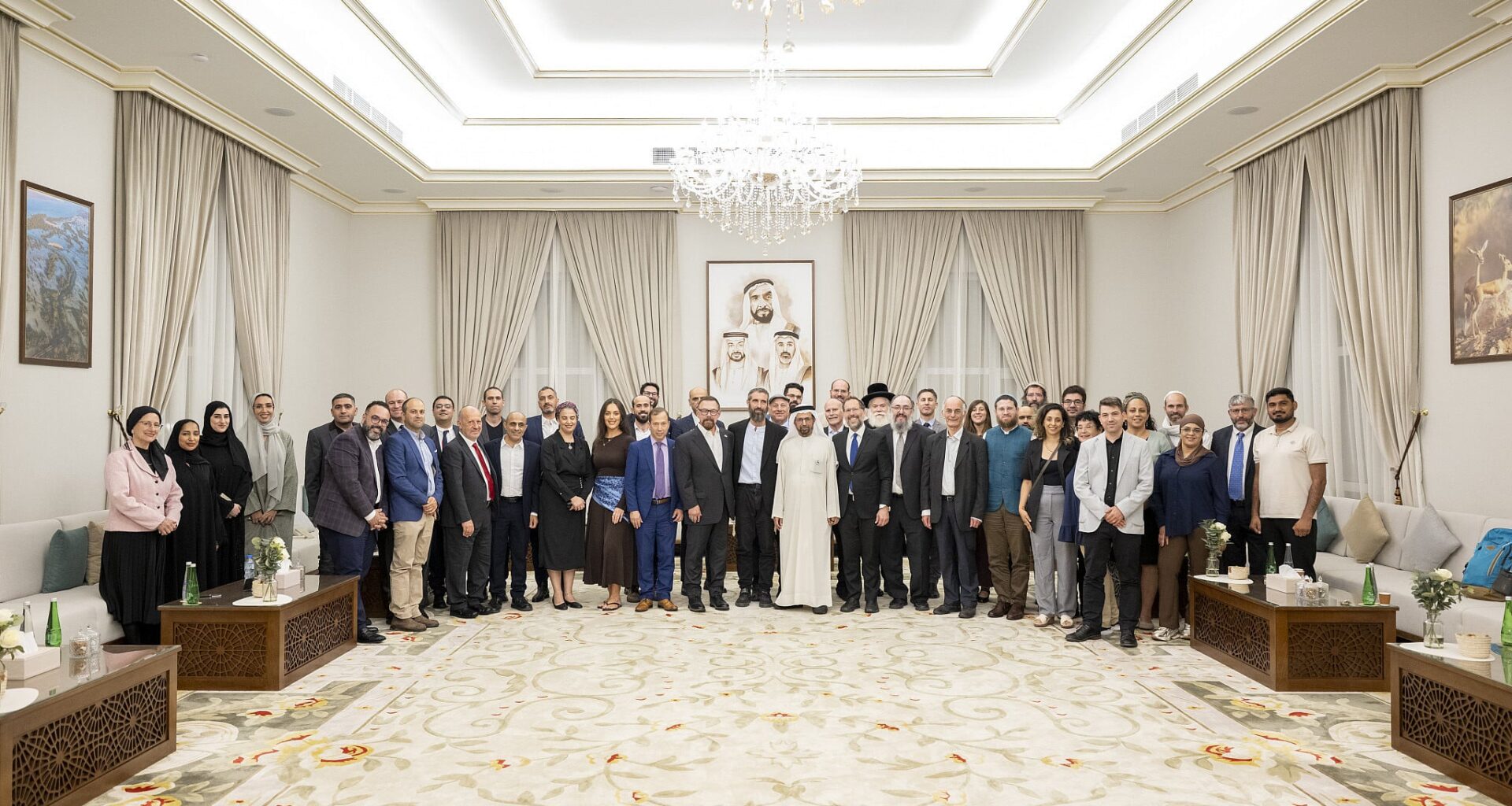
Former president Reuven Rivlin famously described Israeli society as comprising four “tribes”: the ultra-Orthodox, religious Zionists, secular Jews, and Arabs. In early June, dozens of men and women from all four tribes journeyed together as a single delegation to the United Arab Emirates (UAE). During this remarkable visit, we learned much about the UAE, but no less about ourselves, our nation, and our vision for the future of the region.
The delegation brought together representatives from more than twenty organizations in Israel’s interfaith diplomacy field, led by the Jerusalem Interfaith Center and supported by Israel’s Ministry for Regional Cooperation. We traveled to Abu Dhabi to participate in the International Dialogue of Civilizations and Tolerance Conference, hosted by the Emirates Scholar Center. Beyond the conference itself, our broader goal was to strengthen a shared vision in which religious identities become sources of connection rather than conflict in the Middle East, with a particular emphasis on fostering Jewish-Muslim fraternity.
The UAE has become a hub and bastion of the Abraham Accords. Since their signing five years ago, the Accords have endured the devastating tests of war and regional turmoil, demonstrating remarkable resilience.
The central message that resonated throughout our encounters was that the Abraham Accords are not merely about shared economic and security interests, but also about shared values, history, and a common vision for the future. Just as we see with two eyes, there are also two “I’s” in relations between peoples: Interests and Identities. While convergence of interests is essential, whether in economics or security, it is no less important that identity becomes a force for connection rather than division. The peoples of the Middle East, Muslims, Jews, and Christians, share a story in which each has a part. Religion must move from being a part of the problem to becoming part of the solution.
Our first visit was to the remarkable Crossroads of Civilizations Museum, founded by H.E. Ahmed Obaid Al Mansoori. The museum offers a rich testimony to Jewish culture and civilization, including the first Holocaust Museum in the Middle East. It stands as a powerful expression of the idea that the Abraham Accords are rooted not only in interests, but also in values and a vision for the future.
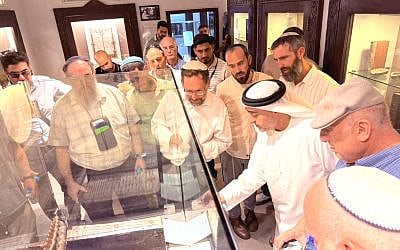
At the Museum. Credit: David Peretz.
Ahmed eloquently observed that “when you make war, you have an enemy; when you make peace, you gain enemies,” reflecting the reality that those who pursue peace often face opposition. I first met Ahmed five years ago at the N7 Conference in Rabat, Morocco, which brought together Israel and the six Arab countries that had made peace with it. The conference focused on regional cooperation and promoting the Abraham Accords through educational and people-to-people initiatives.
It was there that I first heard Ahmed explain that the Arabic word for tolerance, tasāmuḥ (تسامح), carries a warmer meaning than its counterparts in Hebrew and English. Whereas in Hebrew and English tolerance often implies bearing or enduring the burden of difference, the Arabic term conveys generosity, openness, and mutual goodwill. This insight deeply resonated with me. During our reunion in Dubai, I was honored to present him with my Arabic-language monograph on Jewish-Muslim fraternity, which seeks to convey this very message. Since we first met in Morocco, it seems fitting to recall the words of King Mohammed VI:
“The three Abrahamic religions were not created to be tolerant of one another out of some unavoidable fate or courtesy. The reason they exist is to open up to one another and to know one another, so as to do one another good.”
At the museum we also met Sheikh Ghaith Tamimi, an Iraqi Shi’ite scholar whose personal story embodies the transformative power of faith. As a young man, he belonged to a militia and was taught to hate Jews. Through his study of the Qur’an, however, he came to recognize the falsehood of these teachings and underwent a profound change of heart. Today he is a leading advocate of Muslim-Jewish coexistence. Shortly after our meeting, a friend of mine, a religious leader in Baghdad, sent me a video of the encounter, which had gone viral in Iraq and generated thousands of responses.
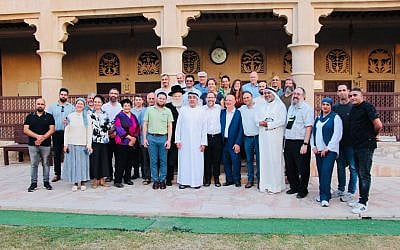
The delegation with Mansoori and Tamimi. credit: David Peretz.
The following day we met H.E. Dr. Ali Rashid Al Nuaimi, Chairman of the Defense Affairs, Interior and Foreign Affairs Committee of the UAE Federal National Council and Chairman of the Manara Center for Coexistence and Dialogue. Like Ahmed, I first met Dr. Ali at the N7 Conference in Rabat. That conference was unforgettable not only because of the discussions, but also because it coincided with Morocco’s historic World Cup victory over Spain. The participants of the conference prayed during the day before the game and danced late into the night after Morocco’s stunning triumph.
Dr. Ali welcomed our entire delegation into his home and hosted us for a strictly kosher banquet. His principal message was clear: the Abraham Accords are not merely security or political agreements. They are intended to create meaningful connections among people, communities, and nations.
Dr. Ali is a remarkable figure. Beyond his governmental responsibilities and extensive interfaith work, he is also a theologian and intellectual. Among his writings is Diversity and Coexistence: Fostering Acceptance in a Diverse and Open Society, which reflects his lifelong commitment to building bridges between communities.
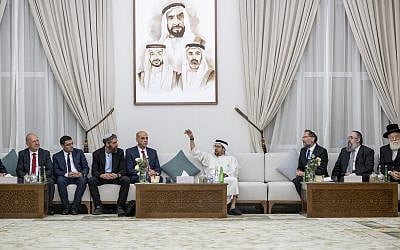
Credit: Manara Center.
He is not merely a man of words but also a man of action. Following the murder of Rabbi Zvi Kogan in Dubai, Dr. Ali traveled personally to Israel to comfort the family. His staff shared with us the wide range of educational and intercultural initiatives his organization promotes around the world.
At the conclusion of our meeting, deeply moved, I asked what we could do for him and for the UAE. His response touched all of us. “The most important thing you can do for me and my nation,” he said, “is to bring your own society together.”
Credit: David Peretz.
This reflected both his genuine concern for Israeli society and his belief that Israel can best fulfill its potential role in the region when it is cohesive and united. Looking around our delegation, so diverse in background, yet so united in purpose, I felt we embodied a small model of what Israeli society could become. The challenge is to bring that spirit home.
In gratitude, I responded that more than oil, the UAE brings light to the region through its commitment to promoting coexistence, dialogue, and human fraternity. In an era marked by conflict and polarization, that light is needed more than ever.
The culmination of our journey was participation in the International Dialogue of Civilizations and Tolerance Conference in Abu Dhabi. Thousands of religious leaders, scholars, policymakers, educators, and civil society activists from across the world gathered to explore how humanity can build a future grounded in dialogue, dignity, and mutual respect.
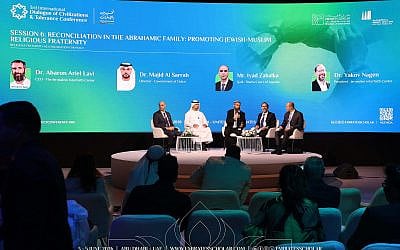
Credit: Emirate Scholars
Standing before this international gathering, I reflected on the extraordinary composition of our delegation. Israelis from all of President Rivlin’s “tribes” had traveled together to the UAE. Our very presence testified to a conviction that diversity need not be a source of division, but can become a source of blessing.
The message I brought to the conference was simple: we have a dream. We dream that the deep religious identities of the peoples of the Middle East will not be a source of conflict, but a source of connection.
We stand together against those who weaponize religion, who invoke God’s name to divide and destroy. Such actions betray not only one another, but the very scriptures and the very God whom they claim to serve.
The Torah recounts tensions between brothers: Isaac and Ishmael, Jacob and Esau, Joseph and his brothers. These stories reflect the complexity of family relationships. Yet again and again, the Bible teaches that brotherly love can ultimately prevail over rivalry and estrangement. So it is today with the relationship between Jews and Muslims.
Just days before our visit, Muslims throughout the world celebrated Eid al-Adha, commemorating the devotion and faith of Abraham. In the Islamic tradition, the son offered is Ishmael; in the Jewish tradition, Isaac. Yet both traditions affirm that both sons were blessed by God and beloved by Abraham. Neither was rejected. In the Qur’an, after the account of the offering, we read: “And We gave him glad tidings of Isaac, a prophet among the righteous. And We blessed him and Isaac.” Likewise, in the Torah, immediately before the Binding of Isaac comes the story of Hagar and Ishmael in the wilderness. There too a beloved son faces the danger of death. There too an angel intervenes at the final moment. And there too God’s blessing is bestowed upon him.
The truth that Jews and Muslims are family is reinforced by the Qur’an’s designation of the Jewish people as Ahl al-Kitab. While often translated as “People of the Book,” the Arabic word ahl also conveys the meaning of family. We are not strangers. We are family. Families must learn to live together with partnership, loyalty, and love.
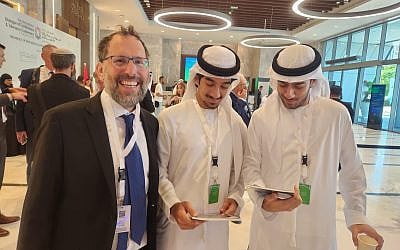
credit: Roee Horen
Among all the verses of the Qur’an, none speaks more deeply to me than the words of Surah Al Imran:
“And hold fast to the Rope of God, all together, and do not be divided. Remember God’s blessing upon you: when you were enemies and He joined your hearts so that by His blessing you became brothers. You were on the brink of a pit of fire and He delivered you from it.”(3:103)
This verse captures the essence of the Abraham Accords and the hope that brought our delegation to the UAE. It reminds us that our connection to God should draw us closer to one another rather than pull us apart. The goal is not merely tolerance, but fraternity.
Most of humanity follows one of the Abrahamic religions, all of which emerged from the Middle East. If religion can become a source of peace, blessing, and connection in this region, then it can inspire people throughout the world to join a broader movement of reconciliation and human solidarity.
This message resonated deeply with the vision we encountered throughout our visit. Again and again, we heard that the Abraham Accords are not merely a political or strategic achievement. They are an invitation to transform relationships between peoples and to rediscover one another as brothers and sisters, blessed by the same God and entrusted with a shared future.