
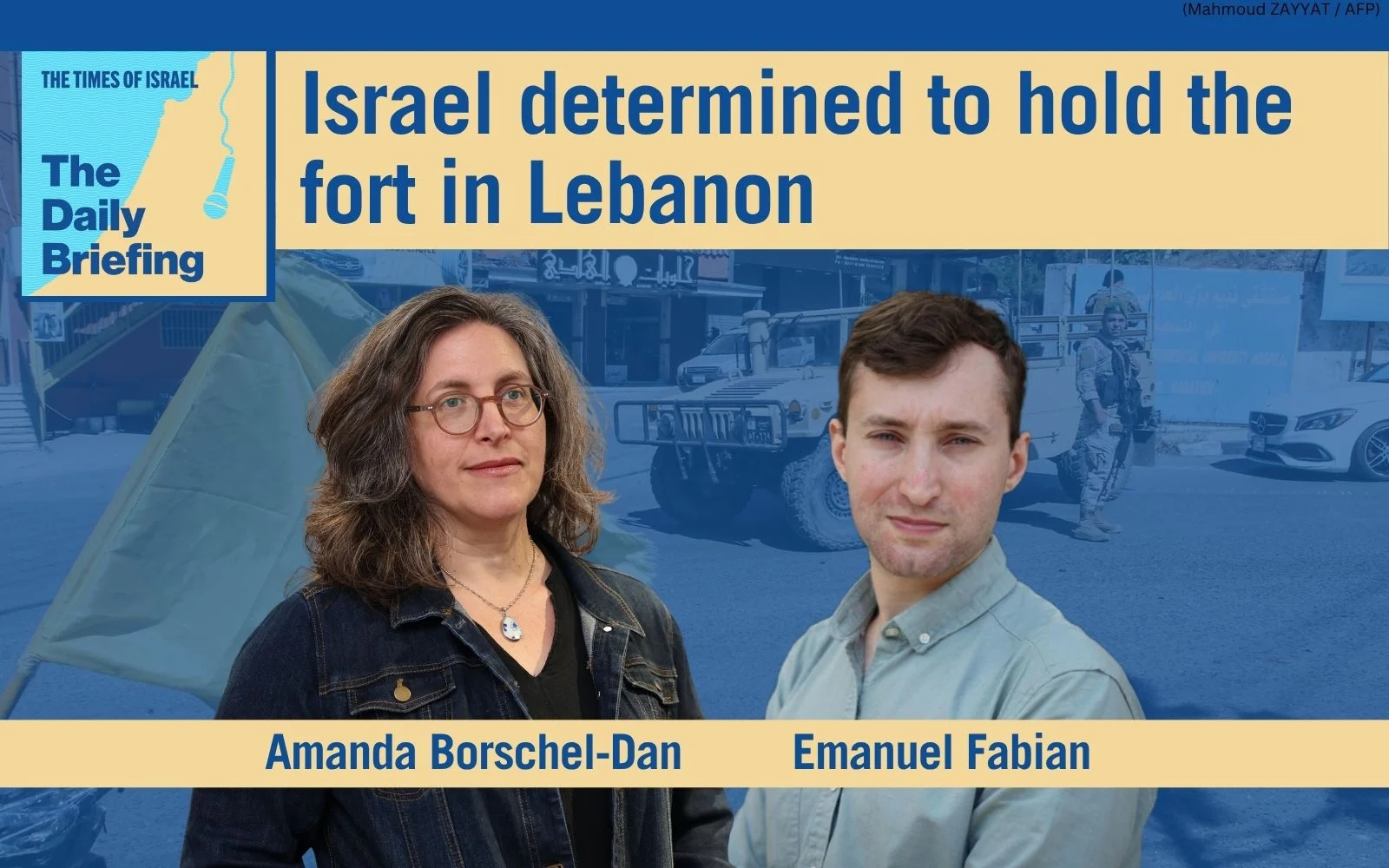
Welcome to The Times of Israel’s Daily Briefing, your 20-minute audio update on what’s happening in Israel, the Middle East and the Jewish world.
Military correspondent Emanuel Fabian joins host Amanda Borschel-Dan for today’s episode.
WATCH the full episode here:
Defense Minister Israel Katz vowed Monday that the Israeli military will remain in southern Lebanon and warned that if Iran strikes, it will be hit “with full force,” promising that Israel will resist any pressure after the US and Iran have reached a deal to end the war that also reportedly includes a commitment to end hostilities in Lebanon. We hear about what the IDF is currently holding in southern Lebanon and the strike on Beirut that almost derailed the Iran-US memorandum of understanding last night.
Late last week, senior Hezbollah commander Ali Mussa Daqduq, mastermind of a January 2007 attack that killed five US troops in Iraq, was killed in an Israeli strike in southern Lebanon, the IDF announced Sunday. Who was this terror architect and what else was he responsible for?
The IDF seeks to erect, for the first time, a permanent post in an area meant to be fully controlled by the Palestinian Authority. The post is set to be built in the northern West Bank’s Jenin refugee camp. What is the purpose of this first permanent post in Area A?
Check out The Times of Israel’s ongoing liveblog for more updates.
For further reading:
Israel vows to stay in south Lebanon; if Iran strikes, we’ll hit it ‘with full force’
IDF says over 70 Hezbollah sites hit as troops advance near south Lebanon’s Nabatieh
Israel braces for Iranian missile fire after strike on Hezbollah target in Beirut
IDF says it killed key Hezbollah official responsible for deadly 2007 attack on US troops
As IDF prepares to build post in Jenin, 2 soldiers hurt, 1 seriously, in blast
Subscribe to The Times of Israel Daily Briefing on Apple Podcasts, Spotify, YouTube, or wherever you get your podcasts. This episode was produced by Ari Schlacht.
Check out yesterday’s episode here:
Today’s transcript:
Amanda Borschel-Dan: Welcome to The Times of Israel’s Daily Briefing. Today is Monday, June 15. I’m Amanda Borschel-Dan, coming at you from Jerusalem, joined by our military correspondent Emanuel Fabian. Mannie, thank you so much for joining me today.
Emanuel Fabian: Hi, Amanda. Good morning.
Borschel-Dan: Good morning. We understand from reports that the United States and Iran have cemented the memorandum of understanding, which is reportedly going to be signed on [June] 19. In the meantime, US President Donald Trump has instructed Israel to desist from attacking Lebanon and vice versa. Hezbollah is not meant to be attacking Israel. So Mannie is here, and we’re going to talk about all that has been happening in Lebanon over the past several days. We’re also going to talk about a new army base in Jenin in the West Bank. All of this and more when we’re back.
And we’re back. I’m Amanda Borschel-Dan, joined by our military correspondent Emanuel Fabian. Mannie, let’s unwind the clock a little bit and talk about what has been happening in Lebanon, just even overnight, since the announcement of this memorandum of understanding. Has there been action on either side?
Memorandum of Understanding and fighting in Lebanon
Fabian: Very little in Lebanon since the announcement of this ceasefire between the US and Iran, which supposedly includes also ending the fighting in Lebanon. We don’t really know the exact details of the deal yet and what it actually entails for Israel, even though Israel’s not really a party to the deal. But as of now, there hasn’t been too much action. Lebanese media reported some artillery shelling in South Lebanon and one drone strike. But the army hasn’t commented yet, and it’s possible that there wasn’t actually a drone strike and it’s just reports of something else. But it’s very unclear, and I don’t think the army really knows what’s happening right now on the ground.
Borschel-Dan: What are we hearing from Defense Minister Israel Katz in the meantime?
Fabian: So Katz is the first, and as of recording, the only official in Israel who has actually commented on this. He didn’t really comment on the ceasefire, but he did say that Israel would remain in South Lebanon, meaning it wouldn’t withdraw from South Lebanon. Whether or not Israel is required to withdraw as part of the deal, we don’t even know if that’s a thing yet. But he said that, despite the pressure from the Americans and pressure that will come, Israel won’t be withdrawing from South Lebanon. The big question now is, what are the rules of engagement in Lebanon? Is the army allowed to respond to threats? Is it allowed to open fire on people approaching its forces? Will it need to withdraw despite Katz saying that Israel won’t? It’s really, really unclear at this point in time, at least right now, until we find out later what the actual deal is.
Borschel-Dan: Right. So please check the live blog for more current updates. But in the meantime, Mannie, let’s talk about what has been happening in and out of Lebanon over the past week. And yesterday, I believe it was, you reported that the IDF was moving ever more inward, ever more northward into Lebanon, the ground forces I’m talking about. So what is the status? Where does the IDF hold right now?
Fabian: So the army was pushing in deeper into Lebanon at two locations. One is near Nabatieh. So Nabatieh is a pretty major city in South Lebanon and also a significant Hezbollah stronghold. The army’s been operating sort of near the Beaufort Castle to destroy Hezbollah tunnels in the area. And Nabatieh is just slightly north of it, a few kilometers. So the army is not in Nabatieh yet, but it is essentially poised to launch an offensive against Hezbollah there. Right now, with this ceasefire, it doesn’t look like that’s going to happen, but that was the army’s plan if there was no ceasefire, was to either push forward into Nabatieh to launch an offensive against Hezbollah there, or to push further towards the west along the Litani River and act against Hezbollah at that location. Those were the two options, but it’s possible that neither will now be carried out. And then to the west in South Lebanon, the army was also pushing towards Majdal Zoun, which is a town in South Lebanon, not particularly significant, but also where Hezbollah was launching rockets and drones.
Troops from Lebanese media were reporting that the army was advancing in the area as well. It’s north of the so-called Yellow Line or the forward defense line that the army has in South Lebanon. So the army has been operating beyond its declared security zone in recent days, but whether or not it now has to withdraw back to those lines or even further, closer to the border, we’ll have to see. In terms of what’s coming the other way from Lebanon into Israel, in the past day, we saw Hezbollah launch several drones that struck Israeli territory, striking military zones, not in Israeli communities. And in response, Israel launched strikes on Beirut, a very, very small, precise strike against an apartment in the southern suburbs of Beirut, a Hezbollah stronghold as well. The IDF said it targeted a Hezbollah command center. There were reports of casualties in the area, three dead, I believe, was what Lebanese media reported. But it wasn’t a strike targeting specifically any Hezbollah operative or something like that. It was just against the command center in response to those drone attacks on Israel. And Iran obviously threatened to respond with missile fire.
The Israeli military said it was bracing for Iranian missile fire. In Israel, the Home Front Command even put out stricter gathering restrictions. But since the announcement of this agreement between the US and Iran, those restrictions have now been lifted, and the assessment is that Iran won’t be firing missiles at Israel now. But for several hours yesterday, there was this growing assessment that the likelihood of missile fire from Iran was there, but it appears to be back to normal now.
Borschel-Dan: Right. We are living in a very surreal state. And I briefly talked about this yesterday with our diplomatic correspondent, Lazar Berman. Two years ago, it would’ve been unthinkable to consider that Iran would be retaliating against strikes from the IDF into Lebanon. And yet here we are at this state right now, and it is extremely concerning, of course. And are you hearing anything out of the army in terms of the IDF’s ability to defend the country?
Fabian: It’s a really worrying sort of situation that we’re now in, that any action that Israel might take in Lebanon, Iran will fire ballistic missiles at Israel. It’s funny because in the past it would have been the other way around, meaning, Iran built up its proxies, especially Hezbollah, to act as a deterrent against Israeli action in Iran, meaning if Israel would strike in Iran, then Hezbollah would then launch massive barrages of rockets and missiles at Israel. But now it’s the other way around. Israel has basically destroyed Hezbollah, not completely, but it has significantly weakened the terror group. So it’s not really this major potent threat anymore that can launch thousands of missiles at Israel in a day. It can maybe launch a few dozen now. But now we have Iran, which is the sort of protector of Hezbollah, not Hezbollah being the protector of Iran. So it’s not the situation that Israel wanted to find itself in. But I think that even with this threat, I think Israel knows how to handle it. It’s been able to intercept Iranian missiles when Iran launched 20-something, 24 missiles at Israel last week. In response to the previous strike on Beirut, Israel intercepted all of them, pretty much all of them.
There wasn’t any significant damage. There was one small hit on an airbase that damaged a warehouse, but no real impact on the base operations. So, it does hurt the economy, it does send millions of people into shelters, but it’s still something that Israel knows how to defend against. It has experience in dealing with this sort of threat. I think the big issue is that if Iran now spends a lot of time building itself up again, building up a massive arsenal of ballistic missiles, then Israel will find itself in the future in a situation where it can’t defend against a massive attack from Iran. And then it will need to do something before it gets to that situation.
Borschel-Dan: Right. At this point, I would say that these most recent ballistic missile attacks have been almost an act of terrorism, or indeed an act of terrorism, because they are striking fear into the hearts and disrupting lives. And that’s what we have generally associated with Hezbollah for all of these years. And so now Iran is its own proxy, I suppose, in carrying out its own terror attacks on Israel in this really surreal situation that we’re in, where Iran could strike at any moment. And of course, Israel is equipped at this point to take down a couple of dozen ballistic missiles. But here we are. We’re being told by the US president not to open any of the fronts that are really existentially threatening us more than the United States, I have to say, just proximity is put in the equation. In the meantime, Mannie, we did hear, however, in the past week of operations in Lebanon, that there were some high-level, or at least one high-level Hezbollah official, who has been targeted. So who is the person specifically that we’re thinking of right now?
Killing of Ali Musa Daqduq
Fabian: So the army announced yesterday that it has killed Ali Musa Daqduq, who is a very prominent Hezbollah official who was the mastermind of a 2007 attack against US forces in Iraq. Five American soldiers were murdered and kidnapped in this attack. And this name, he’s very well-known, at least in the US. Israel is less aware of him. His name became prominent in Israel around 2018, 2019, when the IDF announced that it uncovered a Hezbollah operation in Syria on the border with the Golan, if you remember the Golan File. So Ali Musa Daqduq was the head of that as well. And this officer, he had other major roles in Hezbollah. He was the head of [former Hezbollah security-general Hassan] Nasrallah’s security detail when Hassan Nasrallah was the chief of Hezbollah. He headed the infantry operations of Hezbollah. He was a commander in the Radwan Force, he was a commander in their operations unit, and of course, he headed the Golan File, which was one of Hezbollah’s most ambitious projects to try and set up another front in Syria during the Bashar al-Assad regime. It’s since completely gone.
And during a strike on Friday in South Lebanon, south of the Litani River, in an area where the army is very much operating, it struck and killed Daqduq. His death was announced on Sunday. Initially, some unconfirmed reports were circulating about his death, and then the army shortly afterwards confirmed this. Interestingly, he was reported to have been killed back in, I think it was November 2024. But that report appears to have been inaccurate, at least, or maybe he survived that strike. His son was killed by Israel in Syria in December 2023. So just at the beginning of the war, he was targeted there. The army said that the strike was targeting members of the Golan File, Hezbollah’s efforts to set up operations on the border. And this is a very, very significant elimination for Hezbollah. He was a very prominent commander, still active in Hezbollah, and a veteran commander in the terror group. And I think the Americans are also very happy about this. They had detained him after this 2007 attack, and then he was extradited to Iraq. Iraq had promised to prosecute him, but then they released him, much to the anger of Washington. And then from then on, he went on, obviously, to continue these operations for Hezbollah.
Borschel-Dan: Let’s go to a short break.
And we’re back. I’m Amanda Borschel-Dan here with our military correspondent Emanuel Fabian. Mannie, let’s now turn to the West Bank. And just to remind our listeners, there are three areas in the West Bank. There’s Area A, which is under Arab Palestinian control. There’s Area B, which is mixed, and Area C, which is ostensibly in Israeli control. Now, in the past several years, there’s been a bit more activity in Area A by the IDF. And now we’re seeing, just outside of Jenin, a permanent army base being established there. So, Mannie, let’s first give a little background to the activities in and around Jenin since October 7, 2023.
Permanent IDF base in Jenin, West Bank
Fabian: So I will skip ahead a little bit, and we’ll start from the beginning of 2025. The army launched this major counter-terrorism operation in the West Bank, in Jenin and other refugee camps, Tulkarem, and one near Nablus as well. There were some other operations, it was called Operation Iron Wall, if I’m not mistaken. And the army has basically been deployed to these West Bank refugee camps since then. If you recall, before that operation, there were frequent shooting attacks against Israeli motorists, against the army, and they were always emerging from these refugee camps, specifically the one in Jenin, because there were these organizations of mixed terror groups. It was Hamas, Islamic Jihad, Al-Aqsa Martyrs Brigades. There was that Lion’s Den group for a little bit. They all kind of banded together. It wasn’t really like you see in other areas, like in Gaza or in Lebanon; it was just mainly young men, ages 16 to 22 at the most, managing to get weapons and then launching attacks on Israeli forces. So the army launched this major operation. It has been in these refugee camps since the beginning of 2025.
And shockingly, we haven’t seen these kinds of attacks since then, these roadside shootings. Or roadside bombings. There have been, of course, terror attacks in the West Bank since then. There have been a few rammings and some stabbing attacks, but nothing as we saw previously, where we had terrorists driving around the West Bank, shooting at people, and then going back to hide in the refugee camp. The army has been deployed there since, but it hasn’t had a base there, so it’s been operating out of the homes of the residents of the refugee camp. So the army is now saying it’s setting up a new military post or a base of some sort in the Jenin refugee camp that will be a permanent post there to replace the army using the homes of the Palestinians there. It’s unclear whether or not Palestinians will be allowed to return to the refugee camp. But the army is saying that the establishment of this post is part of a longer process that will eventually enable it to leave the refugee camp and then eventually allow Palestinians to return to it. How long that timeline is is very unclear.
The base hasn’t yet been built, and hasn’t really been planned. Troops were sort of surveying the area last week, and while they were surveying the area, an explosive device hit soldiers. An officer was seriously wounded, and another was lightly hurt. It’s unclear when that bomb was actually planted there, whether it was from a long time ago or not. But regardless, I think it’s going to be a little while before we actually see this base be fully erected. But when it is, then maybe slowly the army will start to leave the actual camp and just base itself in this post, and then slowly allow Palestinians to return.
Borschel-Dan: Right. Just to fill in a couple of gaps for our listeners, tens of thousands of people were evacuated from these areas. You’re calling it a camp. It’s more like a town or a city. There are no tents involved here. We’re talking about structures, many of which have been razed because they were built so hodgepodge, willy-nilly on top of each other, making the corridors between the buildings too narrow for forces to operate through. And so a lot of this camp, let’s call it a town, has been destroyed, just as we’ve seen in Gaza or in Lebanon, in order to create a line of sight, for one thing, but also operational capabilities there. So ostensibly, nobody is meant to be living there at this point. And yet there are forces there. They’ve been there for a long time. And there are shootings here and there between the forces and terrorists who are, for some reason, going back to these places. But it has been low burn, wouldn’t you say, Mannie, since the evacuation, the mass evacuation of the people from these areas.
There have been very few engagements. Maybe in the beginning there was, when the army first entered, but in the past year, I don’t recall there ever being any actual engagements between terrorists and Israeli forces. There have been cases of Palestinian civilians trying to return to the camp to get belongings without coordination with the army, but the army hasn’t even opened fire at them in those cases. It has in a couple of cases, but a lot of the time, they just try to arrest them and escort them back out of the camp. I would say very few engagements and clashes in the camps. And as you mentioned, they’re not really camps, they’re more of a town. The army has demolished some buildings, not all of them; it hasn’t raised everything. It demolished buildings to allow vehicles to actually pass through the streets, so to sort of widen the roads a bit more, it had to demolish some homes. And another interesting thing that I read is that tens of thousands have been evacuated. You ask where they’re living, and the answer is they’re living in their regular homes. A lot of them happen to own homes in the refugee camp for welfare benefits, because when they’re registered as living in the refugee camp, then they get benefits from UNRWA [United Nations Relief and Works Agency] and from the Palestinian Authority and from others.
But they normally live in a regular building in Jenin, the regular city, and not actually in the camp. They just happen to own a building there. But there are, of course, Palestinians who permanently lived in the refugee camp but have now been evacuated and are staying at relatives’, friends’, or other people’s for the past year and a half.
Borschel-Dan: And I believe you said this, but just to emphasize, this is the first permanent IDF base inside Area A. Is that correct, Mannie?
Fabian: Yeah, since the Oslo Accords in the 1990s, Area A is supposed to be under full Palestinian civil and security control. The army, of course, operates in Area A all the time. It conducts raids in Area A, despite its supposed to be under full Palestinian control, but it has never had a permanent presence in Area A. You could consider the army operating in Jenin for the past year and a half as a permanent presence, but this is the first time that it’s actually building a base to be there permanently, even afterwards. And that’s an unusual step that the military is taking, and basically is a violation of what the Oslo Accords are supposed to be. But we’re in a very different reality now, and the army is saying that it has to be in the camp to prevent it from turning into another hotbed of terrorism.
Borschel-Dan: And do you know at this point, Mannie, which type of soldier is meant to be there? Which — I don’t know how you would even call it in English, but — the paratroopers or some kind of other ground force? Who is meant to be there?
Fabian: I would think that, like other military posts across the West Bank, it will be manned by infantry forces or light infantry. Paratroopers are included in infantry because they don’t really do much paratrooping anymore. But that’s likely; it’ll just be a rotation. Right now in Jenin, over the past year and a half, there have been various units that have been holding the area. Paratroopers were there at one point, but also other reservist units were briefly there for a few weeks at a time before being swapped out by other forces. That’s likely to be the case in the future as well.
Borschel-Dan: Okay, Mannie, we are going to end here, and I thank you so much for your updates. And please, listeners, take a look at the live blogs for more updates on what indeed is in this memorandum of understanding between Iran and the United States. Thanks so much for joining me today, Mannie.
Fabian: Thank you.
Borschel-Dan: Thanks for listening to The Times of Israel’s Daily Briefing. Please check out another installment tomorrow. This episode was produced by Ari Schlacht. If you have any questions or comments about this or any other episode, please drop us an email to podcast@timesofisrael.com. Until tomorrow, shalom.