
I am 85 years old. I have been a Zionist my entire life. And I find myself increasingly unable to defend an Israel that has abandoned the vision that made it worth defending.
This is not a comfortable admission. It offers no political home — too Zionist for the Jewish left, too critical for the Jewish right. But it is honest, and honesty is what the current moment demands.
The Promise
When Israel was established in 1948, it carried a weight that no other nation in modern history has carried — the weight of Jewish history, Jewish suffering, and Jewish moral aspiration compressed into a single political act. For American Jews of my generation, Israel was not merely a refuge, though God knows it needed to be that. It was something more: the opportunity, after two millennia of exile, to demonstrate what a polity shaped by prophetic values could actually look like.
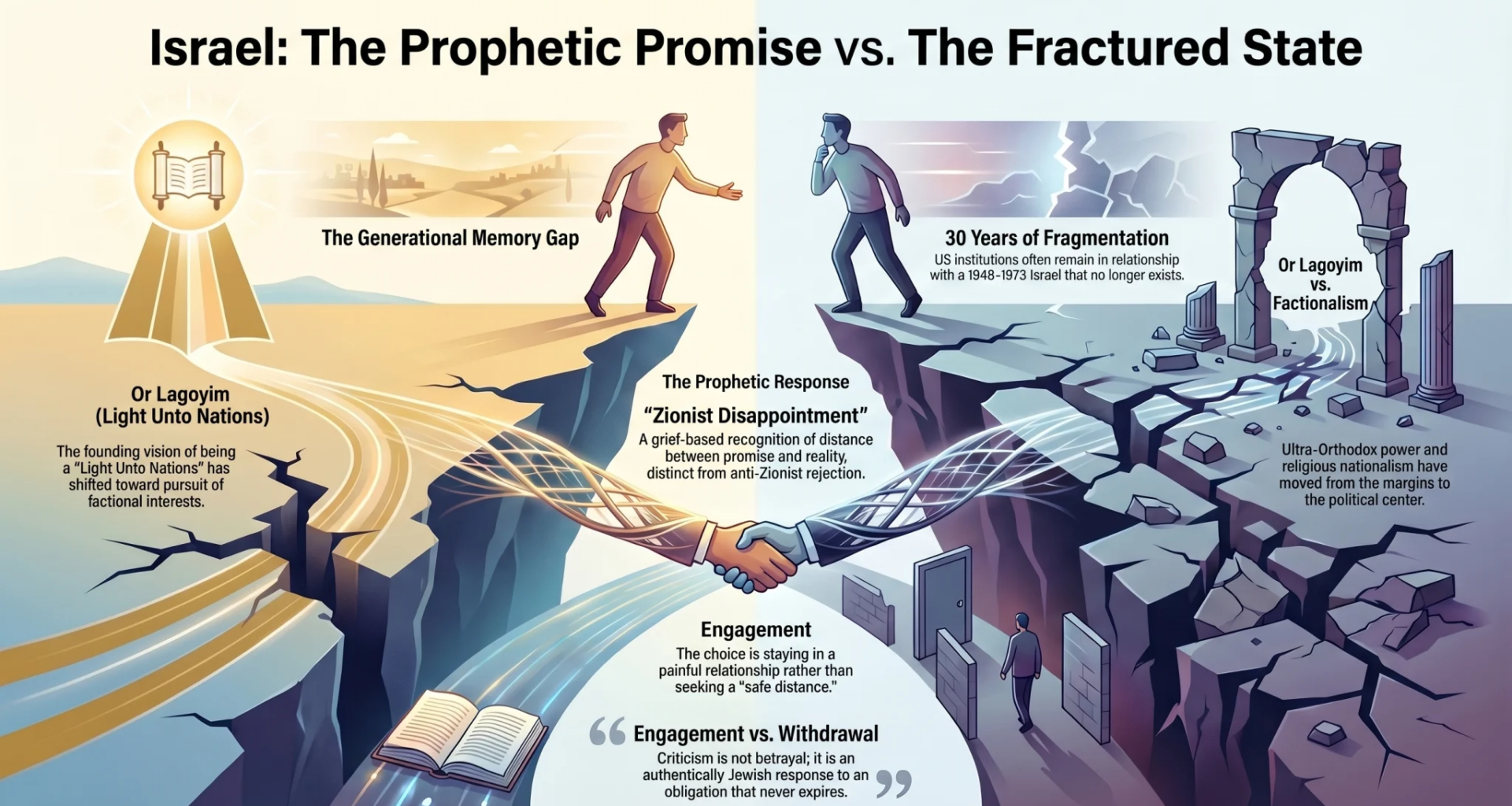
Not a theocracy. Not a utopia. But a nation that took seriously the ancient demand that Jewish collective life carry a moral vocation that ordinary nationalism does not. Or Lagoyim — a light unto the nations — was not a piece of liturgical decoration. It was a covenantal obligation embedded in the deepest layer of Jewish self-understanding. We knew, from the long history of prior Jewish commonwealths, how catastrophically Jewish political life could fail. The founders knew it too. The hope was that this time, informed by that history and forged in the furnace of the Holocaust, would be different.
For a generation, it appeared it might be.
The Trajectory
The Israel of the founding decades was deeply flawed, as all human enterprises are. Its treatment of Mizrahi Jews by the Ashkenazi Labor establishment was often condescending and discriminatory. Its relationship with its Arab citizens was complicated and frequently unjust. Its security needs drove decisions that compromised its values. None of this is forgotten or minimized.
But beneath the flaws there was a discernible trajectory — a shared national narrative about what Israel was ultimately for, beyond mere survival. Labor Zionism, for all its internal contradictions, carried a genuine moral seriousness. The kibbutz ideal, however romanticized in American Jewish memory, represented a real attempt to build collective life on principles of equality and shared purpose. The legal and cultural institutions of the early state reflected an aspiration, however imperfectly realized, toward a society that took justice seriously.
Yitzhak Rabin embodied this trajectory in its final significant expression. He was not a saint. He was a soldier, a pragmatist, and at times a hard man. But he represented the last major Israeli leader who held together the founding generation’s moral seriousness with the practical demands of sovereignty — who understood that Israel’s security and Israel’s soul were not separable questions. His assassination in November 1995 was not merely a political murder. It was the killing of a possibility.
The Fragmentation
What followed was not simply rightward political drift. It was the progressive collapse of any shared Israeli narrative about what the state was for beyond survival, security, and the pursuit of factional interest.
The fragments are familiar. The ultra-Orthodox community, whose founding generation largely opposed Zionism, has leveraged democratic politics into extraordinary institutional power — exemptions from military service, control of personal status law, massive state subsidies — while contributing minimally to the shared burdens of Israeli civic life. Religious nationalists have transformed the settler movement from a security argument into a messianic project that subordinates Israeli democracy to ideological land acquisition. Mizrahi political identity, carrying decades of legitimate grievance against Ashkenazi Labor condescension, has been channeled largely into a rightward politics of resentment that serves its leaders far better than its constituents. Russian immigrants, arriving without deep roots in either Zionist idealism or Jewish religious tradition, have added another layer of nationalist hardness.
The result is a coalition government that contains ministers who would have been considered beyond the boundaries of legitimate Israeli politics a generation ago — figures whose contempt for Arab citizens, democratic norms, and diaspora Jewish opinion is not incidental but programmatic. Ben Gvir and Smotrich are not aberrations. They are the visible expression of a fragmentation that has been building for thirty years, now fully arrived at the surface of Israeli political life.
The Disillusionment
American Jewish disillusionment with Israel is real, widespread, and growing — particularly among younger generations who did not inherit the founding generation’s visceral memory of what Israel’s existence meant and means. But it is important to be precise about what this disillusionment is and what it is not.
It is not, for the most part, anti-Zionism. The organized Jewish anti-Zionist left is real but remains a minority, however loud. What is far more widespread and far less ideological is something quieter and more painful: the grief of people who believed most deeply in what Israel was supposed to be, and who find themselves unable to recognize it in what Israel has become.
This is Zionist disappointment, not Bundist rejection. It does not question Israel’s right to exist. It grieves the distance between the promise and the reality. And it refuses both available comforts — the comfort of abandonment, which releases one from the burden of caring, and the comfort of uncritical defense, which requires one to pretend the fragmentation is not happening.
The disillusionment is also generational in a specific way. American Jewish institutions — federations, philanthropies, summer camps, Hebrew schools, Israel bonds — were built around a particular image of Israel, roughly the Israel of 1948 to 1973, and have been extraordinarily slow to update their emotional and political model. Many American Jews over 70 are still, in their deepest instincts, in relationship with an Israel that no longer exists as the dominant political culture. The Israel of Ben Gurion and Golda Meir, of the kibbutz and the Palmach, of Exodus and the Six Day War — this Israel lives powerfully in American Jewish memory and barely at all in contemporary Israeli political reality.
The gap between that memory and this reality is the source of the grief.
The Honest Reckoning
There is a harder question underneath all of this, and intellectual honesty requires asking it.
Was the prophetic expectation ever realistic? Sovereignty is heavy, and every nation that has attempted to institutionalize moral vision — including the biblical commonwealths that the prophets themselves were indicting in real time — has failed under the weight of actual power, internal division, and external threat. Amos, Isaiah, and Jeremiah were not describing a nation on a righteous trajectory. They were indicting one that had abandoned its vocation almost from the moment it achieved statehood. Perhaps the Or Lagoyim vision belongs more naturally to exile Judaism, stripped of the corruptions of power, than to a functioning state surrounded by enemies and managing the impossible complexities of a multi-ethnic, multi-religious democracy under permanent military threat.
Perhaps. But this concession cannot become a permission slip for abandoning the standard entirely. The prophets did not leave Israel because it failed. They stayed and indicted it, generation after generation, because the obligation did not dissolve with the failure. The tradition does not release Israel — or us — from the demand simply because the demand is hard.
There is also an uncomfortable truth about American Jewish expectations specifically. The Israel that American Jews loved was, in significant measure, a projection — an image shaped by distance, selective memory, and the particular needs of a minority community seeking pride and purpose in a country that was not its own. The kibbutz was more complicated than the romance. The founding generation’s treatment of those who did not fit the Ashkenazi Labor template was frequently harsh. The moral clarity of 1948 was real but partial.
American Jews loved a version of Israel that was always partly their own creation. The disillusionment is real, but it is also partly the disillusionment of people confronting the gap between a cherished image and a complex reality — a gap that was always there, even when it was easier not to see it.
Where This Leaves Us
Caught between uncritical defense and delegitimization, between nostalgia and despair, American Jews of my generation face a choice that has no comfortable resolution.
The choice is not between loving Israel and criticizing it. Those have never been mutually exclusive, and anyone who insists they are is asking for something the tradition itself does not require. The prophets were Israel’s most severe critics and its most devoted servants simultaneously. Criticism rooted in love and obligation is not betrayal. It is perhaps the most authentically Jewish response available.
The choice is rather between engagement and withdrawal — between staying in the difficult, painful, unresolved relationship with an Israel that disappoints us, and stepping back into a safe distance that protects us from the grief but releases us from the obligation.
For those of us formed by the founding promise, withdrawal is not available. The promise made Israel too important, too central to Jewish self-understanding, for disengagement to be honest. We are left instead with the prophet’s uncomfortable vocation: to stay, to care, to demand, and to grieve — not because we expect to be heard, but because the obligation does not expire when it becomes inconvenient.
Israel is not what we hoped it would be. It may never be. But it remains ours — in all its fracture, its failure, and its irreplaceable significance — and the demand that it be better does not diminish with our disappointment.
If anything, it grows.