
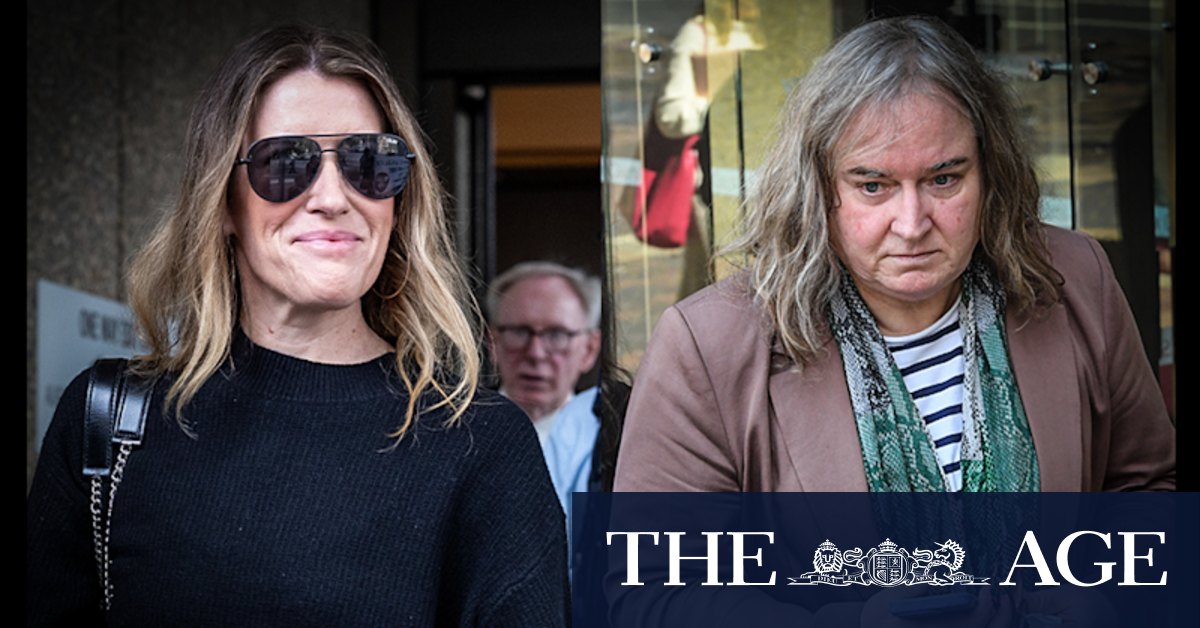
Grover has said she does not remember removing Tickle individually, as “thousands of men” had applied to join the community she designed as a safe space for those deemed female at birth. Tickle contacted Grover multiple times seeking readmission, the court has heard.
Loading
What is Giggle for Girls?
Screenwriter Grover worked in Hollywood from 2009 to 2018, during which time she reports that she experienced such intense sexual harassment that she required trauma therapy when she returned home to the Gold Coast.
Grover’s therapist told her she needed a “strong female support network” to assist in her healing, she has said, and after discussing this with her mother, the pair came up with the idea for a women-only social media app, Giggle for Girls.
The app’s vision was “to create an online refuge,” Grover’s lawyer has told the Federal Court: “It would be a place without harassment, mansplaining, d— pics, stalking, aggression.”
Grover has said she was not aware of the politics around transgender access to women-only spaces when she created her app, but that when it went live, she began receiving messages about being transphobic, threats of physical harm, and was spammed by large numbers of men wanting to join Giggle.
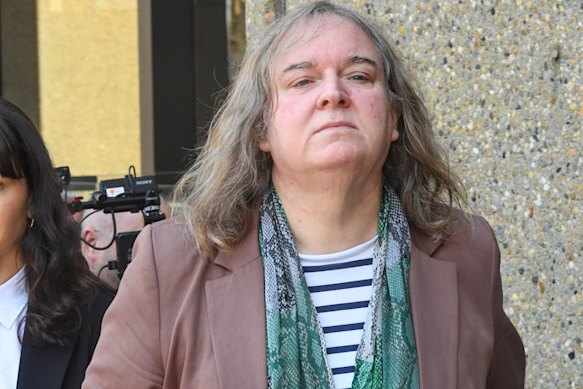
Roxanne Tickle leaves the Federal Court of Australia in Sydney in 2024.Credit: Peter Rae
How did the legal action start?
Roxanne Tickle made a complaint to the Australian Human Rights Commission (AHRC) in December 2021, stating that she was being discriminated against by Giggle because of her gender identity. Grover has told interviewers that she could not accept the commission’s proposed conciliation conditions.
Grover has stated that the terms included her attending gender education, paying Tickle $20,000, allowing trans women to join Giggle, and moderating content to exclude comments that could be offensive to trans people.
Loading
The AHRC concluded there was no reasonable chance of the complaint being resolved at conciliation, opening the way for Tickle to take her case to sue Giggle to the Federal Court of Australia.
The Federal Court case
Judge Robert Bromwich heard the case Roxanne Tickle v Giggle for Girls Ltd in August 2024, the first time the Federal Court had heard an action alleging gender identity discrimination. It was described as testing the meaning and scope of the Sex Discrimination Act.
Tickle’s lawyer, Georgina Costello, argued that “gender is not merely a biological question, it is partly social and partly psychological”.
“Ms Tickle was assigned male gender at birth, but she has changed to being a woman and that fact is clear in this case,” she said. Tickle argued Giggle discriminated against her directly and indirectly.
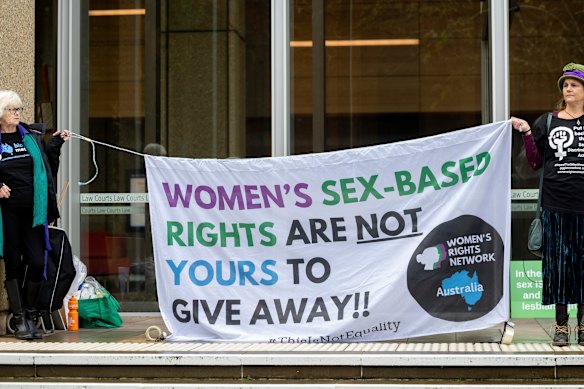
Representatives from the Lesbian Action Group and Women’s Rights Network Australia outside the Federal Court in August 2024.Credit: Sitthixay Ditthavong
Grover’s lawyers argued that the app’s exclusion of trans women was a “special measure” under the Sex Discrimination Act, a concept allowing for discrimination in circumstances aimed at addressing the historical disadvantage of a group. Creating Giggle was a measure to provide a safe place online for women, recognising that they experience unique challenges and discrimination.
Grover’s argument was reported as hinging on the interpretation of the term “woman” within the Sex Discrimination Act as relating to sex assigned at birth rather than gender identity.
Much of the proceedings, in which Tickle was claiming $200,000 in damages, centred around what constitutes a woman under Australian law, and whether someone’s sex can be changed.
Loading
Tickle wins the case
Justice Bromwich found Roxanne Tickle had been discriminated against indirectly, and awarded her $10,000 in damages, in what was described as a historic victory.
He said, “the acceptance that Ms Tickle is correctly described as a woman … is legally unimpeachable”, and that sex may take into account biological and physical characteristics, legal recognition and how people present themselves and are recognised socially.
But Bromwich also found that for direct discrimination to have been proven, it would need to have been proven that Giggle was likely aware of Tickle’s gender identity and dismissed its legitimacy.
Loading
The facts suggested the decision to exclude her was a “quick or reflexive choice” based on Giggle’s condition that members of the app appear as cisgendered females in selfies (cisgendered means people whose gender identity aligns with their assigned sex at birth). Bromwich awarded Tickle $10,000 and legal costs capped at $50,000.
Giggle and Tickle both appeal
Giggle for Girls and Sally Grover, and Roxanne Tickle, appealed Justice Bromwich’s finding before the full court of the Federal Court of Australia in Sydney, from August 4 to 6.
Grover and Giggle are appealing against the $10,000 damages, arguing that Tickle was not discriminated against, even indirectly, because Grover did not know Tickle was transgender when she was barred. Tickle is seeking higher damages of $40,000, with her lawyer suggesting that direct discrimination better describes what occurred.
Noel Hutley SC, for Grover, told the court a woman was someone assigned female at birth – or “natal woman” – and that just about any special measure in the Sex Discrimination Act targeted at one group would probably involve discrimination of another group. He said special measures should be protective and enabling, not restrictive.
Grover’s side argued the Sex Discrimination Act bears the “ordinary” definition meaning of men and women.
But Celia Winnett, barrister for the Sex Discrimination Commissioner acting as a friend of the court, said the definition of women includes transgender women. “‘Woman’ does now have a broader ordinary meaning … informed by its use” and is “broad enough to include trans women”, she said.
The Guardian reported that Ruth Higgins SC, for Equality Australia, told the court that transgender people experienced unique forms of identity discrimination, and that “sex” included social recognition and personal identification. “Sex is a way of classifying people along a scale between a man at one end and woman at the other,” she said.
“Sex at birth is but one conception of sex,” said Higgins, and a purely biological definition relied on a false simplicity.
Justices Melissa Perry, Geoffrey Kennett and Wendy Abraham are expected to deliver their finding in February.
The Morning Edition newsletter is our guide to the day’s most important and interesting stories, analysis and insights. Sign up here.