
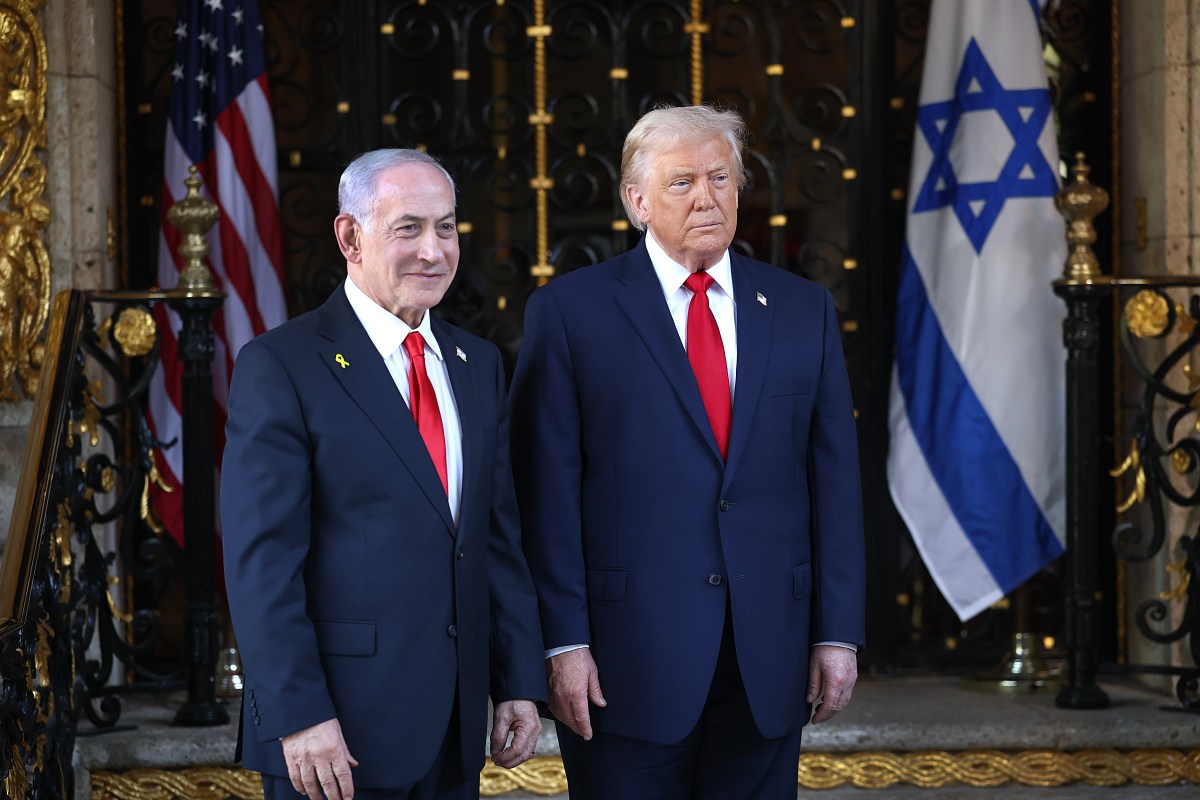
President Donald Trump signaled a deepening rift with Israeli Prime Minister Benjamin Netanyahu by claiming “there would be no Israel” without him in a stinging rebuke at the G7 (Group of Seven) summit.
Trump has displayed increasing frustration with his ally in recent weeks as the United States attempted to strike a peace deal with Iran, before an agreement was eventually reached on Sunday. Trump and Netanyahu ordered joint United States and Israeli strikes on Iran on February 28 with the stated aim of destroying the Islamic Republic’s ability to make a nuclear weapon.
Speaking alongside Qatar’s Emir Sheikh Tamim bin Hamad Al Thani, at the summit of the world’s biggest economies in Évian-les-Bains, France, Trump said: “Without the United States, there would be no Israel. Without me, there would be no Israel, because no other president was willing to do what I did.”
Read More on World
“Israel would have been blown up a long time ago, had I not gotten involved,” said Trump, although he denied frustration with Netanyahu, saying the two had “a great relationship,” but he criticized a recent Israeli attack in Lebanon and said too many civilians were being killed.
Referring to an unspecified Israeli strike, Trump said: “I saw that attack, I saw where that bomb went. That was vicious.” Trump said as he also warned Netanyahu to be “more responsible” with respect to Lebanon.
Lebanon a Sticking Point for Iran Deal
Israel has faced international condemnation for strikes on Lebanon, which became embroiled in the Iran war on March 2 after Hezbollah fired rockets into northern Israel in support of the group’s backer, Tehran. The death toll in Lebanon has risen to 3,798 killed and 11,781 wounded, according to the country’s Ministry of Public Health. Israel now occupies a swathe of southern Lebanon where more than one million people have been displaced.
The conflict in Lebanon presents an obstacle to the framework agreement in the Iran war. Tehran, Hezbollah’s main backer, said any new Israeli strikes on Lebanon and further occupation of the country would violate the agreement.
Trump said Tuesday that Lebanon has been “treated the worst” out of “all countries” as they “can’t defend themselves” as they deal with Hezbollah, which the government in Beirut cannot control.
He added that Israel had been “fighting Hezbollah for too long, and too many people are being killed.”
“You don’t have to knock down an apartment house every time you’re looking for somebody because there’s a lot of people in those apartment houses and they’re not all Hezbollah, that I can tell you,” he added.
Iranian Foreign Minister Abbas Araghchi said if Israel remained in southern Lebanon, the deal would be violated, meaning “the war “has not fully come to an end.”
But Israeli Defense Minister Israel Katz has said that Israeli troops would stay due to the threat posed by Hezbollah, and Netanyahu said Monday that Israel would remain in Lebanon “as long as necessary.”
Given that a U.S. official said the deal did not call for an Israeli withdrawal from Lebanon, disagreements remain over the terms of the memorandum of understanding (MOU) ahead of its scheduled signing on Friday.
Hezbollah told Reuters on Tuesday that Iran had said it would demand a withdrawal of Israeli troops, which would be the result of, and not a precondition for, continuing talks between Tehran and Washington. Hezbollah said there would be “no nuclear deal between Iran and the United States unless the Israelis withdraw” from Lebanon.
Anger in Israel at Deal
The reports of a deal between Iran and the U.S. have been greeted with dismay in Israel, with Netanyahu in the firing line ahead of elections.
Netanyahu has said that he would continue to fight to stop Iran from getting a nuclear weapon, which had been a professed war aim from both Israel and the U.S., but the lack of details over the plan has raised concerns that Tehran emerges with the upper hand.
Brigadier General Yossi Kuperwasser, head of the Jerusalem Institute for Strategy and Security (JISS), told Newsweek the U.S. administration “is giving everything away for cheap, providing the regime with billions of dollars to strengthen its domestic grip and continue funding its proxies, like Hezbollah and Hamas, without demanding real, irreversible concessions in return.”