
Sign up for the Slatest to get the most insightful analysis, criticism, and advice out there, delivered to your inbox daily.
INGLEWOOD, California—As I arrived at Monday’s Group G World Cup match between Iran and New Zealand, the first thing I saw was a group of about 50 demonstrators standing on a corner outside a choked traffic checkpoint holding up signs decrying January’s mass slaughter of protesters in Iran by the Islamic republic’s government: “40,000 people murdered in two days,” the sign declared. An accurate count is not known, but at least 7,000 citizens were butchered by their government in an incredibly brief span just five months ago, to little account.
As hundreds of happy Iran soccer supporters—almost certainly opponents of the regime themselves—walked by, the loudest protester shouted, “You’re going to cheer terrorists! Good for you!”
The cry honestly sounded tinged with jealousy. The Iranian soccer team is one of the best in world soccer and has historically been beloved both in Iran and among the large Iranian diaspora that hates the regime for which the team plays. This previously unifying force, though, had become a lightning rod prior to this week’s game, with boycotts and protests promised following the horror of January.
The question ahead of this match, for all Iran fans, was: Is it OK to cheer this team?
Inside Los Angeles Stadium on Monday—in a town that is home to 230,000 Persians, the largest Iranian diaspora in the world—the answer was very much yes, as the team played to a 2–2 draw in one of the most unexpectedly thrilling games of the World Cup, cheered on by a crowd of 70,000, most of them Iran fans. The soccer was very, very fun.
What those fans witnessed was fantastic and wholly unexpected. The chatter before the game was that New Zealand was the worst team in the tournament—ranked dead last among the field at 85th in the FIFA World Ranking, behind such minnows as Cabo Verde and Curaçao—and that the contest against 20th-ranked Iran should not be close or interesting. Instead, New Zealand rose to the moment and nearly achieved the upset and a first-ever World Cup victory, while Iran struggled in defense for the entirety of the game before pulling off two comebacks to earn the point.
Team Iran, to be fair, had contended with more than any other side in World Cup history. Its domestic league was suspended in March due to the American–Israeli war against Iran, as most players have missed months of match play. For a long time, it was unclear whether the team would attend this World Cup, with the Iranian federation threatening to boycott and U.S. authorities threatening not to allow the team into the country. Even when the visas were granted, they were limited to two days at a time and excluded many team staffers. After the team’s base camp was moved from Tucson, Arizona, to Tijuana, Mexico, the visa situation required the team to travel across the border the day before match day and back to Mexico immediately after the game. On top of it, the Iranian federation left one of its best players, Sardar Azmoun, off the roster due to perceived “disloyalty” to the regime. In a prematch press conference, manager Amir Ghalenoei disingenuously shrugged off the exclusion, comparing it to Neymar missing the early phase of the tournament due to injury.
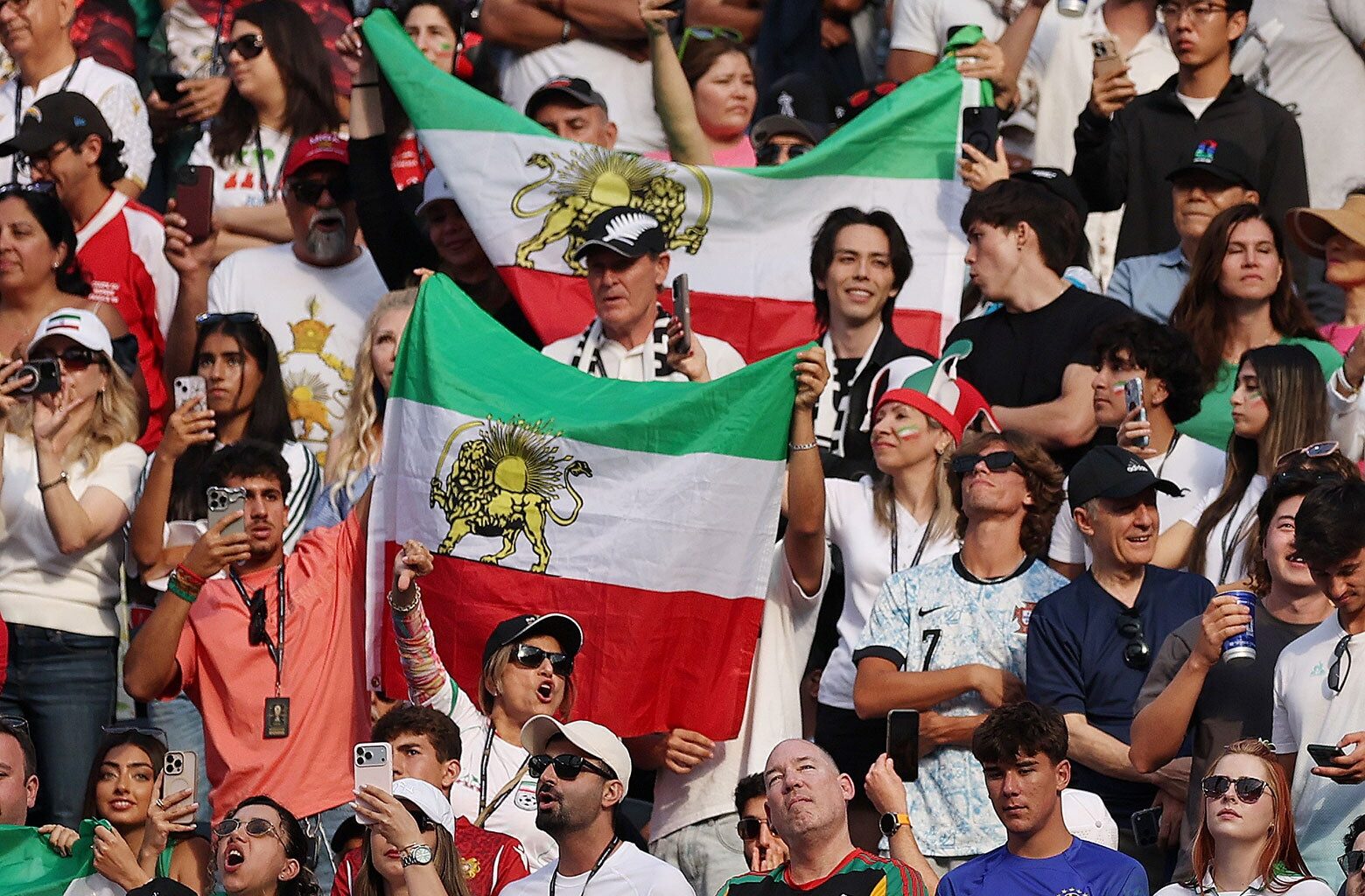
On top of it all, when game day finally arrived, many of the team’s fans booed Iran’s national anthem. And although many said they would boycott, the fans who did show up in the tens of thousands staged their own form of microprotest, with attendees holding up the “Lion and Sun” flag of the previous Iranian regime that had been officially banned by FIFA as overly “political.” Despite seeing a few desperate attempts by match stewards to get fans to put their flags away, they mostly remained in the stadium and were waved visibly during the match’s biggest moments.
Oh, and until Sunday’s peace deal, this would have been the first-ever World Cup match in which the host country was at war with one of the competing teams.
So the Iran squad, despite its heavily favored status, was not without its challenges.
Still, at the whistle, the Iranians came out as if none of that mattered and they wanted to win the entire tournament in the first five minutes. They perhaps emerged too hot. Despite wave after wave of initial early attack by Iran, 26-year-old New Zealand winger Elijah Just scored one of the best link-play goals of the tournament. In just the seventh minute, after a fantastic back-and-forth with star Premier League striker Chris Wood, he opened the scoring to the utter shock of the crowd.
At that early point, it seemed as though all of Iran’s tribulations might get the better of the team, with New Zealand dominating over the next 15 minutes and nearly scoring a second goal a number of times, including one absolute sitter for Wood right in front of a goal that the Iranians just barely managed to clear.
Then, in the 23rd minute, the crowd exploded as Iran captain Mehdi Taremi, a striker for Olympiacos in the Greek first division, nearly scored on a phenomenal outside strike but just hit the right bar.
The crowd returned in full force after that effort and after the momentum once again shifted back to the Iranians, who nearly earned a penalty and then came close to scoring on a wide-open goal after an error by All Whites goalkeeper Max Crocombe left the net unguarded.
It was a windy and relatively chilly evening in the stadium, below 70 degrees for much of the match, and the two-and-a-half-minute hydration break felt even more unnecessary than usual, coming almost immediately after a long period of injury stoppage. As a cameraman with one of the official World Cup broadcasters put it to me, these breaks were clearly about “more money for FIFA: more beer, more soda, more business.” Less soccer, was my immediate thought, as these breaks have consistently broken up the momentum of the game and of whichever team had been getting the better of the match.
This was not the case for Iran. When play resumed, the team got its breakthrough equalizer, as Ramin Rezaeian poked the ball in right past Crocombe off a rebound from striker Shahriyar Moghanlou.
These two early goals set the pace for the entire match, which went back and forth with both sides having a number of very good chances throughout. Right before halftime, Iran seemed to take the lead off a free kick into the box headed beautifully into the net by Iran defender Ali Nemati. The crowd exploded more than at any prior point in the match, but Nemati was clearly offside, and the goal did not count.
New Zealand took the lead back early in the second half, with Just scoring a beautiful second after another fantastic one-two with Wood. Mohammad Mohebi scored another equalizer just nine minutes after that New Zealand goal, with a beautiful header into the side of the net off a gorgeous long ball into the box by the previous goal scorer, Rezaeian. The rest of the match was on a total knife’s edge, with both sides having chances to steal it in injury time, before ultimately ending in a 2–2 draw.
Again, it was one of the most thrilling matches of the tournament so far, if not the best. And this was not a given coming into the game, particularly considering the outside drama that seemed to envelope Iran’s squad. Prior to the match, Tarebi complained of having “felt the tension from the first moment you arrived at this World Cup.”
“This kind of tension, it undermines that joy, and it undermines the message of FIFA and our people, that is about football that brings about peace,” he added. “I think this World Cup could have provided a better atmosphere than it had.”
After the match—a joyous celebration of Iran’s team by Iran’s enormous diaspora—Tarebi seemed to view things a bit differently, expressing gratitude toward the fans, even as he displayed bitter disappointment at the hosts for forcing the team to travel back to Mexico that very night. Coach Ghalenoei, in his own postmatch press conference, described Iran as “the most oppressed team in the whole World Cup.” Still, it was impossible not to be grateful to Southern California’s Iran fans, who showed up in full force, tens of thousands strong.
“I want to mention our supporters in Los Angeles—it was an incredible atmosphere during the game, all 90 minutes, and it was like home for us,” Tarebi said. “I hope they are doing the next two games the same thing.”
Given the controversy around this team and the criminality of this regime, which won’t be going away anytime soon, Iran supporters will continue to wrestle with whether to provide that support over the next two games.
Before the game, I spoke with two members of the Persian diaspora on opposing sides of the question. Fred Parvaneh, the social media director of the English-language Iranian site Kayhan Life, was planning to attend the game with his sons and cheer for Iran. “I keep sports and politics very separate,” he told me.
Parvaneh had posted something to this effect on his personal Instagram page:
I have a bone-deep, burning hatred for the Islamic Republic and the wreckage it has inflicted on my family, my friends’ families, and generations of Iranians robbed of their lives and futures. That hatred is real and it is not going anywhere. But these athletes are not the regime, and anyone who cannot tell the difference has a serious problem.
This sentiment had received enormous backlash, and he had had to turn off comments on the post. In our conversation, Parvaneh blamed the exiled son of the shah, Reza Pahlavi, for the backlash against the team this year. He noted that Pahlavi had previously been an Iran national team supporter but argued that he turned against the team this year for political gain. “All the people that are monarchists that support the old regime, they follow whatever he is says, so now they’re all in an uproar,” he told me, derisively calling Pahlavi “an ex–soccer fan.”
After speaking with Parvaneh, I talked to another ex-fan, who asked to be identified only by her former name, Sara, because she still has family and property in Iran and worried about retribution from the government for speaking out.
Sara immigrated to the United States when she was 20, after leaving the Islamic faith and after learning that a girl two blocks from her university had been killed in the street by authorities after an argument over her hijab.
Jeremy Stahl
Is the World Cup Ruined? We Already Have Our Answer.
Read More
It’s Incendiary. It’s All Too Common. It’s One of the Most Annoying Cop-Outs on TV.
Is the World Cup Ruined? We Already Have Our Answer.
The Most Surreal Part of the Knicks’ Triumph Came the Day After
She understands Parvaneh’s criticism of Pahlavi’s expediency but said that after the massacre in January, there was no way she could support this team. This is especially difficult for her, she says, because she comes from a big soccer family—her father, who remained in Iran after she left home, followed the team nearly everywhere it went for years. Sara says the athletes are in an understandable bind.
“They cannot speak freely. They cannot express freely because their family will be under a lot of pressure,” she said. “But at the same time, we can’t just choose convenience over principle when it matters. Sometimes we have to say no.”
Sara sees the January crackdown as that no moment and feels that Iran should have been kicked out of this World Cup, the way Russia was disqualified from international competition following its invasion of Ukraine.
Still, her brother and nephew will be traveling all the way from Chicago for the next match at Los Angeles Stadium on Sunday, against favored Belgium. Sara says she thinks that they plan to wear Belgium uniforms and cheer for that team, despite her family’s longtime support of the Iran team.
If Sunday’s game is anything like Monday’s, it’s going to be very hard for them not to switch sides right back.
Get the best of movies, TV, books, music, and more.