
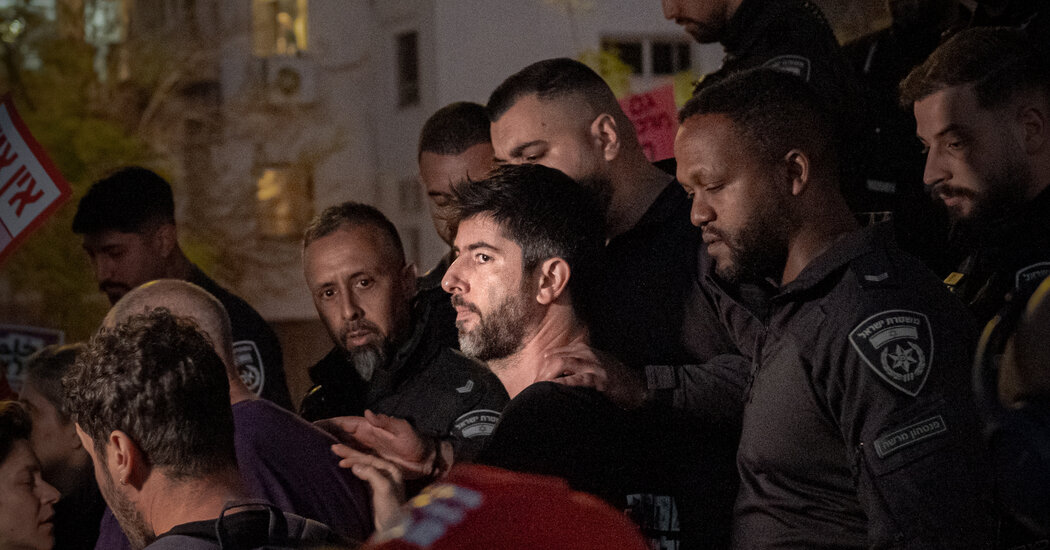
Standing Together has also worked to embolden Palestinian citizens politically. An estimated 75 percent of Palestinian citizens of Israel ages 18 to 25, as well as about 60 percent of Palestinian women overall, said they did not plan to vote, according to a 2025 survey by the pollster Yousef Makladeh. Sally Abed, a Palestinian leader of Standing Together who is also on the City Council in the Israeli city of Haifa, says one of the goals of the new party is to reach those Palestinian citizens. “They want to see themselves represented in politics,” Ms. Abed said.
Mr. Green says Israel needs a new political party that sets out a clear path to offset the right’s explicit policies of — as he described it — “destruction, ethnic cleansing in Gaza and the West Bank and even territorial expansion in Syria and Lebanon.” Mr. Green criticized the center and left parties for continuing to manage the conflict and evade or stave off the Palestinian issue. “We are at a historical juncture: Jewish and Palestinian citizens need to be offered a decisive plan that champions life, equality and Israeli-Palestinian peace,” he said.
For many in Israel, the coming election, expected to be held in early fall, is shaping up, once again, to be a referendum on Benjamin Netanyahu. Will Israel vote out its longest-serving, domineering prime minister, the one who presided over the country during the deadliest attack in its history on Oct. 7, and who has since kept it in a constant state of war and failed to deliver either victory or security? Despite many Israelis’ dissatisfaction with and distrust of Mr. Netanyahu, at best, and their detestation of him, at worst, polls show voters still don’t see anyone more suitable to lead the country. His political survival, whether he manages it by cobbling together enough votes to form another coalition or by blocking the opposition from doing so, is entirely plausible.
The driving forces behind the opposition’s inability to unseat this unpopular leader are intertwined. One is the fact that on core issues regarding the Palestinians and Iran, opposition parties aren’t offering an alternative to the status quo. The other is the refusal by almost all Jewish Israeli parties to consider a coalition with Palestinian Arab parties, at least publicly. This, too, is an extension of the consistent exclusion of the Palestinian minority from political and civic spheres in Israel.
Israeli political polling is a stark illustration of the problem. In most mainstream polling, voters are funneled into three distinct groups: those who support coalition parties, those who support opposition parties and “the Arabs.” But Arabs, who make up 20 percent of the population, are just as politically diverse and fragmented as Israeli Jews. Thus a key division in Israeli politics runs along ethnic and national lines, rather than civic or policy lines.