
Leaders at the G7 summit yesterday threw their support behind US President Donald Trump’s tentative agreement with Iran to open the Strait of Hormuz and further extend a shaky ceasefire — even though he has offered scant detail about how that would be implemented.
In a declaration issued overnight, the leaders called the deal a “historic opportunity to prevent Iran from acquiring any nuclear weapon and tackling the threats related to its regional and ballistic activities.”
The leaders said that they were “ready to contribute to its implementation,” although neither the White House nor Iran has released the text of the agreement.
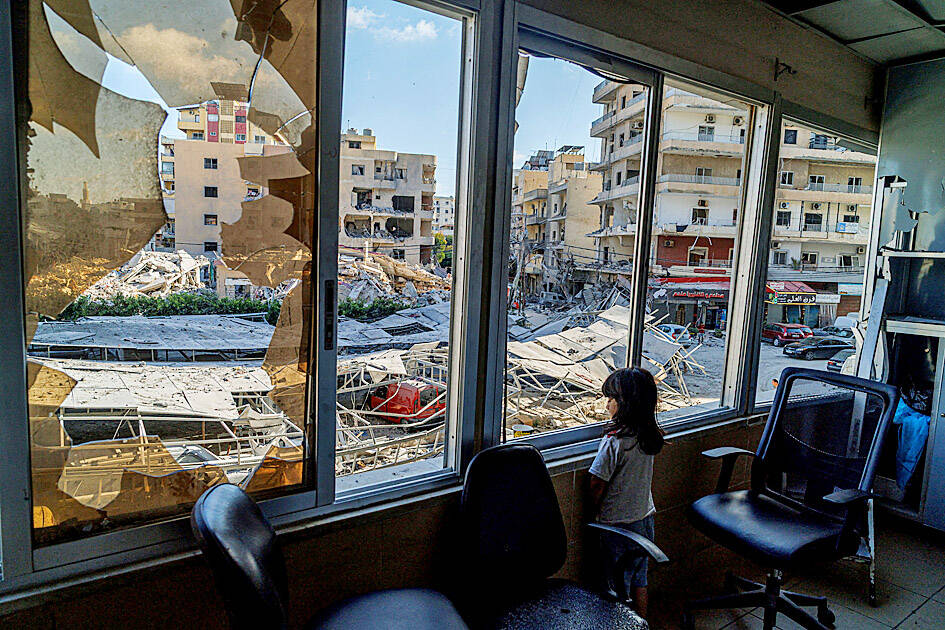
Photo: Reuters
According to leaked copies of an interim agreement, Iran would immediately take steps to reopen the Strait of Hormuz once the deal is signed and would be allowed to sell its oil without restrictions.
Officials say the leaked text broadly matches the document.
The accord, due to be formally signed in a ceremony in Switzerland tomorrow, lays out that the US would work to end all US and UN sanctions imposed on Tehran if a final agreement addressing Iran’s nuclear program is reached.
However, Trump said the deal is still under wraps. He was speaking at a one-to-one meeting with Egyptian President Abdel-Fattah al-Sisi.
“Nobody knows what it is, but it’s very strong,” he told reporters. “It’s a memorandum of understanding, and if I don’t like it, we’ll go back to shooting at them, dropping bombs.”
The final day of summit talks started late with Trump, the last to arrive, saying: “I’m the boss” as he entered the room and sat next to host French President Emmanuel Macron.
The assembled leaders laughed, and Trump grinned.
In related news, Israeli forces yesterday carried out airstrikes on several areas in south Lebanon, state media reported, despite a peace deal in the Middle East war that includes Lebanon.
Lebanese National News Agency said Israeli warplanes launched raids targeting the Nabatieh al-Fawqa area and the eastern outskirts of neighboring town Kfar Tebnit.
The Israelis also launched a drone strike on the town of Ansariyeh in the Zahrani area, it reported.
While violence has declined in Lebanon since a US-Iran agreement to end the Middle East war was announced on Monday, Israeli strikes on the south have still killed at least five people since the deal, the news agency reported.
The reduction in violence has allowed some south Lebanon residents to return and inspect their towns and villages, but the Lebanese army has urged locals to delay their return, citing “the risk of Israeli violations and attacks.”
Iranian Minister of Foreign Affairs Abbas Araghchi said on Tuesday that an end to the conflict would be incomplete “without the withdrawal of Israeli forces from the territories it occupied in this war.”
“Any military attack by the Zionist regime on Lebanon from now on and the continued occupation of Lebanese territories from now on will be considered a violation of the memorandum of understanding in our view,” he said.
However, Israeli Prime Minister Benjamin Netanyahu said on Monday that his country’s forces would remain in Lebanon “for as long as necessary.”