
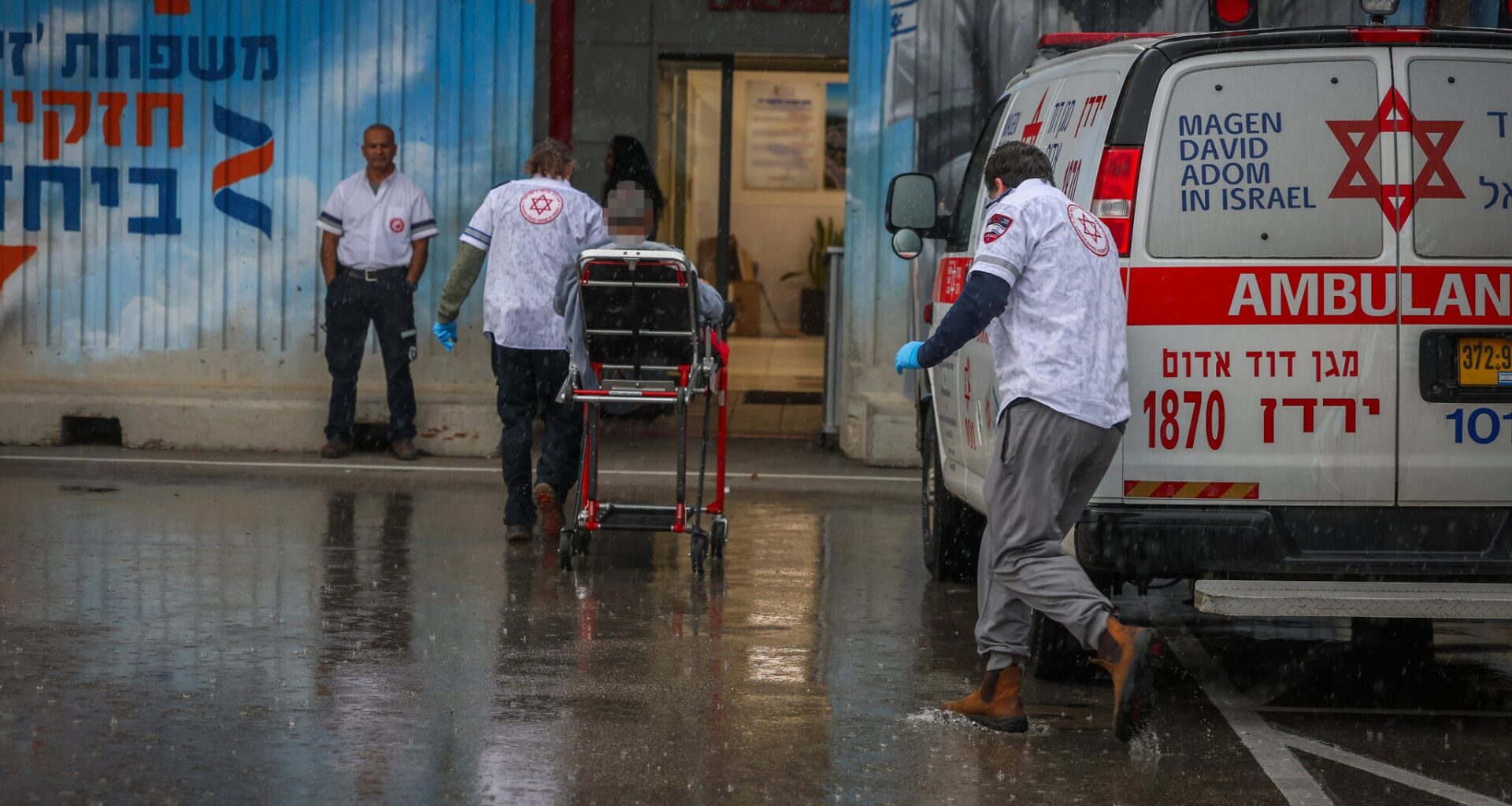
At least three Hezbollah terror operatives captured during Israel’s recent round of fighting with the Iran-backed group received medical treatment at Ziv Medical Center in Safed, where they were held under IDF guard while receiving care, two sources with direct knowledge told The Times of Israel.
The same northern hospital has also recently treated a young Syrian Druze civilian from the village of Hader, near the Israeli-Syrian border, who was accompanied by her mother, according to a separate source, also with direct knowledge.
The cases — which the IDF and Ziv hospital did not deny — raise questions regarding Israel’s military and humanitarian medical policy, as well as domestic controversy over treating enemy fighters inside civilian hospitals.
According to the sources, the Hezbollah terrorists were treated at Ziv roughly two weeks ago, and kept handcuffed and blindfolded in a room guarded by IDF soldiers.
The treatment of Hezbollah operatives in a civilian hospital would be an apparent contravention of a Health Ministry decision, made shortly after Hamas’s October 7, 2023, onslaught, that captured terrorists would only be treated in the medical facilities of the IDF or the Israel Prison Service — though that decision has reportedly been contravened before, and focused mainly on Hamas terrorists in the aftermath of the massacre.
Get The Times of Israel’s Daily Edition
by email and never miss our top stories
By signing up, you agree to the terms
The IDF Spokesperson’s Office did not deny the sources’ accounts. In a written response to The Times of Israel, it said that over the past year, it had arrested individuals suspected of involvement in terror activity against Israeli civilians or troops, and that detainees requiring medical care receive it from IDF medical personnel or, when medically necessary, are transferred to hospitals.
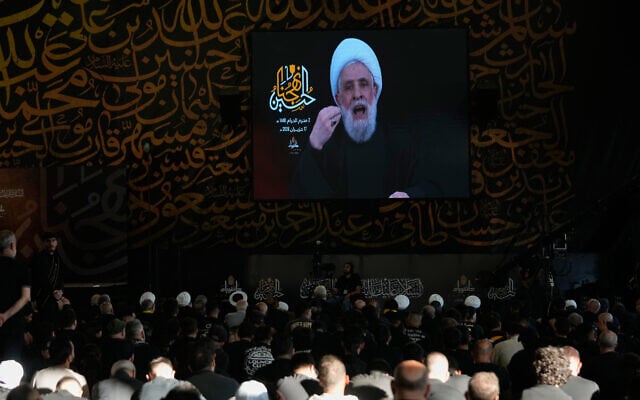
Hezbollah leader Sheikh Naim Qassem, is seen on a screen during a sermon marking the first day of Ashoura, at the grave of late Hezbollah leader Sayyed Hassan Nasrallah, left, in Beirut, Lebanon, June 17, 2026. (AP Photo/ Hussein Malla)
Ziv Medical Center also declined to confirm the details to The Times of Israel, citing medical confidentiality, privacy, and security considerations, but did not deny that such patients had been treated there. The hospital said it operates according to law, state directives, and medical ethics, and provides care to anyone brought to it whose medical condition requires treatment.
The Health Ministry did not respond to a request for comment.
Treated as required, guarded ’24/7′
In its response, the IDF said that “as part of the IDF’s effort to maintain security,” various security operations were carried out over the past year, “including the arrest of individuals suspected of involvement in terrorist activity against Israeli civilians or IDF forces.”
Such suspects, the military said, are taken for “further questioning, screening, and detention at a designated facility inside Israel.” It added that arrests in the field and detention inside Israel are regulated by Israeli law and IDF orders.
Israel’s Incarceration of Unlawful Combatants Law allows a person to be held in detention when there is a reasonable basis to believe the person participated directly or indirectly in hostilities against Israel, or belongs to a force carrying out hostilities against Israel, and when their release could endanger state security.
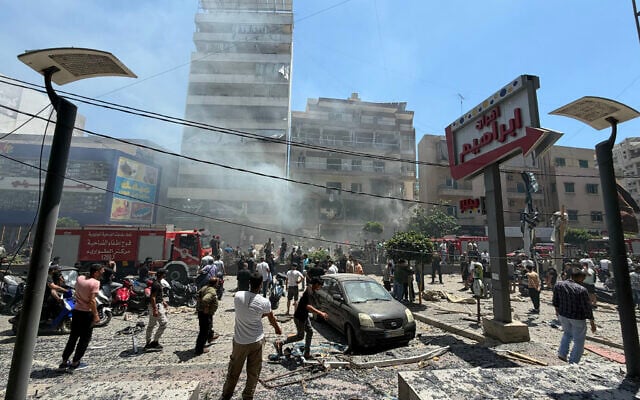
The aftermath of an Israeli airstrike that targeted Hezbollah at a building in Beirut’s southern suburbs on June 14, 2026 (Ibrahim AMRO / AFP)
“Throughout the period of detention, medical supervision is provided as needed and in accordance with legal obligations, and regular medical examinations are conducted,” the military said, adding that “detainees who require medical treatment receive care from certified medical personnel in the IDF, and in certain cases, when required according to medical need, they are transferred to hospitals for further treatment.”
In such cases, there are “24/7 security and oversight mechanisms in place to ensure the detainees pose no safety risk” to surrounding civilians, the IDF said.
In the case of the Syrian civilian, the IDF said it “provides life-saving medical assistance to Syrian civilians, in accordance with a policy determined in advance by the political echelon and coordinated with all relevant bodies.”
The IDF appeared to be referring to Israel’s longstanding, politically approved policy of providing humanitarian medical assistance to Syrian civilians in exceptional cases — a practice that began during the Syrian civil war under Operation Good Neighbor, was formally wound down in 2018, and has resurfaced in a more limited form after recent incidents of violence against Druze populations across the Syrian border.
Hader, the Druze village on the Syrian side of the Golan from which the young woman and her mother were said to have come, has been closely watched by Israel’s 150,000-strong Druze community, which has pressed Israeli authorities to protect Syrian Druze there.
Israel has at times used medical care as a tool of humanitarian outreach with neighboring countries. The Times of Israel revealed in December that Israel is advancing a plan to develop a hospital on its territory to treat Jordanian patients, as part of a joint Israeli-Jordanian industrial park along the border of the two countries.
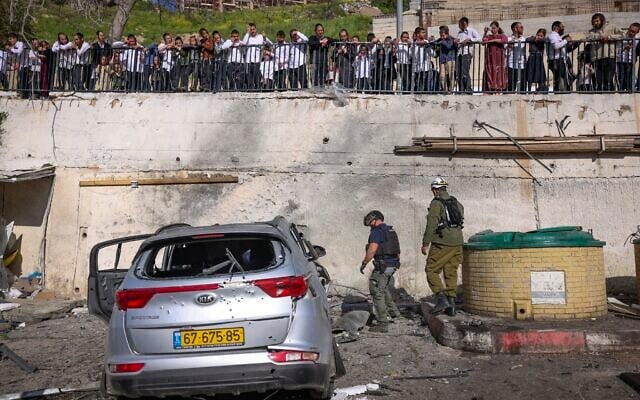
Civilians and security forces at the scene where a missile fired by Hezbollah from Lebanon struck a parking area in Safed, causing heavy damage, April 10, 2026. (David Cohen/Flash90)
Hospital stresses ‘medical ethics’
Safed’s Ziv Medical Center is the main hospital serving much of the Galilee and Golan region.
In its response, the hospital said it “operates in accordance with the law, the directives of state authorities, and the principles of medical ethics that bind every medical institution in Israel.
“The hospital provides medical care to any person brought to it when their medical condition requires it, regardless of their identity, religion, nationality, or the circumstances of their injury,” the response read.
The hospital declined to address details of any patients it has treated “for reasons of medical confidentiality, protection of patients’ privacy, and security considerations.”
The hospital did not respond directly to questions on whether staff members had objected to treating Hezbollah terrorists, whether patients nearby were informed, or whether there had been requests to transfer such patients to a military medical facility.
Asked specifically whether civilian medical staff are required to treat enemy fighters, the IDF and Ziv said the question should be referred to the Health Ministry, which oversees civilian hospitals. The ministry did not respond by publication time.
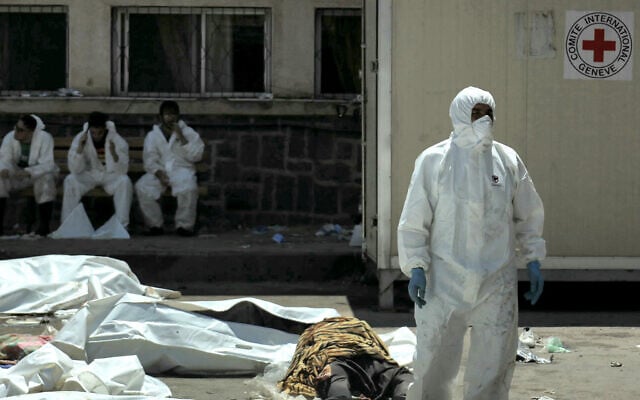
A medical worker walks past body bags containing people killed during sectarian violence in southern Syria’s predominantly Druze city of Sweida, outside Sweida National Hospital on July 20, 2025 (Shadi al-Dubaisi/AFP)
The Israeli Medical Association, however, has explicitly stated that Israeli doctors treat all human beings regardless of their actions, and that even captured Hamas terrorists receive necessary care according to medical need.
Such policies also carry an international dimension, as Israeli officials have at times pointed to Israel’s treatment of captured or wounded enemy fighters as evidence that it operates in accordance with the laws of war, even against terrorist organizations that deliberately target civilians.
We can’t do this work alone.

The war with Iran has been draining for all of us in Israel. But when I heard about a high casualty incident – ballistic missile impacts in Arad and Dimona that left nearly 200 people wounded – I drank a cup of coffee, packed a bag, and headed south.
There, I spoke with Shilgit, the head of an after-school program for underprivileged youth. Standing outside her destroyed center, Shilgit said it was a miracle that no children were hurt and spoke about the community coming together in the hours since.
As a Times of Israel reporter, I’m committed to telling stories of resilience like Shilgit’s. But my colleagues and I can’t do this alone. If you value work like this, please consider joining our reader support group, The Times of Israel Community. Your financial support is essential to keep real human reporting like this going.
— Stav Levaton, military reporter