
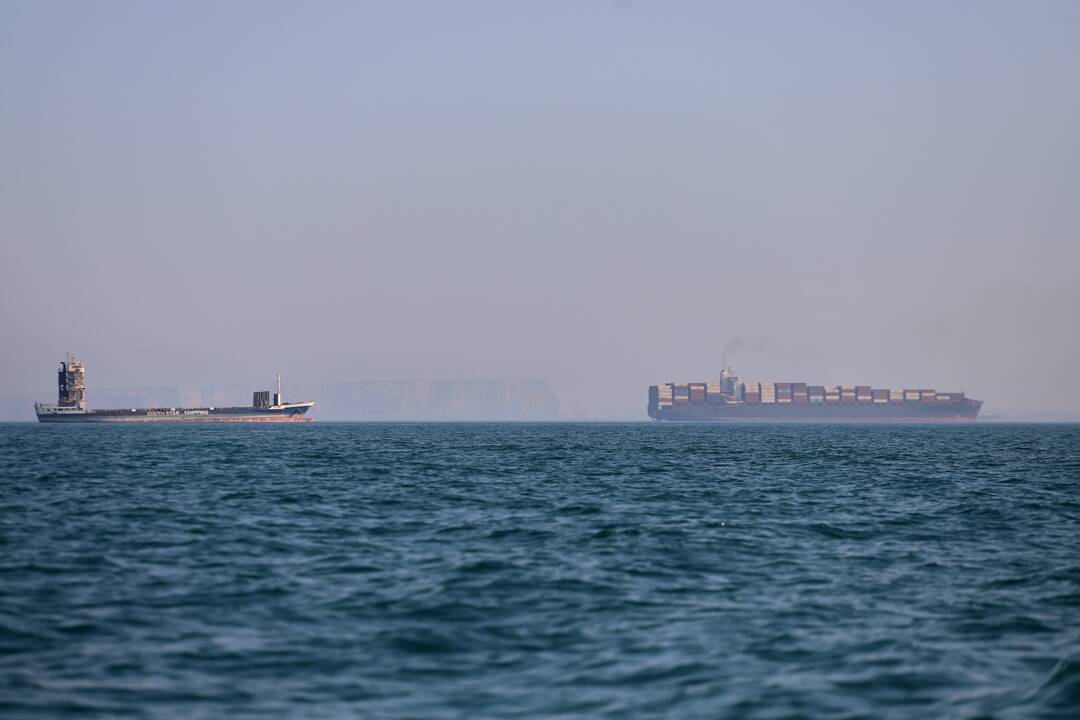
As Iran and the US unveil a preliminary agreement signed on Wednesday, shrouded in political nuances, experts consider what the deal may mean if Tehran imposes fees on shipping through the Strait of Hormuz.
Four months after the United States and Israel launched a war against Iran, the terms of a framework for peace negotiations between Washington and Tehran, signed this week, reveal conditions that few would have expected just days ago, and which some see as a win for Iran. These include the immediate lifting of Washington’s maritime blockade and the restoration of traffic through the Strait of Hormuz within 30 days.
But as negotiations enter a second phase, the two states’ recent rhetoric on how ships transiting through the strait would be governed has raised questions. During the G7 summit in Evian, president Donald Trump said that the waterway would be “permanently toll-free”, while the Islamic Republic says it will impose fees, including for navigational services and environmental protection. At stake is Tehran’s interest in retaining some leverage over the US versus the illegality of charging tolls on it under international law.
The waterway, which Iran had for decades threatened to use against its adversaries, became a potent tool of war when the current conflict began on 28 February. Ahead of this week’s memorandum of understanding, Tehran made Iranian sovereignty over the strait a key condition in negotiations, and in May established the Persian Gulf Strait Authority, a government agency to manage “safe passage permits” after saying that it would charge ships transiting through the channel.
According to the MoU, Iran will provide safe passage to commercial shipping “with no charge” for 60 days, while demining is undertaken during the first month. The protocol also requires that the US “prevent any interference or obstruction” against Iran.
Oman has been in discussions with Iran over the strait, which, at its narrowest, separates the two countries by only 21 miles (34 kilometres), placing it within the territorial waters of both countries. But the sultanate has rejected Iran’s proposal to collect transit fees.
The price of passage
For those working closely with the shipping sector, it wouldn’t be the first time that charges are imposed on vessels transiting an international waterway, just as Turkey invoices ships for piloting services through the Bosphorus Strait. After coming under attack, Tehran imposed tolls on a small number of mostly minor-sized ships navigating the waterway, with exemptions for “friendly” countries.
Stéphane Graber, director general of the International Federation of Freight Forwarders Associations (Fiata), stresses, however, that reimposing tolls would be a no-go. “The Iranians are being very careful (not) to talk about tolls, because that would be illegal,” he says, adding that a key concern is whether service fees, which are legal, are applied discretionally by Iranians or are “politically motivated”, which would be unacceptable to the US.
The strait’s closure since the war began on 28 February has triggered the largest disruption to the global oil market and fertiliser and food supply chains, as well as inflation worldwide. It also led to higher costs for goods traders due to huge backlogs of shipping containers.
Read more: Freight logistics sector struggles as Gulf war disrupts trade
But Graber says the prospect of higher costs linked to possible Iranian fees is “something that the transport industry will probably be able to accommodate”. He does not expect them to be too high, for fear of diverting shipping from the strait.
According to the International Maritime Organisation, roughly 150 vessels passed through the channel per day before the war, but that number has dwindled to just a handful since the start of hostilities.
Legal controversies
From a legal point of view, ships travelling through international straits and territorial seas, such as the Strait of Hormuz, are bound by two Geneva treaties, including the 1982 UN Convention on the Law of the Sea. According to Unclos, as it’s known, “transit passage” applies when travelling between two high seas, meaning here that the strait remains open to international shipping.
“Fees would be incompatible with transit passage through a strait that links sections of the high seas or exclusive economic zones (EEZ) used by international shipping,” says Robert Kolb, law professor at the University of Geneva. The EEZ is a maritime area where countries have rights to underwater resources, with surface waters being international.
However, the expert says that legal controversy prevails over the legal status in the strait. ”There are various arguments in this matter, and the legal issue has therefore not been conclusively settled,” Kobl added.
Neither Iran nor the US has ratified UNCLOS and has objected to “transit passage” as binding under international law.
Farzan Sabet, researcher at the Global Governance Centre at the Geneva Graduate Institute, says while Iran may now be talking about navigation fees, the threat of reimposing a toll may resurface if hostilities resume. Tehran may want to retain the option in case negotiations over its nuclear capabilities stall and the US ramps up the pressure again. For instance, Washington could walk back the waiver on the export of Iranian oil or reimpose sanctions, according to the expert.
“This is a card that the Islamic Republic could look to play again,” Sabet said. Domestically, it could project a signal that the regime “retains some kind of control over the Strait of Hormuz – a benefit derived as a result of the war. It would be more of a face-saving measure rather than a concrete outcome from the war that would have economic and geopolitical implications.”
Cost of resilience
With the digital ink still fresh on the agreement, shippers remain cautious about resuming transit through the strait, with little movement of vessels on Thursday morning as they await more information on the deal, including mine clearance.
“It’ll take some time to ensure that everybody feels confident enough so that things can start to move again,” Graber warns, adding that the issue of safety and security guarantees has been discussed at the World Trade Organization.
Meanwhile, he notes that the crisis in the Gulf has boosted efforts to redirect freight traffic to other modes of transport. “These chokepoints are vulnerable and critical points in the supply chain. We need alternatives.” Fiata has been helping to develop and improve logistics for multimodal transport, including railway and road transit, between countries. A Central Asian transport corridor linking China to Turkey will soon benefit from a common digital platform to simplify cross-border shipping.
“The world will have to integrate into the logistics the cost of resilience,” Graber says.