
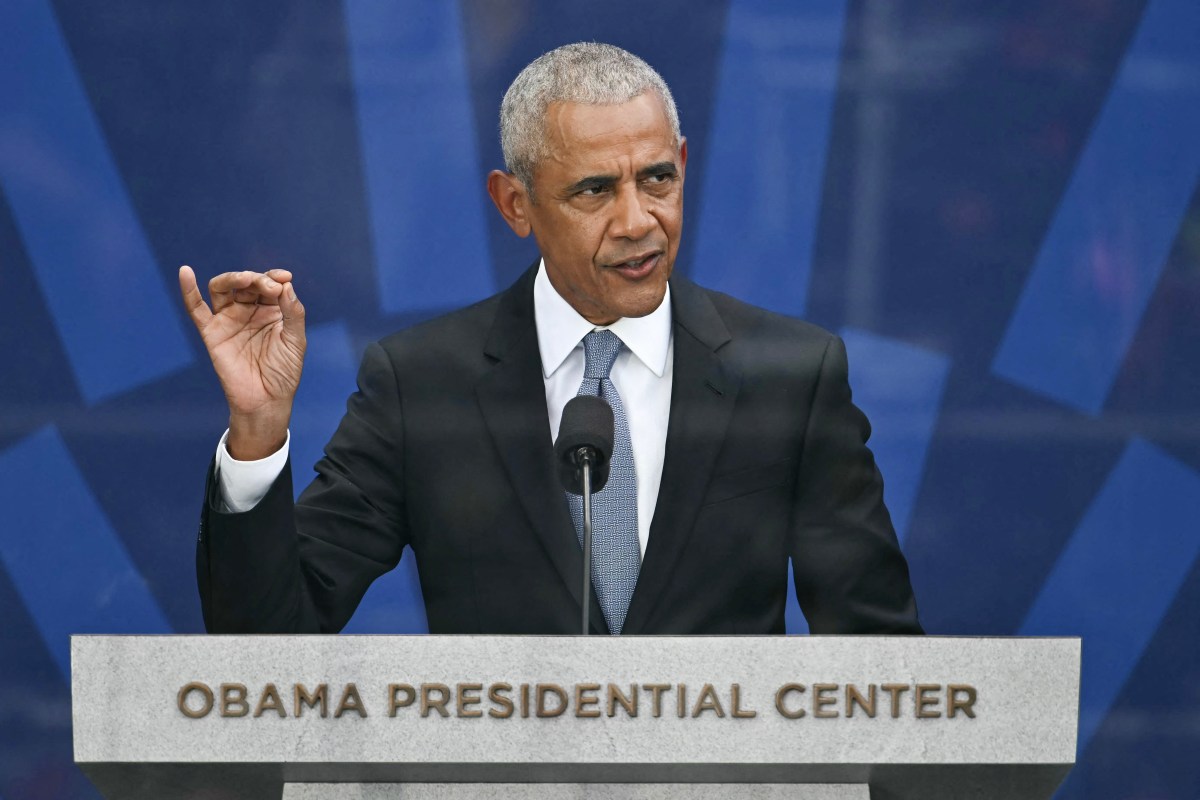
Former President Barack Obama said he was “very happy” to see President Donald Trump secure a ceasefire with Iran, while warning that the United States may be in a weaker position despite months of military conflict.
In an interview with NBC’s Today that aired Friday, Obama welcomed the halt in fighting but questioned whether the war ultimately achieved enough to justify its costs. His comments come as the Trump administration seeks to build on a recently announced ceasefire framework and move toward broader negotiations with Tehran.
“I am very happy to see a ceasefire,” Obama said. “I’m hopeful that it holds.”
Read More on Politics
The comments mark one of Obama’s most direct assessments of the conflict since fighting between the United States, Israel and Iran escalated earlier this year. Obama’s comments also underscored the continuing debate over whether the conflict was necessary—and whether the outcome differs significantly from the diplomatic approach pursued during his own administration.
Obama Questions Whether the War Was Worth It
While speaking favorably of the ceasefire, Obama suggested the conflict may have left the United States little better off than before.
“We’ve now fought a war, spent billions and billions of dollars, put enormous strain on our military,” Obama said during the Today interview. He added that it appears the United States is now “back where we were before we started the war, except maybe a little bit worse off.”
His remarks also come as policymakers, military analysts, and foreign policy experts continue to debate whether any side can claim a clear victory in the conflict. Obama’s comments also nodded to a long-running debate over the 2015 Iran nuclear agreement, formally known as the Joint Comprehensive Plan of Action (JCPOA), which his administration helped negotiate and sign before Trump withdrew from it in 2018.
Trump, for his part, is touting the war as a major success and pushing back on the view that Iran is better off. In a Friday Truth Social post, the president said Iran “doesn’t, any longer, have an Air Force, a Navy, Antiaircraft Equipment, Radar, or practically anything else, and yet the Dumocrats say that Iran is better off now than it was four months ago.”
 Military Experts Split on Who Won
The question of who is emerging stronger from the war remains heavily disputed. Some military experts argue that Iran suffered severe military and strategic setbacks, including damage to key military assets and the weakening of regional proxy groups.
Mark Cancian from the Center for Strategic and International Studies told Newsweek he believes the U.S. “is in a better position…The United States and Israel have conducted about 20,000 strikes against Iran, but because of Iranian information suppression, we don’t see the effect of all of those strikes.”
Others contended that Iran’s leadership survived a major military campaign, remained in power and ultimately returned to the negotiating table without suffering regime change, allowing Tehran to claim a degree of political success despite significant losses.
“It is difficult to make the case that this war achieved any significant positive result for the United States,” James Stavridis, a retired U.S. Navy admiral and former supreme allied commander of NATO, told Newsweek.
The competing assessments reflect the broader debate Obama referenced in his remarks, with supporters of the Trump administration arguing military pressure helped produce the ceasefire while critics question whether the costs outweighed the gains.
Obama’s Iran Nuclear Deal Returns to Spotlight
Obama’s comments also focus attention on his landmark foreign policy achievement, the 2015 JCPOA.
The accord, negotiated with Iran, the U.S. and several world powers during Obama’s presidency, placed restrictions on Tehran’s nuclear program in exchange for sanctions relief. Supporters argued the deal successfully constrained Iran’s nuclear activities and subjected the country to extensive international monitoring.
Trump withdrew the United States from the agreement during his first term, arguing it failed to permanently stop Iran’s nuclear ambitions and gave Tehran too many concessions. In the wake of Trump’s decision, Iran began to slowly withdraw from the commitments it had made, substantially increasing its enrichment of uranium.
During his Today interview, Obama suggested many of the issues currently being negotiated were addressed under the original agreement and questioned whether the U.S. is likely to secure terms substantially different from those contained in the JCPOA.
“This administration, or a prior version of this administration, pulled out of it [the JCPOA], which caused then Iran to develop more nuclear capacity,” the former president said.
Republicans Divided Over Trump’s Iran Strategy
Obama is not alone in raising concerns about the war’s outcome, with Republicans at odds over Trump’s Iran policy.
Some GOP lawmakers have sharply criticized the emerging agreement. Senator Bill Cassidy of Louisiana recently called the framework a “tremendous foreign policy blunder” and argued that the details released so far raise serious questions about whether Iran’s nuclear ambitions can be permanently constrained.
Others have rallied behind Trump’s approach. In a post on X on Friday, Senator Lindsey Graham of South Carolina said he “completely” agreed with Trump’s assessment that Iran’s ability to support terrorism and threaten Israel had been “massively degraded.”
“Mr. President, continue to try to find a diplomatic solution to Iran’s nuclear ambitions and other issues that have plagued the world since 1979,” Graham wrote. “The day diplomacy is off the table will present America and our allies with some very stark choices.”
The contrasting responses underscore the debate now emerging in Washington over whether the ceasefire and broader diplomatic effort represent a strategic success for the Trump administration or a concession that could leave key security concerns unresolved.
What Happens Next?
The ceasefire has temporarily halted direct hostilities, but major questions remain about Iran’s nuclear program, sanctions relief and the long-term durability of any final agreement.
Regional tensions also persist. Israeli strikes in Lebanon on Friday highlighted the fragile security environment and raised fresh concerns about whether broader peace efforts can hold.
For now, Obama and Trump appear to agree on at least one point: avoiding a return to open warfare.