
A good friend of mine, Emily, who holds progressive political views, recently asked me what I thought about the West Bank.
I told her that if I believed withdrawing from the West Bank would bring peace, I would support it.
I do not want Israel to rule over millions of Palestinians indefinitely. Palestinians deserve dignity, opportunity, and self-determination.
Yet underlying many conversations about Israel is an assumption that the occupation of the West Bank is both morally wrong and the central obstacle to peace. Among many Democrats, this is not merely an argument but a starting premise.
Many people move quickly from the belief that the occupation is wrong to the conclusion that Israel should withdraw from the West Bank. What is often missing is an understanding of why so many Israelis became skeptical that withdrawal would bring peace.
The problem is that many Americans discussing the conflict today either do not know or have forgotten the history that shaped Israeli public opinion.
Palestinians tell a very different story about these events, one that includes displacement, military occupation, and unfulfilled aspirations for statehood.
My purpose here is not to tell that story, nor to deny the hardships Palestinians have experienced. Rather, it is to explain a part of the Israeli story that many Americans rarely hear and that I believe is essential to understanding why so many Israelis became skeptical of territorial withdrawal.
Many Israelis view the history differently than it is often presented in the United States. Israel gained control of the West Bank during the 1967 Six-Day War after facing threats from neighboring Arab states. Before 1967, Jordan controlled the West Bank and Egypt controlled Gaza, yet neither territory became an independent Palestinian state. Whether one agrees with Israeli conclusions or not, these facts are also part of the historical context that shapes Israeli thinking.
When Israel is discussed in American political circles, the focus is often on Benjamin Netanyahu, Itamar Ben-Gvir, and Bezalel Smotrich. Whatever one thinks of those politicians, they did not create Israeli skepticism about territorial withdrawal.
That skepticism was shaped by decades of experience.
Many Americans are unaware that Israel repeatedly pursued land-for-peace agreements.
The first Likud prime minister, Menachem Begin, signed a peace treaty with Egypt and returned the entire Sinai Peninsula—territory roughly three times the size of Israel itself—in exchange for peace. This is worth remembering because Likud is generally considered Israel’s major right-wing party. The idea that territorial compromise has been pursued only by the Israeli left is historically inaccurate.
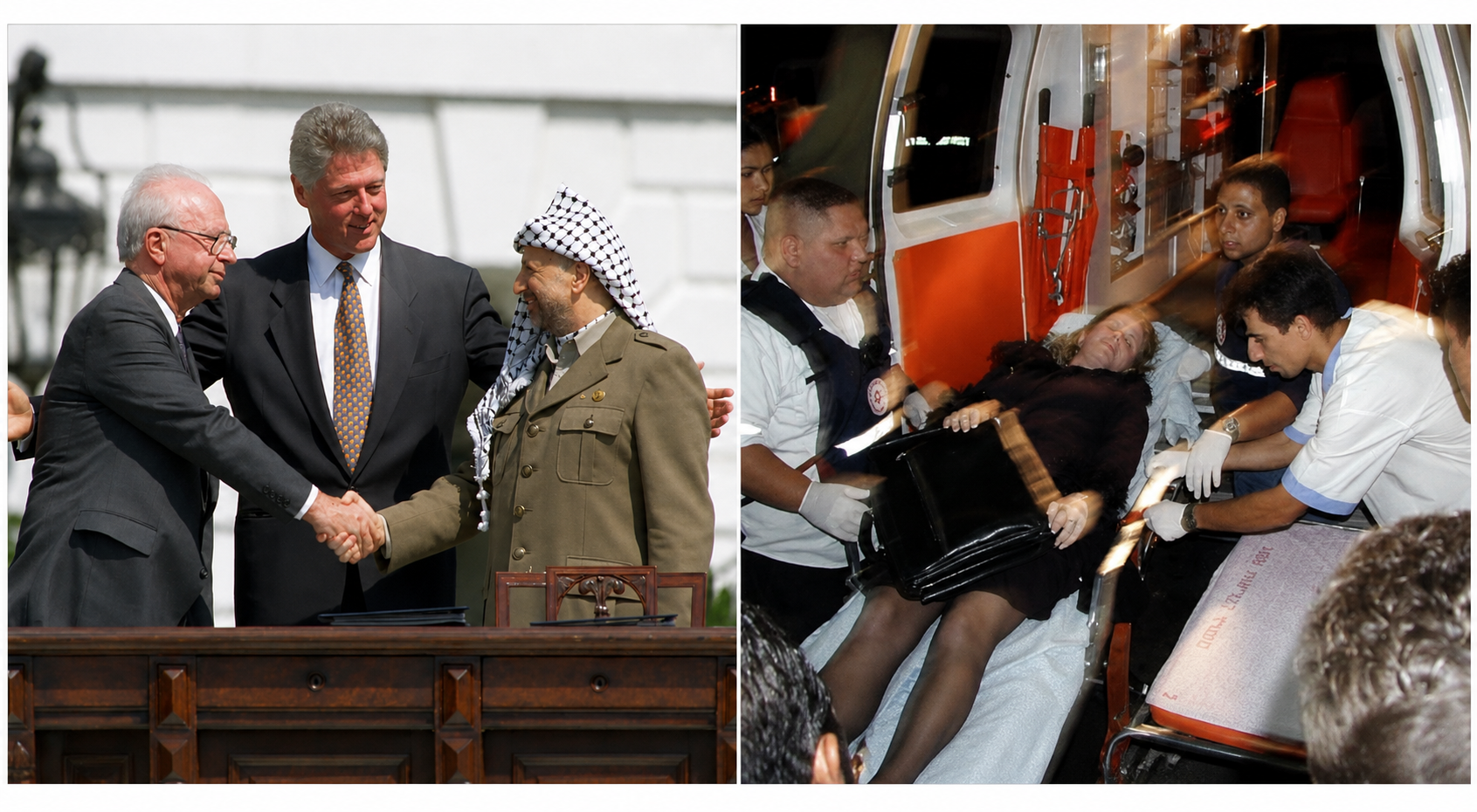
In the 1990s, Israeli leaders entered the Oslo process. At the time, many Israelis genuinely believed they were witnessing the beginning of reconciliation between Israelis and Palestinians. The hope was not confined to a small group of idealists. It was shared by large segments of Israeli society.
Later, Prime Minister Ehud Barak made far-reaching proposals at Camp David, and Prime Minister Ehud Olmert would later offer terms that many observers believed could have led to the creation of a Palestinian state.
Reasonable people disagree about why those efforts failed. My purpose here is not to assign blame. It is simply to note that repeated attempts at territorial compromise were made.
Then came the Second Intifada.
Instead of the peace many had envisioned, Israelis experienced years of suicide bombings in buses, restaurants, shopping malls, and other civilian locations. More than a thousand Israelis were killed.
Reasonable people disagree about why Oslo failed. But it is impossible to understand modern Israeli attitudes without understanding how deeply the violence of the Second Intifada affected Israeli society.
The lesson many Israelis drew was not that Palestinians do not deserve a state. It was that territorial concessions alone do not necessarily bring peace.
The next major experiment came in Gaza.
In 2005, Prime Minister Ariel Sharon ordered the evacuation of every Israeli settlement in Gaza. Thousands of Israelis were forcibly removed from their homes. Entire communities that had existed for decades were dismantled. Israeli soldiers were ordered to remove fellow Jews from homes, schools, synagogues, and businesses. The disengagement deeply divided Israeli society and was one of the most painful domestic episodes in Israel’s history.
Supporters of the withdrawal believed that this painful sacrifice could create new possibilities for peace. Many hoped Palestinians would view the withdrawal as evidence that territorial compromise was possible and that coexistence could be achieved.
Instead, Hamas eventually took control of Gaza. Years of rocket attacks followed.
Many Israelis concluded that Hamas had drawn a very different lesson from the withdrawal: that sustained violence had forced Israel to retreat and that additional violence could produce further Israeli concessions. More broadly, many Israelis concluded that Hamas viewed the withdrawal not as a step toward coexistence but as evidence that the Jewish state could ultimately be defeated.
For many Israelis, the October 7 massacre appeared to confirm those fears.
Whether one agrees with that interpretation or not, it is a critical part of how many Israelis understand what happened.
The common assumption today is that Israelis oppose withdrawal because they have become more right-wing. Many Israelis would say the opposite: they became more skeptical of withdrawal because of what happened after earlier attempts at compromise.
The West Bank presents an additional concern.
Unlike Gaza, the West Bank overlooks Israel’s narrow coastal plain, where most of the country’s population, infrastructure, and economic activity are concentrated. Ben Gurion Airport, Jerusalem, Tel Aviv, and major transportation routes lie within easy range of the high ground.
For decades, military and strategic experts have warned that a complete Israeli withdrawal could leave Israel extraordinarily vulnerable if the territory were ever to follow the path of Gaza. Whether one agrees with those assessments or not, they are taken seriously by many Israelis and form an important part of the debate.
There is another aspect of this discussion that is often overlooked, even by many Jews.
The territory commonly called the West Bank is also known as Judea and Samaria. For Jews, these are not simply biblical place names but the geographic heartland of Jewish civilization. Judea was the historic homeland of the tribe of Judah, from which the word “Jew” is derived. Hebron, Bethlehem, Shiloh, and many of the most important sites in Jewish history are located there.
Jewish communities have existed in parts of this region continuously for thousands of years, although their size and circumstances varied greatly under different empires and rulers.
This does not resolve modern political questions, nor does it negate Palestinian ties to the land. But it does help explain why many Jews do not view the territory as simply another piece of disputed real estate.
At the same time, many Israelis would support territorial compromise if they believed it would bring a durable peace. The debate is often less about ancient history than outsiders assume and more about security and the lessons Israelis have drawn from recent experience.
Another concern frequently raised by Israelis receives far less attention in the United States: what Palestinian children are taught about Jews and Israel.
Many Israelis ask a simple question: If peace is the goal, are both societies preparing their children for coexistence?
Organizations that have examined Palestinian educational materials, including reports concerning UNRWA schools and Palestinian Authority textbooks, have documented examples in which Jews are demonized, violence is glorified, or Jewish historical ties to the land are denied.
This matters because peace agreements are ultimately sustained not only by political leaders but by the attitudes of ordinary citizens. Israelis who see such materials naturally ask whether future generations are being prepared for coexistence or continued conflict.
While Israeli society has its own shortcomings and internal disagreements, Israeli schools do not teach children to hate Muslims or deny Muslim ties to the land.
For many Israelis, this raises a troubling question: if peace is truly the goal, why are so many Palestinian children still being exposed to messages that portray Jews as illegitimate or hostile?
There is another aspect of the conflict that many Americans misunderstand.
Many observers assume that the conflict is primarily about borders.
Many Israelis increasingly believe it is also about legitimacy.
After October 7, demonstrations erupted across Western campuses and cities. Among the slogans frequently heard were “Free Palestine,” “From the river to the sea,” and “Globalize the Intifada.”
I do not assume that everyone who uses these slogans intends them as calls for violence or the elimination of Israel. Many people are expressing sympathy for Palestinians, while others may simply be repeating phrases whose history and implications they have never seriously considered.
Yet many Jews hear these slogans differently. To Jews who remember the Second Intifada, a call to “globalize” the Intifada does not sound like a call for coexistence. It evokes memories of suicide bombings in buses, restaurants, and shopping malls.
When a gunman murdered two young Israeli Embassy employees, Yaron Lischinsky and Sarah Milgrim, outside an event at the Capital Jewish Museum in Washington while shouting “Free Palestine,” many Jews heard that slogan differently than its defenders intended. Similarly, when an attacker firebombed a group of Jewish demonstrators in Colorado who were marching in support of the hostages held by Hamas—many of them elderly—causing injuries that ultimately claimed the life of 82-year-old Karen Diamond, many Jews again heard the attacker’s cry of “Free Palestine” through the lens of violence rather than peace.
Much of my own thinking on this subject has been influenced by Israeli writers and thinkers such as Haviv Rettig Gur and Micah Goodman.
Both argue, in different ways, that the central dilemma facing Israelis is not simply a choice between peace and occupation. It is a choice between competing risks.
On one hand are the moral, political, and demographic costs of ruling over millions of Palestinians. On the other are the security risks that many Israelis fear would follow a withdrawal that fails to produce genuine acceptance of a Jewish state.
I do not claim to have a solution to this conflict.
I understand the hardships faced by Palestinians and believe they deserve a better future.
But I also believe that anyone seeking to understand Israeli attitudes today must grapple honestly with the history of the peace process, the Second Intifada, the Gaza withdrawal, and October 7.
Without that history, it can be easy to conclude that Israeli opposition to withdrawal stems primarily from right-wing politics, religious nationalism, racism, or indifference to Palestinian aspirations.
With that history, a different possibility emerges: that many Israelis support neither permanent occupation nor endless conflict, but have become skeptical that territorial withdrawal alone will bring peace.
One may ultimately disagree with that conclusion. But understanding it is the first step toward understanding how many Israelis view the conflict today.