
When Israeli Ambassador to India Reuven Azar reportedly alleged that Hamas-linked activity is taking place in Pakistan and Bangladesh, many people in South Asia may have treated it as another diplomatic warning from the Middle East. But Bangladesh should not ignore it.
Bangladesh is not in the Middle East. It has no border with Israel. It has no direct role in the Gaza war. Yet Middle Eastern conflicts have long entered Bangladeshi politics through mosques, political slogans, street protests, social media campaigns, and religious mobilization.
That is why Israel’s concern deserves attention.
This issue is not only about whether Hamas has a formal network in Bangladesh. That question requires evidence and careful intelligence work. The bigger public question is whether Bangladesh is becoming a place where Hamas-style narratives, anti-Israel rhetoric, anti-India politics, and Islamist street pressure can overlap.
That overlap is dangerous for Israel. It is also dangerous for Bangladesh.
Bangladesh has a long history of sympathy for the Palestinian people. Many ordinary Bangladeshis feel deep emotion when they see Palestinian civilians suffering. That sympathy should not be dismissed. Supporting Palestinian civilians is a humanitarian position. It is not the same as supporting Hamas.
But in today’s political climate, that difference is often blurred. Palestine is no longer discussed only as a humanitarian issue. In many Islamist circles, it becomes a religious identity issue. Israel is not criticised only as a state or government. It is often described as a permanent enemy of Muslims.
That language matters.
When Israel is framed as the eternal enemy of Muslims, political disagreement becomes religious hostility. When a foreign conflict is turned into a test of Islamic loyalty, local politics becomes more dangerous. People are no longer asked to think about policy, war, civilians, diplomacy, or terrorism. They are asked to choose a religious side.
This is the environment in which Hamas narratives can travel beyond Gaza.
A recent example of this wider political climate is Barrister A.S.M. Shahriar Kabir, a Bangladeshi Supreme Court lawyer and political commentator. He should not be confused with the well-known secular writer and anti-fundamentalism activist Shahriar Kabir. Barrister A.S.M. Shahriar Kabir is a different person.
In public discussion, Barrister A.S.M. Shahriar Kabir has appeared around Islamist political activity. In widely circulated online remarks, he reportedly framed Israel as a permanent enemy of Muslims and placed India in a similar hostile category. This exact quote should be checked against the original video before publication, but the political meaning of such rhetoric is clear.
It does not simply criticize Israeli policy. It turns Israel into a religious enemy. It also links anti-Israel language with anti-India politics. For Israel, India, and Bangladesh, this kind of ideological connection should not be ignored.
The issue is not whether every anti-Israel speaker in Bangladesh is connected to Hamas. That would be an unfair and irresponsible claim. The issue is whether Bangladesh is becoming a space where anti-Israel hatred, Islamist mobilisation, anti-India narratives, and global jihadist symbols can meet.
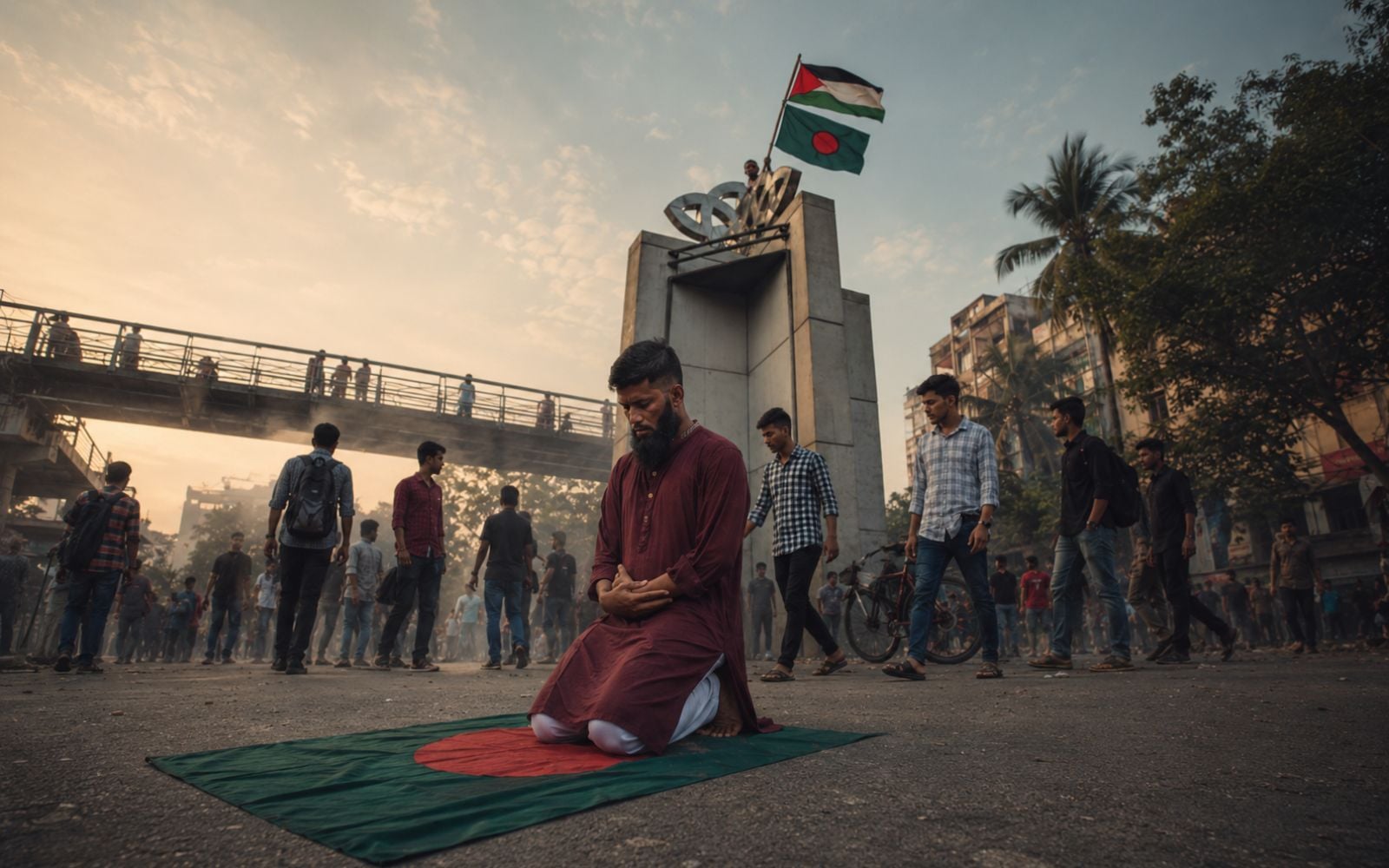
There are also disturbing visual signs of this ideological confusion.
In recent Bangladeshi social media images, one can see a symbolic pattern that deserves attention. In one image, a man appears to be praying on the national flag of Bangladesh. In another, the Palestinian flag is raised above or beside the Bangladeshi flag on a rooftop.
These images should be verified before being treated as formal evidence. But as symbols, they are important. They show a deeper crisis of loyalty, identity, and political direction.
If a national flag becomes a prayer mat, it suggests that some people do not see the state as a shared home for all citizens. They judge the state by whether it serves their religious-political vision. If Palestinian symbolism is raised above national identity, it suggests that a foreign conflict can become more emotionally powerful than the country itself.
This is not normal politics. It is a crisis of national identity.
Again, the Palestinian flag is not the Hamas flag. Supporting Palestine is not the same as supporting Hamas. But in Bangladesh’s Islamist street politics, Palestinian symbolism can easily be mixed with Hamas-style rhetoric, anti-Jewish hatred, and anti-India anger. That is where the danger begins.
Israel understands this danger because Israel has lived with it for decades. Hamas does not spread only through military cells. It also spreads through language, symbols, emotional mobilisation, religious anger, fundraising networks, online propaganda, and street pressure.
Bangladesh must understand this too.
The country is already passing through a sensitive political time. There is growing religious pressure in public life. There are attacks and threats against minorities. There is anger against India. There is strong anti-Israel sentiment in many Islamist circles. There is also increasing use of social media to mobilise crowds quickly.
In such an environment, even if Hamas does not have a formal structure inside Bangladesh, Hamas-style politics can still influence public thinking. That influence can shape street slogans, youth mobilisation, online narratives, and hostility toward Israel, Jews, Hindus, India, and local minorities.
This is why Israel is right to watch Bangladesh carefully.
The concern is not only about Israel’s security. It is also about the future of Bangladesh itself. A country that allows foreign jihadist narratives to grow inside its society eventually loses control over its own politics.
Today the slogans may be about Gaza. Tomorrow they may be about India. The next day they may target Hindus, Buddhists, Christians, Indigenous peoples, secular writers, journalists, or even Muslims who disagree with extremist politics.
This is how radical politics expands.
Bangladesh must make a clear distinction between humanitarian sympathy and extremist alignment. It can support Palestinian civilians without allowing Hamas ideology to grow. It can criticise Israeli government policy without turning Jews or Israel into a religious enemy. It can defend Muslim rights without importing Middle Eastern jihadist politics into South Asia.
That distinction is important.
Israel also has a reason to take Bangladesh seriously because South Asia is not far from the Middle East ideologically. Pakistan has long been a concern for Israel because of its history of Islamist politics, terror networks, and anti-Israel positioning. If similar narratives grow in Bangladesh, then the region becomes more complicated for Israel, India, and the West.
Bangladesh’s geography also matters. It sits beside India, near Myanmar, and close to maritime routes in the Bay of Bengal. It has a large population, strong religious networks, and a politically active diaspora. If radical anti-Israel networks or Hamas-linked propaganda find space there, the impact will not remain local.
This is why the Israeli ambassador’s warning should not be dismissed as distant diplomacy.
Bangladesh should not wait until the problem becomes visible in violent form. The time to act is when the warning signs appear in language, symbols, networks, and public mobilisation.
The state must protect religious freedom, but it must not allow religious extremism to control public life. It must protect the right to support Palestinians, but it must also prevent Hamas ideology from entering mainstream politics. It must protect Muslims, Hindus, Buddhists, Christians, Indigenous peoples, and all citizens equally.
A strong state does not allow foreign conflicts to destroy its national identity.
A wise society does not allow sympathy to become hatred.
And a responsible government does not ignore the moment when international jihadist narratives begin to find local language.
Israel is right to watch Hamas-linked activity in Bangladesh. But Bangladesh should also watch itself.
Because if Bangladesh fails to control Islamist street politics today, the danger tomorrow will not be Israel’s alone. It will become Bangladesh’s own national crisis.
June 23, 2026
Tokyo, Japan