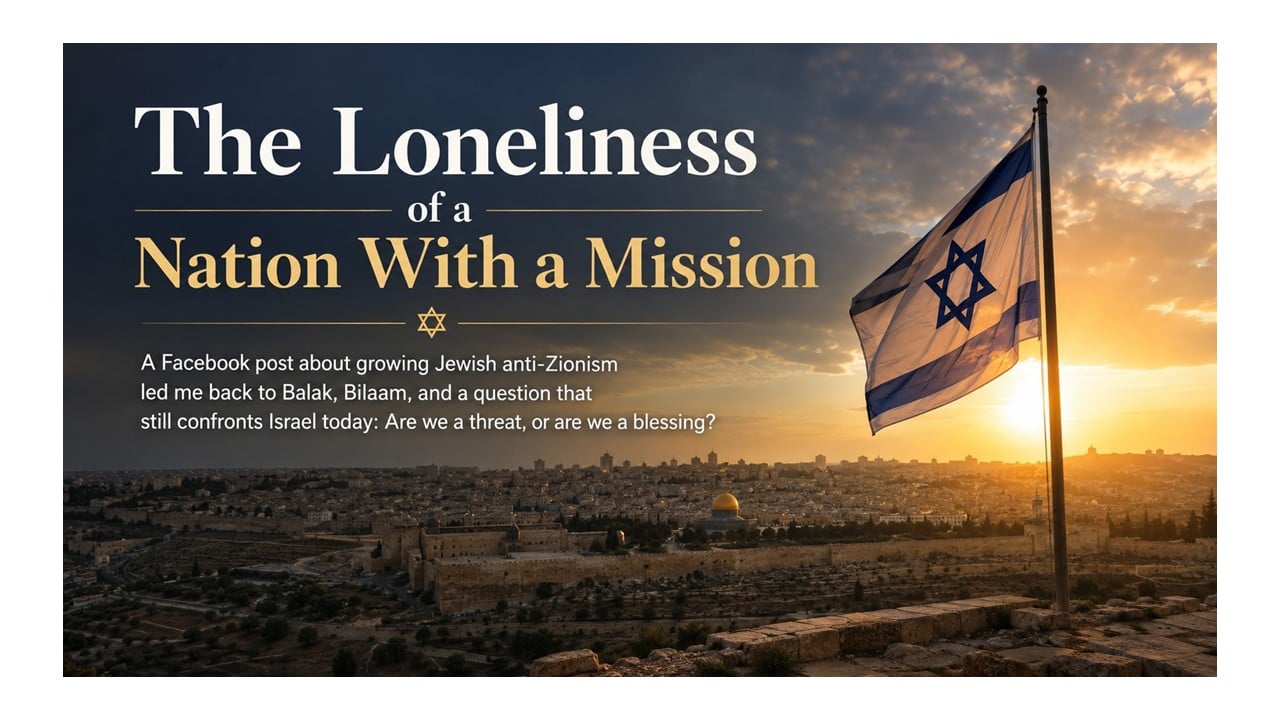
A Facebook story from a cousin stopped me in my tracks this week.
The story described a growing secular Jewish anti-Zionist movement, particularly among younger Jews in North America and Europe. It argued that increasing numbers of Jews no longer view Zionism as central to their identity and are distancing themselves from the idea of a Jewish state.
I sat staring at the screen for a few moments.
Not because I was surprised that Jews disagree. We always have.
Not because criticism of Israel is illegitimate. It is not.
I was saddened because the post seemed to reflect a growing disconnect from something that lies at the very core of my Jewish identity.
For me, Zionism is not a political party.
It is not a government.
It is not Netanyahu, Trump, Biden, or any other leader.
Zionism is the story of a people who prayed for two thousand years to return home.
It is the story of Jews who endured expulsions, pogroms, persecution, and the Holocaust, yet never abandoned hope.
It is the story of Hebrew becoming a living language once again.
It is the story of Jewish sovereignty restored in the Land of Israel.
Most importantly, it is the story of purpose.
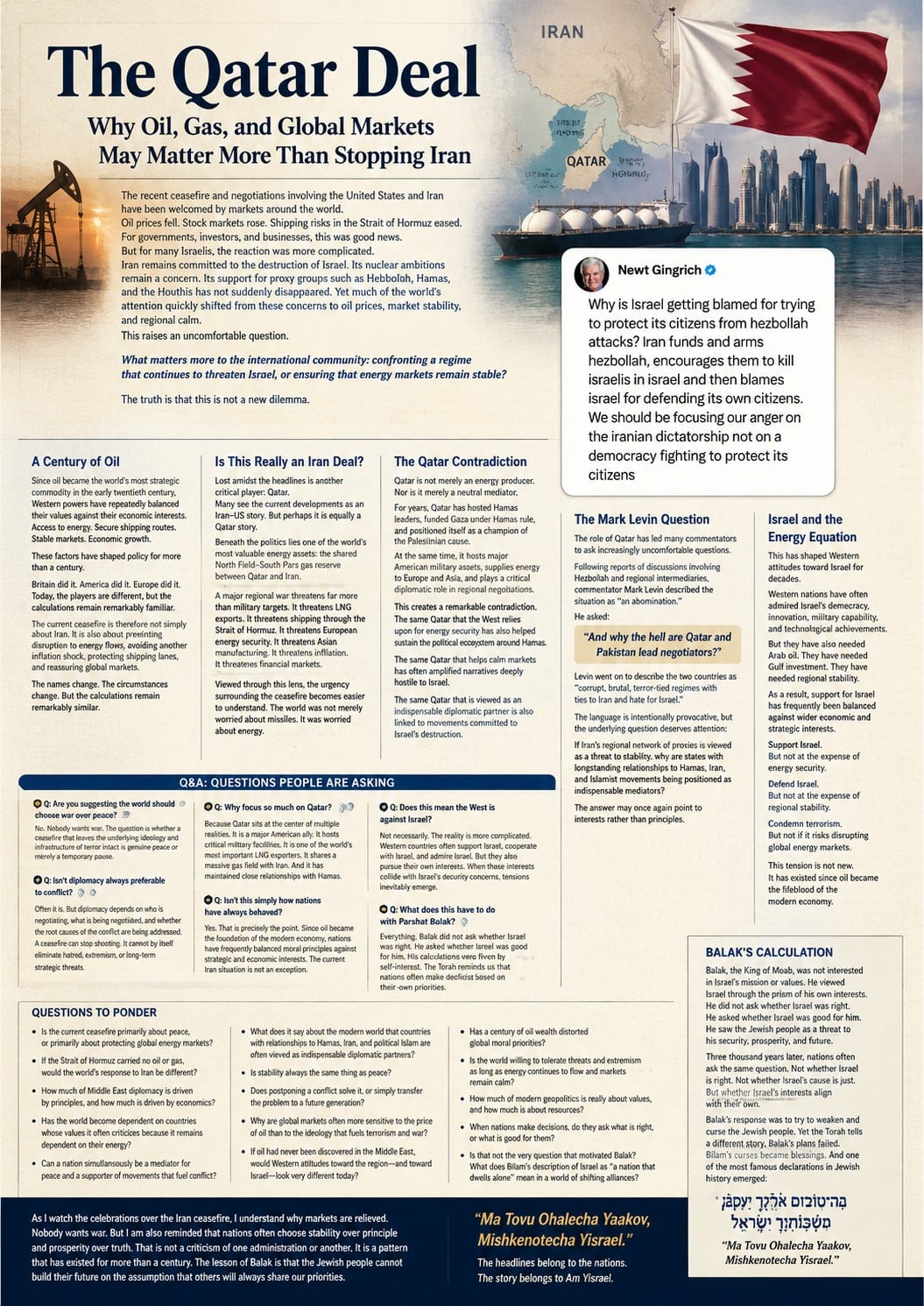
As I reflected on that Facebook story, I found myself thinking about this week’s Parsha Balak.
Because Balak also looked at Israel and failed to understand what he was seeing.
Balak Saw a Threat
Balak looked at Israel and saw a threat.
He did not see a people returning to their homeland.
He did not see a covenant.
He did not see a nation carrying a moral and spiritual mission.
He saw danger.
The irony is that the Israelites were not seeking conflict with Moab. Yet Balak became obsessed with them. He mobilised political influence, financial resources, and spiritual power to stop them.
Three thousand years later, the pattern feels strangely familiar.
The world’s only Jewish state occupies an extraordinary place in the world’s imagination. Jews comprise less than two-tenths of one percent of humanity, yet Israel receives an amount of attention, criticism, and obsession wildly disproportionate to its size.
International institutions focus on Israel.
University campuses mobilize around Israel.
Media outlets scrutinize Israel.
And Israel’s enemies devote enormous resources to its destruction.
One has to ask why.
The Reality Israelis Live
Nor is the challenge confined to Gaza.
As Israelis debate politics and the future of Zionism, many families face a more immediate reality.
Iran and its proxies continue to threaten Israel’s existence. Hezbollah has heavily armed southern Lebanon, and since October 7, northern Israelis have endured evacuations, disrupted lives, and constant missile and drone threats.
This is not theoretical—it is daily life.
Parents worry about their children’s safety. Reservists leave families for months. Entire communities have lived with uncertainty, displacement, and fear.
When Israelis hear anti-Zionism, they hear it alongside rockets, drones, and repeated denials of Israel’s right to exist.
At the same time, many Israelis are also grappling with difficult questions about power, responsibility, and the human cost of ongoing conflict. There is an awareness, for some, that security cannot be separated from the broader regional reality, including the suffering of Palestinians and the long-term implications of military responses.
This context does not remove the need for reflection or accountability, but it explains why, for many, Zionism is not merely political.
It is the conviction that Jewish survival cannot depend solely on the goodwill of others.
The Obsession With the Tiny Jewish State
Today, Israel is a country of roughly ten million people. Jews comprise less than 0.2% of humanity. If the world were reduced to a neighborhood of 1,000 people, less than one person would be an Israeli Jew.
Yet no nation receives anything close to the same level of scrutiny.
The United Nations spends disproportionate attention on Israel.
International media devotes endless coverage to Israel.
University campuses organize around Israel.
Activists march about Israel.
Terror organizations devote extraordinary resources to Israel.
One has to ask why.
Why did Hamas spend billions of dollars on tunnels instead of schools?
Why devote vast resources to rockets, tunnels, drones, weapons, propaganda, and international campaigns rather than economic development?
The answer cannot simply be geography or politics.
Something deeper is taking place.
The Misunderstanding of Zionism
One of the great tragedies of our generation is that Zionism has become so widely misunderstood.
For many of us, Zionism is not merely a political ideology.
It is the modern expression of an ancient Jewish dream.
For two thousand years Jews prayed facing Jerusalem.
For two thousand years Jews ended the Passover Seder with the words, “Next year in Jerusalem.”
For two thousand years Jews dreamed of returning home.
The purpose of that return was never merely sovereignty.
It was mission.
The prophet Isaiah described Israel as a “light unto the nations.”
God told Abraham that through his descendants all the families of the earth would be blessed.
The return to Zion was meant to create a society that could bring those values into the modern world.
A Light Unto the Nations
Look at what Israel has contributed despite constant war and insecurity.
Israeli innovations help feed the world.
Israeli medical advances save lives across continents.
Israeli water technologies are used in regions facing severe drought.
Israeli emergency response teams are among the first to arrive after disasters.
Israeli scientists, entrepreneurs, and researchers contribute far beyond the country’s size.
This is not accidental.
It reflects something deeply embedded within Jewish civilization: the desire to repair the world.
Israel is far from perfect. Every nation is.
The Hebrew prophets were among the fiercest critics of Jewish society.
But their criticism stemmed from love and aspiration, not rejection.
They wanted Israel to live up to its mission.
The Loneliness of Being Different
Bilaam eventually utters one of the most famous verses in the Torah:
“Behold, it is a people that dwells alone and is not reckoned among the nations.”
For centuries Jews struggled with this verse.
Was it a blessing or a curse?
Perhaps it is both.
The Jewish people have often stood alone.
Empires have risen and fallen.
Political alliances have shifted.
Friends have become critics.
Supporters have become adversaries.
Yet the Jewish people remain.
Not because we are stronger than every empire.
Not because we are larger than every nation.
But because our existence has never depended solely on power.
The Blessing Behind the Curse
Balak wanted a curse.
God transformed it into a blessing.
That has been the Jewish story throughout history.
The nations often define the Jewish people according to their fears.
God defines the Jewish people according to their purpose.
Balak saw a threat.
Bilaam eventually saw a blessing.
The challenge for us today is not to become consumed by those who misunderstand us.
It is to remember who we are.
To continue building.
To continue innovating.
To continue caring for the vulnerable.
To continue bringing Torah values into the modern world.
To continue striving to be a light unto the nations.
The future of Israel will not ultimately be determined by headlines, media narratives, international institutions, or shifting political winds.
It will be determined by whether we remain faithful to our mission.
The Jewish people have faced Pharaoh, Babylon, Rome, the Inquisition, pogroms, Nazism, Soviet Communism, and modern terrorism.
The names change.
The challenge remains.
And our answer remains the same:
Am Yisrael Chai.
Not merely because we survive.
But because we still have a purpose worth living for.
Questions to Ponder
Why does the world’s only Jewish state attract such disproportionate attention, criticism, and obsession?
If Zionism is not merely about power or territory, what is its deeper purpose in the twenty-first century?
Have we become so focused on Israel’s flaws that we overlook its contributions to humanity?
Can Israel remain both strong enough to defend itself and moral enough to fulfill its prophetic mission?
What does it mean today to be a “light unto the nations” in a world increasingly divided by ideology, identity, and conflict?
How should Jews respond when anti-Zionism emerges not only from enemies, but from fellow Jews?
Is the challenge of our generation merely to preserve the Jewish state, or to ensure that it remains worthy of the vision that inspired its creation?
When future generations look back at our time, will they remember a people defined by its conflicts, or a people defined by its contribution to the world?
Are we allowing Balak’s view of Israel to shape our understanding of ourselves, or are we striving to see ourselves through the eyes of Bilaam?
If Israel’s greatest significance lies not in its size but in its purpose, what responsibility does that place on each of us?
Further reflection: