
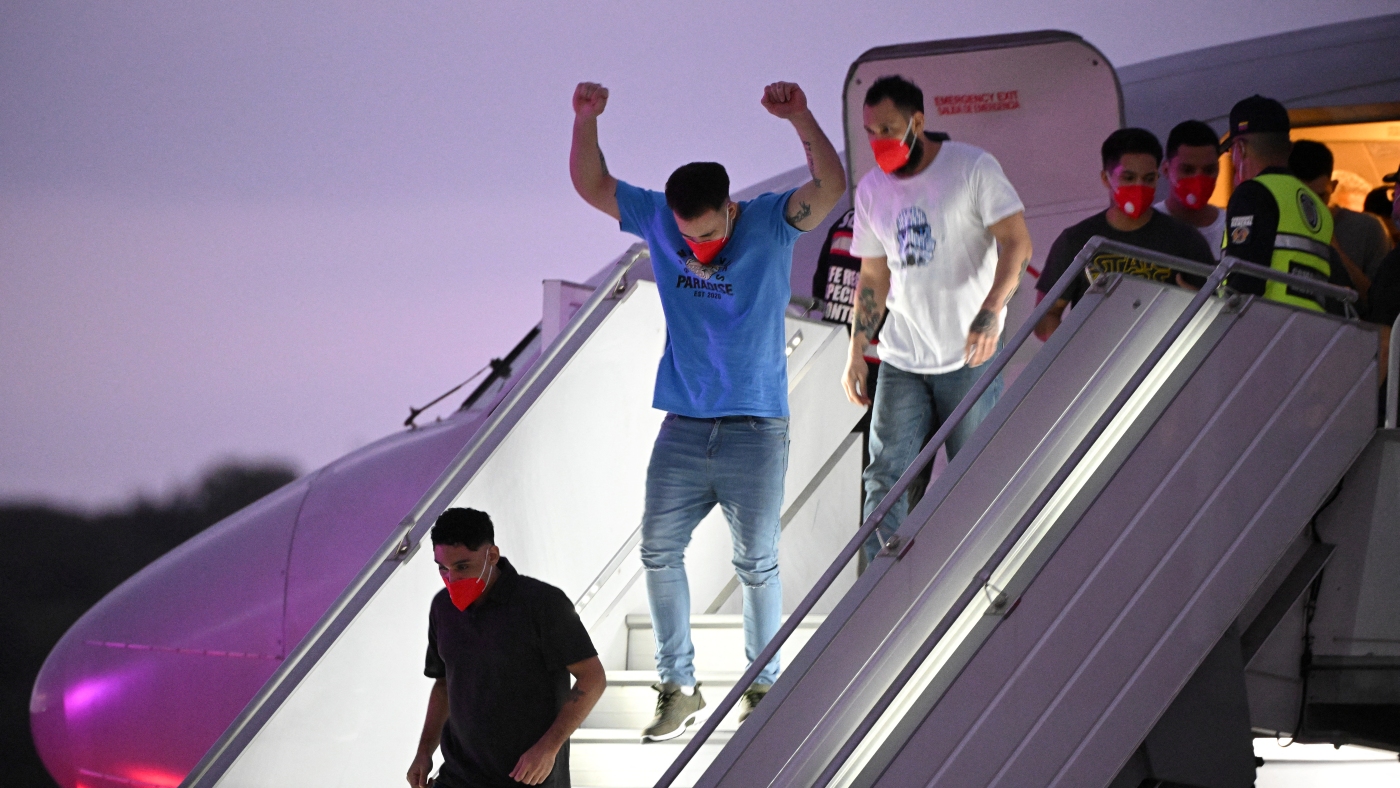
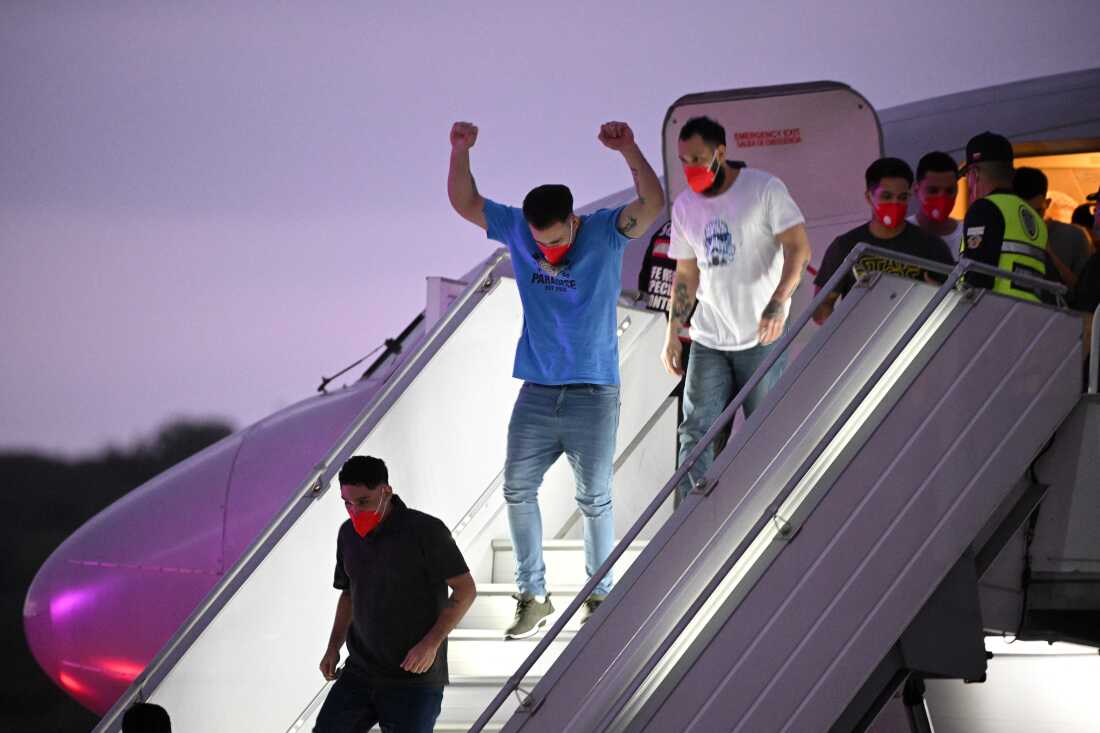
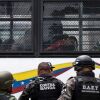
A Venezuelan migrant who was jailed in El Salvador gestures as he gets off a plane at Simon Bolívar International Airport in Maiquetía, Venezuela on Friday. El Salvador freed scores of Venezuelans deported from the United States to a notorious maximum security prison, the outcome of a highly coordinated prisoner swap between Caracas and Washington.
Federico Parra/AFP via Getty Images
hide caption
toggle caption
Federico Parra/AFP via Getty Images
BOGOTÁ, Colombia — Venezuela has freed 10 Americans in exchange for Venezuelans whom the United States had sent to a prison in El Salvador, the U.S. and Salvadoran governments said Friday.
Venezuela also released an unspecified number of Venezuelan political prisoners as part of the deal.
Salvadoran President Nayib Bukele confirmed the exchange in a message on X, saying his government handed over Venezuelans accused of being part of a gang in exchange for “a considerable number of Venezuelan political prisoners” as well as Americans.
A social media account belonging to the State Department’s hostage affairs office posted a photo of the men it said were released from detention in Venezuela on a plane.
In a statement, Secretary of State Marco Rubio said the United States welcomed the release of 10 Americans and of Venezuelan political prisoners.
The governments did not name the people released.
A State Department official told NPR that the people freed from Venezuela included U.S. citizens and permanent residents who were designated as “wrongfully detained” less than a year ago. The official, who spoke on condition of anonymity because they weren’t authorized to speak publicly, said the list included Wilbert Joseph Castañeda and Lucas Hunter.
In March, the Trump administration sent about 250 Venezuelan migrants to El Salvador, whose government was paid to house them in a maximum security prison, known as CECOT.
The United States accused many of the men of being gang members and deported them under the Alien Enemies Act, which had not been invoked since World War II.
Lawyers for the Venezuelan deportees argue their transfer to El Salvador was illegal. Dozens of them were in the middle of asylum cases, and had been held in U.S. detention centers for months.
On Friday, Bukele published a video of men in handcuffs he said were being handed over to Venezuela, as they boarded a plane taking them to the South American country.
Today, we have handed over all the Venezuelan nationals detained in our country, accused of being part of the criminal organization Tren de Aragua (TDA). Many of them face multiple charges of murder, robbery, rape, and other serious crimes.
As was offered to the Venezuelan… pic.twitter.com/teuIT4GiRT
— Nayib Bukele (@nayibbukele) July 18, 2025
Later, Venezuelan news outlet TeleSur broadcast what it said was the arrival of a plane carrying a group of the Venezuelan migrants home.
Bukele said the prisoner swap was the result of “months of negotiations.” It was kept secret until Friday — and some of the relatives of the Venezuelan migrants say they found out about it on social media.
Gabriela Mora, whose husband Carlos Uzcategui was one of the men sent by the U.S. to El Salvador, tells NPR she was at an event at her daughter’s school in Venezuela when she learned about the news.
“This makes us very happy,” she told NPR by phone from Lobatera, a town in Venezuela’s Tachira state. “We have waited for this day for too long.”
Uzcategui, a coal miner from Tachira, entered the U.S. in December after he received an appointment, through the U.S. government’s CBP One app, to cross the border and make his case for asylum in the country.
He was then held in a detention center in Texas. U.S. immigration officials alleged that tattoos of crowns and stars on his chest were linked to the Tren de Aragua gang. Uzcategui’s family says he got the tattoos 15 years ago, before the gang had even been established.
“He is not a gang member,” Mora said in an interview in May. “Just a hard working man who wants to provide for his family.”
NPR’s Michele Kelemen contributed reporting from Washington, D.C.