
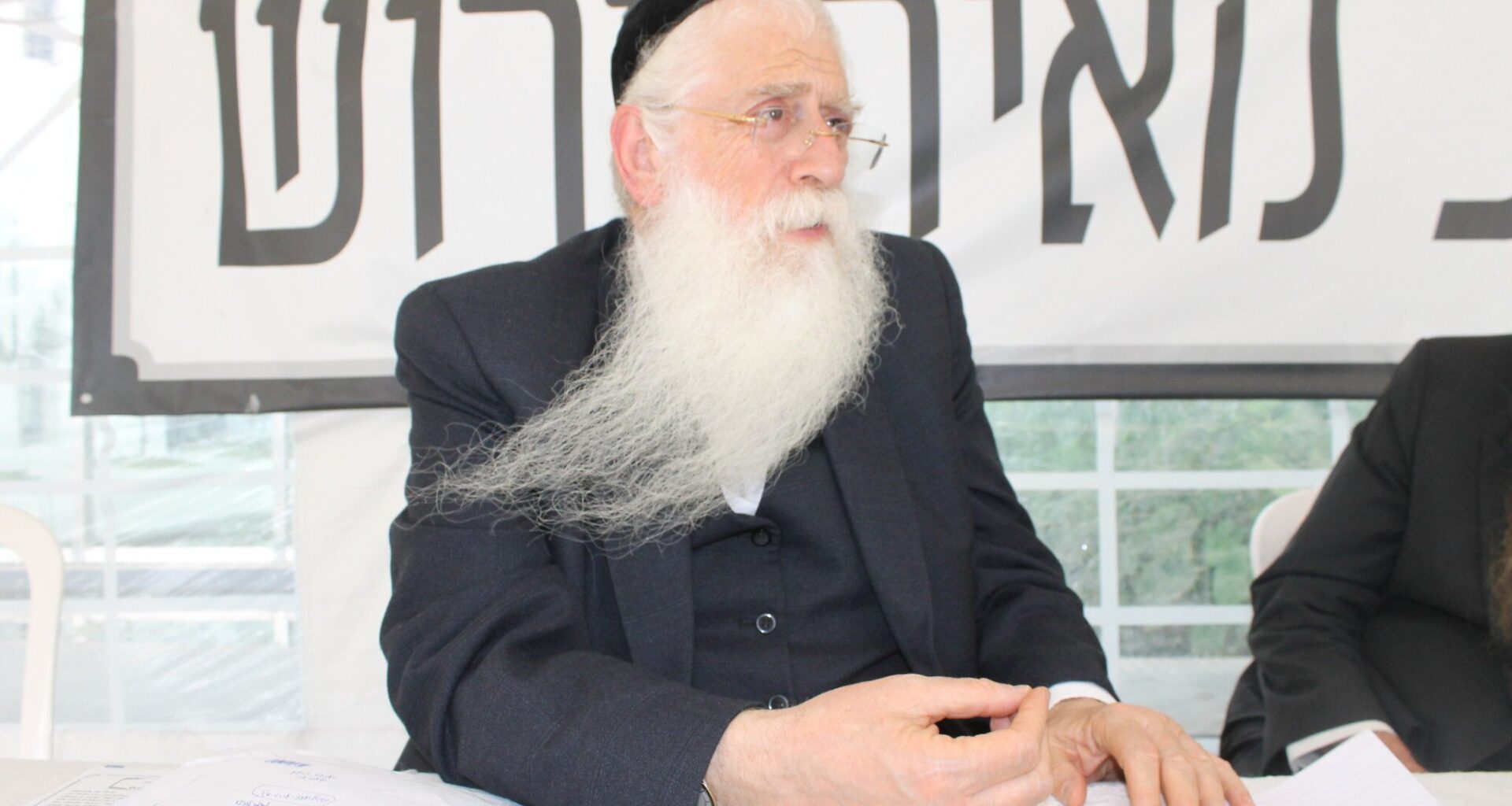
Seated in a white plastic tent in front of the stone and glass facade of the Justice Ministry in Jerusalem this week, United Torah Judaism MK Meir Porush was blistering. And it wasn’t just the 38°C (100°F) heat.
Clad in a long black coat and velvet kippa, the 70-year old ultra-Orthodox lawmaker was on the sixth day of a partial hunger strike to protest the arrest of several yeshiva students for evading the military draft in a new army push to strengthen enforcement against draft dodgers.
Arriving outside the ministry last Thursday morning, Porush — a member of UTJ’s Hasidic faction, called Agudat Yisrael, who resigned as Jerusalem affairs minister when his party recently went into the opposition — announced that he intended to relocate his office’s activities and forgo food for nine hours a day until the “persecution of Torah students” ends.
“I cannot sit comfortably in my office when the military is roaming around at night and arresting yeshiva students,” he said in the wake of the Haredi community’s declaration of “war” against the new conscription push, insisting that it was his “duty as a public representative to express our protest against the measures demanded by the attorney general.”
Haredi leaders say military service is a threat to their way of life and would keep ultra-Orthodox men from studying Torah. Many Haredim blame Attorney General Gali Baharav-Miara for the rise in arrests, saying she is pushing the IDF to crack down on evasion.
Get The Times of Israel’s Daily Edition
by email and never miss our top stories
By signing up, you agree to the terms
Some 80,000 ultra-Orthodox men aged between 18 and 24 are currently believed to be eligible for military service, but have not enlisted. The Israel Defense Forces has said it urgently needs 12,000 recruits, due to the strain on standing and reserve forces amid the ongoing war against Hamas in Gaza and other military challenges.
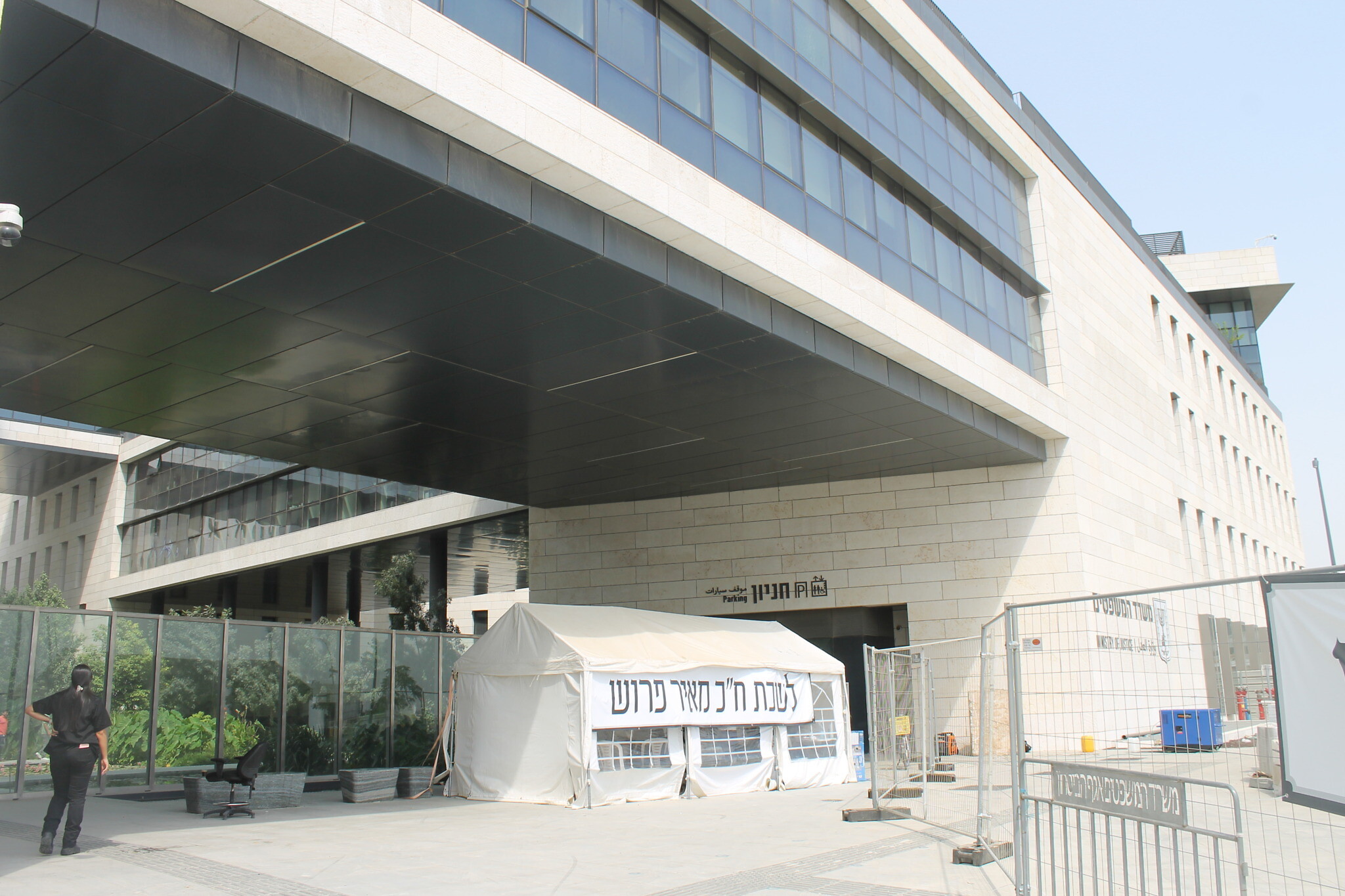
UTJ MK Meir Porush’s protest tent at the entrance to the Justice Ministry in Jerusalem, August 12, 2025. (Sam Sokol/The Times of Israel)
Last summer, the High Court of Justice ruled that longstanding mass exemptions for these yeshiva students were illegal. Since then, the IDF has significantly stepped up its efforts to recruit the eligible Haredi men, sending out 54,000 conscription orders in July alone, although the Attorney General’s Office told the court last week that the government’s efforts were insufficient.
A nonviolent ‘civil war’
When this reporter arrived to meet with Porush on Tuesday afternoon during a heat wave, the lawmaker’s generator had broken down, cutting off power to the tent’s portable air-conditioning unit and rendering it a virtual sauna.
Asked how he was feeling, the sweaty Porush replied that he had begun drinking small amounts during the day, on doctor’s orders, but had no plans to end his partial hunger strike, which also does not include Shabbat, anytime soon.
In recent weeks, Porush’s rhetoric has grown increasingly strident, and in July he stated that the arrest of yeshiva students undercut the legitimacy of the state itself.
“If they had told us back then that Torah scholars would be arrested because that’s what the attorney general wanted, in my opinion Agudat Yisrael would have said it did not want a Jewish state to be established,” he declared from the Knesset rostrum.
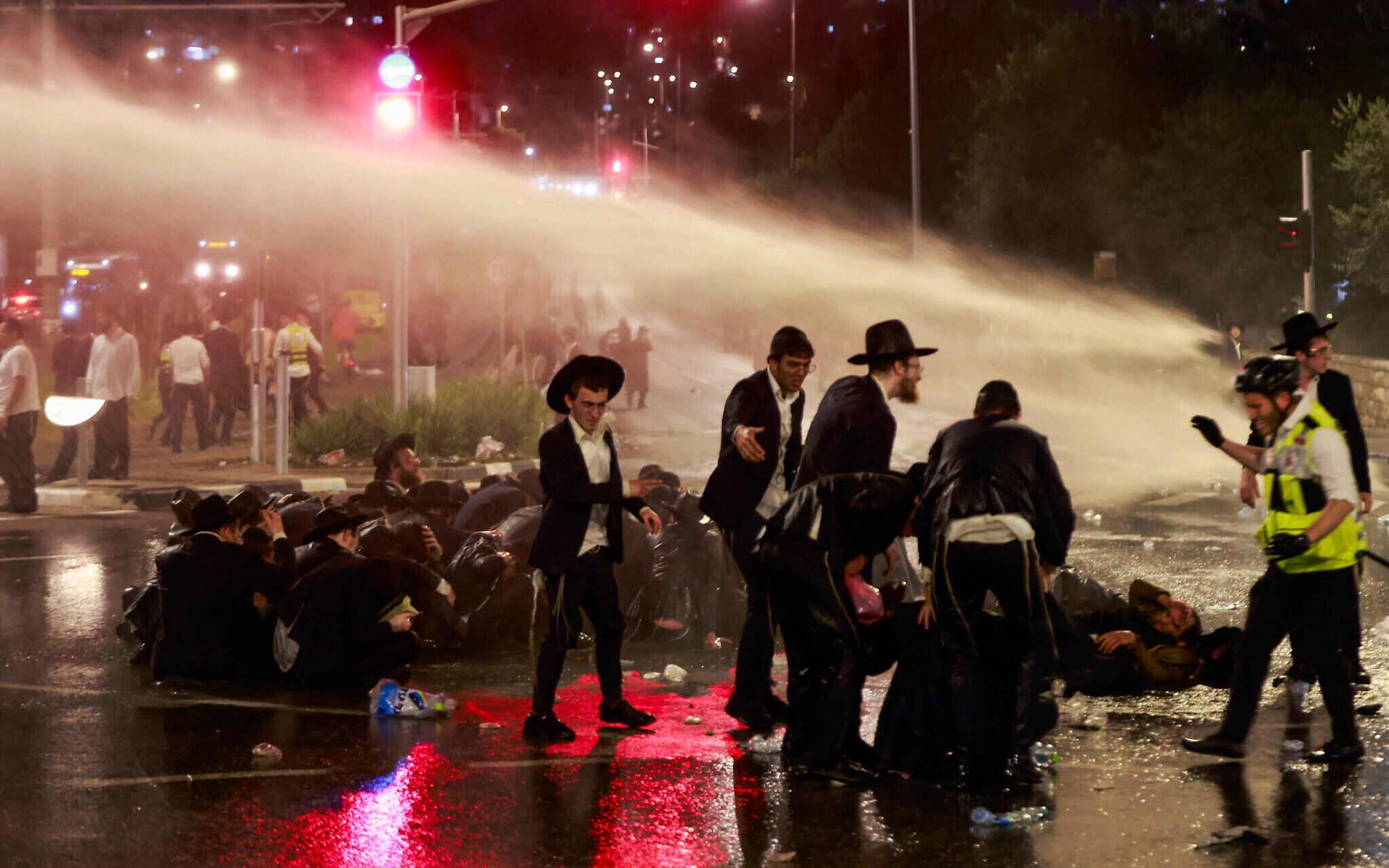
Police use a water cannon to disperse ultra-Orthodox demonstrators as they protest military enlistment orders and the arrest of yeshiva students who avoided the orders, during a rally in Jerusalem on August 7, 2025. (Menahem KAHANA / AFP)
Following his party’s decision to exit the government over its failure to pass a bill reinstating yeshiva students’ exemptions, both Porush and the Haredi leadership’s rhetoric has grown even more heated.
Speaking with the Haredi news site Kikar Hashabbat shortly after setting up his protest tent, Porush warned that the conflict over conscription could escalate into “civil war” if legislation is not passed regulating military service exemptions.
“You can’t go to war with some 1.25 million ultra-Orthodox citizens who want to live here in a certain way,” he said, arguing that unless action is taken now to deal with the issue, “it will develop and grow and no one will be able to stop it.”
Asked what he meant by a civil war, Porush told The Times of Israel that while the Haredim had “not prepared Kalashnikovs and pistols,” the authorities had “started a war with us, and we have to defend ourselves. So of course we will act — as much as they try to harm us, we will prepare. We will know how to respond.”
אז היום באוהל המחאה של ח”כ פרוש, הגנרטור שלו התקלקל ולא היה מזגן. אז הצוות שלו הביאו גנרטור חדש, והכניסו אותו דרך אזור בנייה סגור. העובדים מחו ואיימו להתקשר למשטרה… אבל הם לא התקשרו בסוף pic.twitter.com/oXCx4V3qcj
— Sam Sokol (@SamuelSokol) August 12, 2025
“Just as [Prime Minister Benjamin] Netanyahu never said exactly what he would do in Iran, I’m not going to say what I will do,” he said, declining to elaborate on the Haredi community’s strategy.
He did, however, explicitly rule out the use of violence.
“God forbid,” he declared.
As Porush spoke, a heated exchange could be heard as workers outside the ministry attempted to remove members of his staff who had driven through their construction site with a new generator.
Despite the yelling, the air conditioner was soon back online, lowering the temperature inside the tent while barely cooling Porush’s demeanor.
‘For 77 years we’ve been allowed to learn Torah’
Speaking with The Times of Israel earlier this week, a senior government source expressed optimism regarding the possibility of passing a conscription law, stating that a compromise initially agreed to by the Haredim and then-Knesset Foreign Affairs and Defense Committee chairman Yuli Edelstein in June could serve as the basis for legislation acceptable to all involved.
Edelstein’s subsequent decision to back away from the compromise and instead sharpen the sanctions on draft dodgers prompted the Haredi parties’ exit from the government and led to his own replacement as chair of the committee shortly afterwards.
Even Porush’s Agudat Yisrael faction, which has expressed extreme skepticism regarding the possibility of passing a bill both sides can support, will fall in line, the source asserted, arguing that the Haredi parties will come back to the table when the Foreign Affairs and Defense Committee, now headed by Likud MK Boaz Bismuth, formulates a new draft of the legislation based on Edelstein’s compromise.
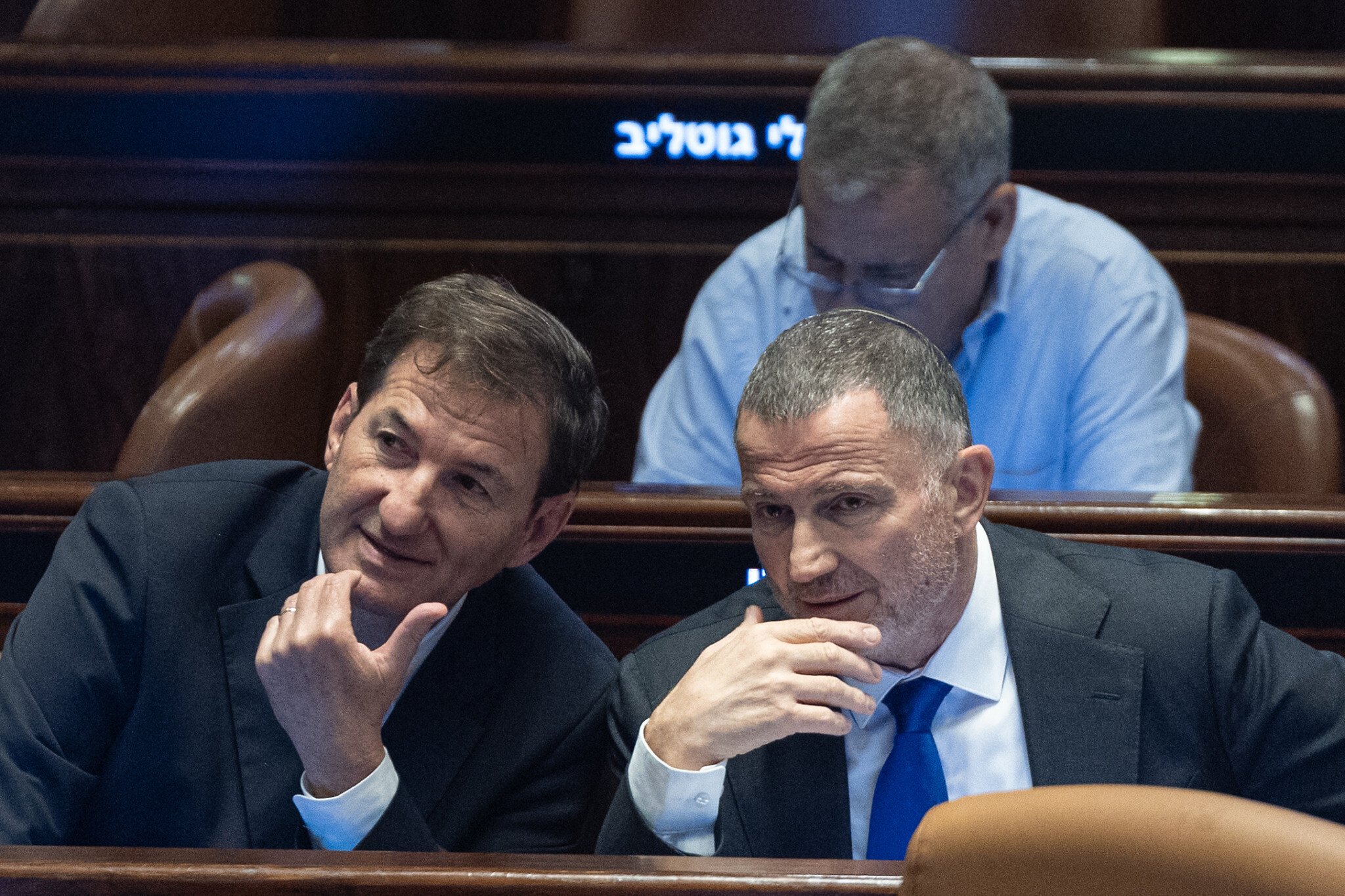
Likud MK Boaz Bismuth (left) speaks to fellow party MK Yuli Edelstein in the Knesset on July 23, 2025. (Yonatan Sindel/Flash90)
Asked what he thought about the possibility of a compromise bill containing some sanctions, Porush said he wasn’t familiar with all of the details of the Edelstein compromise but insisted that “anyone who sits and studies [Torah] gets a deferment from the army. That’s it.”
“Today yeshiva students are taken from their homes and prevented from learning Torah. That must not happen,” he said. “I know that until now we studied without sanctions. That’s how it should be.”
As to how such a bill could possibly pass muster with the High Court, Porush was evasive, stating that the matter was “complicated” and could not be solved all at once.
“I’m not saying I want to buy time. I’m saying something clear — until a year ago, anyone who studied got a deferment. That’s what I want. Whether it happens today, next week, whenever — that’s what must be,” he said.
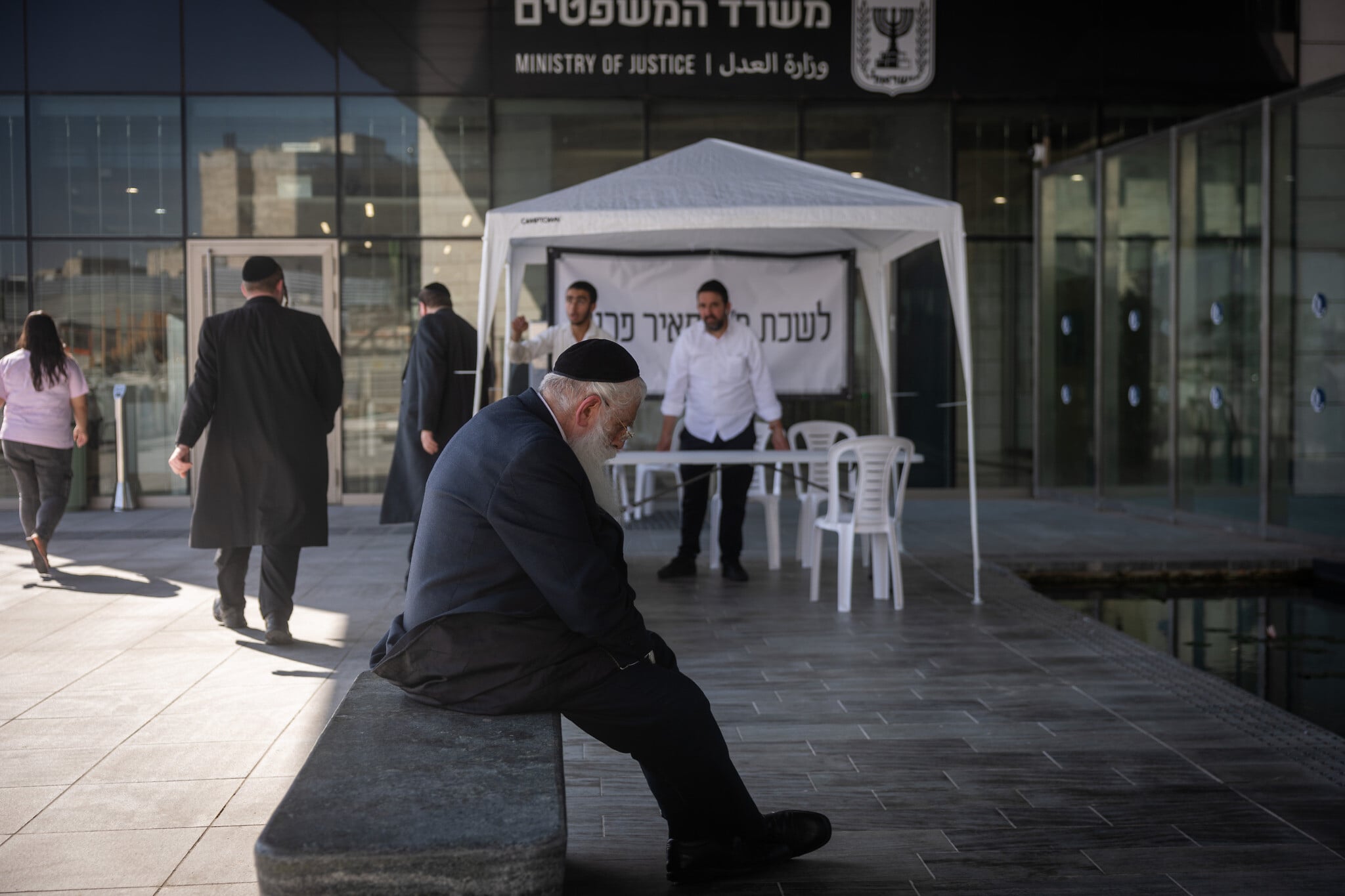
United Torah Judaism MK Meir Porush protests outside the Justice Ministry in Jerusalem following the arrest of yeshiva students who refused to enlist in the Israeli military, August 7, 2025. (Chaim Goldberg/Flash90)
Porush was also less than forthcoming when asked about his own efforts to encourage draft evasion.
A Times of Israel investigation earlier this year found that a phone hotline linked to Porush, then a member of Netanyahu’s cabinet, had been advising yeshiva students to ignore draft orders and lie to the IDF.
Under Israeli law, someone inciting others to evade service during wartime is liable to a prison term of 15 years.
Asked if it was appropriate for a government minister to actively encourage evasion during wartime, Porush said, “Speak to an attorney,” adding that he would not engage in any action that violated the law.