
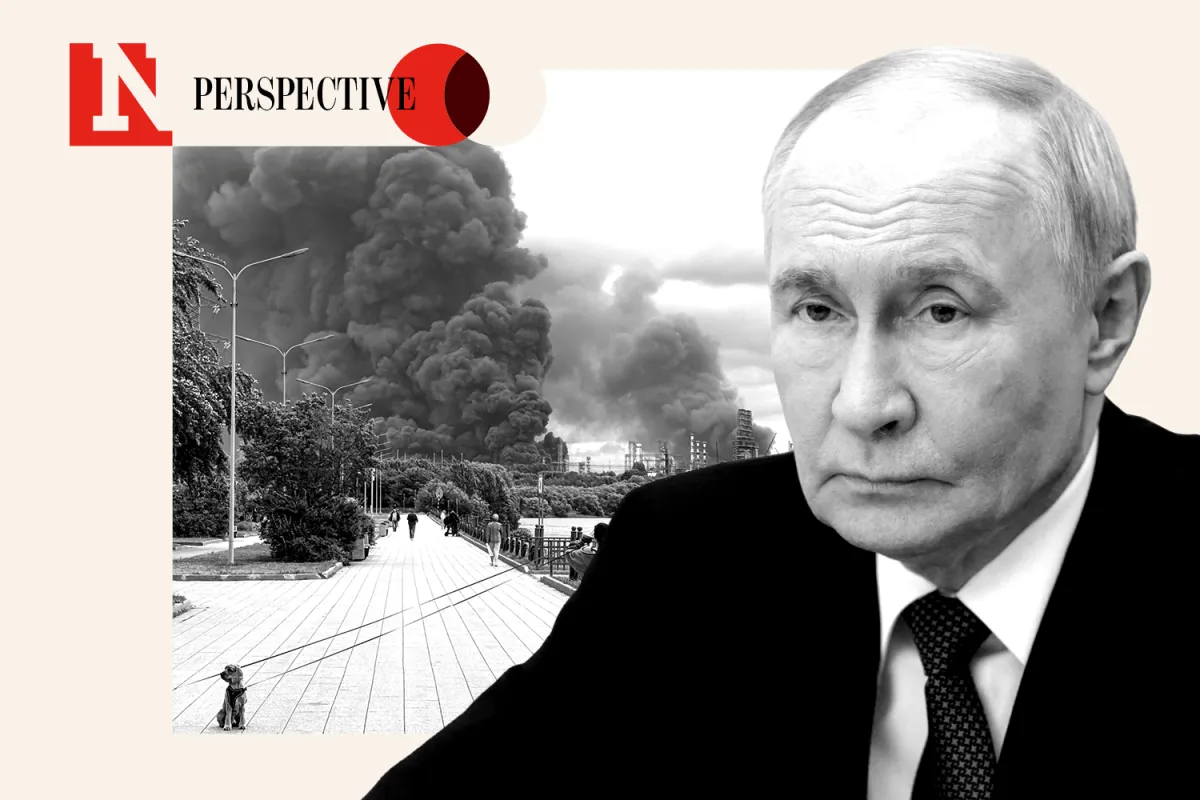
Ukraine launched on June 18 what Russian officials described as the largest drone assault on Moscow since the start of the full-scale war, sending black smoke over the southeastern Kapotnya district and striking the capital’s main oil refinery for the second time in a week.
The arresting images were a snapshot of a quieter strategic shift: two assets that have underwritten Vladimir Putin’s wartime endurance are being squeezed at the same moment.
For most of the war, two pillars have done the heavy lifting, one black, one glistening. Oil keeps cash flowing into the treasury. Gold offers an escape hatch from a dollar system the West has turned into a weapon.
Read More on Analysis
Now, Ukrainian drones are battering the physical infrastructure behind the first while financial markets deflate the value of the second.
Brent crude has dropped roughly a quarter in a month to the mid-$70s, and Urals—the grade Russia actually sells—has fallen further, by roughly a third, into the low $60s.
Gold, which hit an all-time high above $5,600 an ounce in January, has since fallen below $4,100, a seven-month low and well off its January peak, though it remains more than 20 percent higher than a year ago.
Neither pillar has yet collapsed. Both are crumbling.
The Oil Engine
Ukraine’s long-range campaign has stopped aiming at symbols and started aiming at plumbing—refineries, fuel depots, pumping stations and the rail links that turn crude into usable energy.
The Kapotnya plant supplies roughly a third of the Moscow region’s fuel. The strikes of June 16 and 18 forced it to halt crude processing and damaged its main primary-distillation unit; Reuters reported the damage may keep the refinery offline for the rest of the year.
Whatever the precise timeline, the lesson is that even Russia’s most heavily defended airspace is no longer a sanctuary.
Former U.S. Army Europe commander Ben Hodges has made the same point as strategy, not mere spectacle. He told Ukrinform last year that Ukraine should be given greater capability to strike Russia’s oil and gas infrastructure, “further disrupting their ability to export oil.”
This is the part of the war economy that crude exports cannot paper over. Russia can keep selling barrels abroad, but refined fuel is what runs the army, the harvest and the daily business of its cities.
In May alone, Ukraine struck at least 16 refineries, hitting eight of the country’s 10 largest and pushing refining throughput to its lowest level since 2009.
The strain became acute enough that Russia—among the world’s biggest fuel exporters—took the rare step of arranging gasoline imports by sea, extended its export ban and watched rationing spread to filling stations in Moscow and a dozen regions.
Moscow’s own language now points to the same vulnerability.
Putin said this week Ukrainian drones were coming in a “huge stream” and were meant to “destabilize” society, while Deputy Prime Minister Alexander Novak told him officials were considering suspending diesel exports to protect domestic motorists.
Falling prices turn the screw from the other side. Russia’s federal budget ran a deficit of 4.6 trillion rubles in the first quarter of 2026—already larger than the gap planned for the entire year—as oil and gas revenue dropped 45 percent.
The brief “war premium” that lifted prices during the U.S.-Israeli campaign against Iran is now unwinding, as an expected U.S.-Iran agreement promises to restore Gulf supply.
Physical disruption is climbing precisely as the revenue available to absorb it shrinks.
The Golden Hedge
Gold is the other half of Putin’s wartime insurance policy.
Since 2014, and intensively since 2022, Moscow built gold into a sanctions-resistant store of value. It is no one else’s liability, and bullion held at home cannot be frozen the way dollar reserves can.
After the invasion, Western governments immobilized more than $330 billion of Russia’s central bank reserves—roughly half the war chest Moscow had built—leaving the gold it can still touch carrying far more weight.
A RAND study commissioned by Britain’s sanctions directorate found gold central to Russia’s de-dollarization campaign, and noted that on the eve of the invasion Moscow had shifted its National Welfare Fund entirely into yuan and gold.
But this is also the limit of the strategy. Gold is a buffer, not an engine. As that same RAND analysis put it, gold “is not, and will not become, a substitute for oil exports.”
It can cushion a shock, but it cannot fund a war, especially one that has now run longer than the Great War of 1914 to 1918.
The Hedge Loses Its Shine
A falling gold price does not erase Russia’s bullion, but it thins the cushion at the moment Moscow most needs padding.
Bank of Russia data show the dollar value of the central bank’s gold peaked near $403 billion at the end of January and fell to about $326 billion by the end of May—a drop of roughly $77 billion, or 19 percent, in four months.
And the decline is not only a matter of price. The central bank’s reported gold holdings have also fallen: down by about 27.9 tons in the first four months of the year, the sharpest such decline since 2002, according to World Gold Council data cited by Kitco.
Natalia Milchakova, lead analyst at Freedom Finance Global, told The Moscow Times in May the sales were “first and foremost” to cover the budget deficit.
That is the quiet link between the two pillars—Moscow is liquidating its sanctions hedge precisely to plug the fiscal hole the oil shock is opening.
“In addition, the sale of gold could be aimed at forming a reserve of foreign currency—its shortage arose due to weak export income at the beginning of the year,” she said, originally in Russian. “The precious metal was exchanged for yuan.”
China, Russia’s strategic partner, which has provided the Kremlin an economic lifeline during the Ukraine war, seems to be the beneficiary.
Gold still accounts for nearly half of Russia’s usable reserves. But a hedge that is shrinking in both price and quantity, while the rest of the reserves stay frozen, is one under real strain.
Private Russians Joined the Gold Rush
The turn toward gold was never only the Kremlin’s.
Cut off from euro and dollar savings, Russian households have bought an estimated 282 tons of physical gold since the invasion—more than the entire official reserves of Spain—and official World Gold Council data shows consumer demand still rose in 2024.
Dmitry Kazakov of BCS Global Markets put the behavioral shift plainly: after sanctions-related restrictions, foreign currency became a less convenient savings tool, and demand for gold has risen since 2022.
Russian banks, by contrast, roughly halved their physical gold holdings that year, cashing in as prices set records. And in March, Putin signed a decree banning most exports of gold bars heavier than 100 grams, which officials justified as a crackdown on illicit capital flight.
A state fully confident in its golden hedge does not bolt the door to stop it leaving.
Resilience Is Not Immunity
None of this means Russia is running out of money. Gold remains well above its level of a year ago, and oil is still an enormous revenue stream.
Moscow has spent three years proving it can adapt—rerouting oil to China and India behind a shadow fleet, rebuilding payment rails, and absorbing shock after shock that was supposed to break it.
The deficit is being financed cheaply through domestic borrowing and an estimated 11 trillion rubles in liquid reserves, leading some analysts to expect the Kremlin to spend more this year, not less.
CEPA’s David Axe argued in December that Ukraine’s deep-strike campaign produced powerful images but still lacked enough force to push Russia toward defeat.
The same month Sergey Vakulenko, a senior fellow at the Berlin-based Carnegie Russia Eurasia Center think tank, told CNN that “the amount of economic damage one has to inflict on Russia is probably more than Ukraine could create at the moment.”
“I believe that if push comes to shove, Russia could probably survive with half of its oil and gas exports,” Vakulenko continued.
Crumbling, Tumbling
The argument here about Russia’s two pillars is narrower.
Both are becoming more expensive to maintain and less reliable at the same time.
That thesis would, of course, weaken if Urals climbs back toward $80, if Ukraine’s strike tempo proves impossible to sustain through the winter, and if gold steadies near current levels—each of which is plausible.
For now, though, the trend lines point the other way.
Putin’s domestic bargain has always rested on a promise that the war can be kept distant, manageable and affordable.
Drone strikes on the Kapotnya refinery have put the smoke over Moscow’s own skyline; a sliding oil price and a shrinking gold cushion make the bill harder to pay.
The two pillars are still standing. They are simply no longer as solid as the Kremlin needs them to look. Perhaps one day, they will come tumbling down.

In a polarized era, the center is dismissed as bland. At Newsweek, ours is different: The Courageous Center—it’s not “both sides,” it’s sharp, challenging and alive with ideas. We follow facts, not factions. If that sounds like the kind of journalism you want to see thrive, we need you.
When you become a Newsweek Member, you support a mission to keep the center strong and vibrant. Members enjoy: Ad-free browsing, exclusive content and editor conversations. Help keep the center courageous. Join today.
