

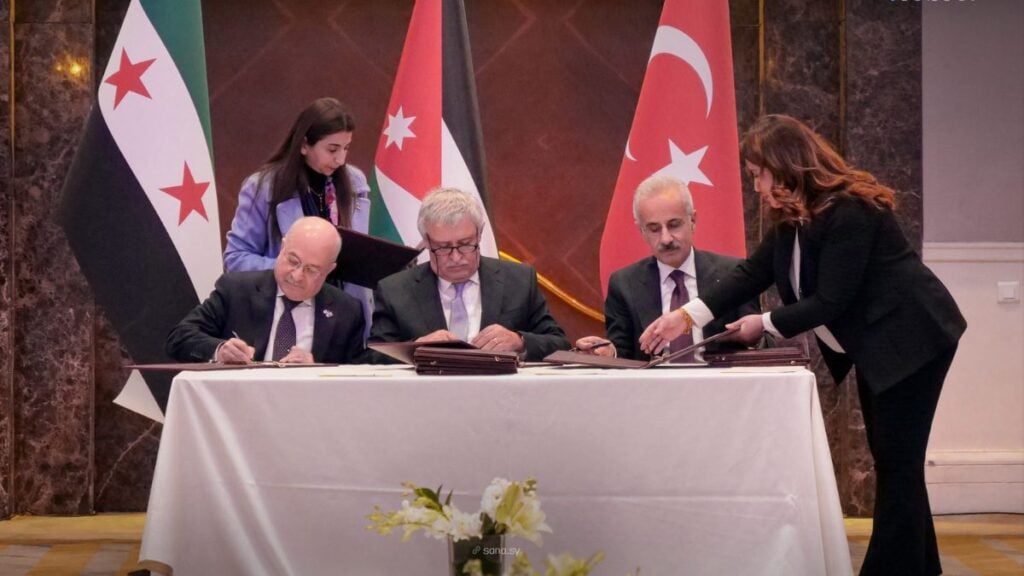
Image:Transport ministers of Syria, Jordan, and Turkey sign a memorandum of understanding to strengthen cooperation in land, air and maritime transportation, railway projects, and regional logistics connectivity, April 7, 2026. The agreement reflects the growing regional effort to expand transport networks and develop alternative trade routes. (SANA)
According to reports published by TheMarker and Haaretz, Transportation Minister Miri Regev recently sent a letter to Prime Minister Benjamin Netanyahu concerning the strategic implications of the India-Middle East-Europe Economic Corridor (IMEC) and regional developments. The letter demonstrates that the debate surrounding IMEC and initiatives designed to bypass Israel has reached the highest levels of government.
The letter focuses primarily on international developments, the Abraham Accords, and U.S. policy. Yet it also raises a broader strategic question: Is Israel concentrating mainly on what other countries are doing, or is it investing enough in strengthening its own competitive advantages?
In two articles published in The Times of Israel on June 5 and June 13, I suggested that Saudi Arabia, Turkey, and Qatar could promote alternative trade corridors bypassing Israel. If a long-term competition over post-war trade routes is indeed emerging in the aftermath of the U.S.-Iran conflict, Israel’s response cannot be limited to diplomatic discussions alone. It must also include significant investment in infrastructure, logistics, and industry.
The Port of Eilat should become far more than a local port or a “dry port.” It has the potential to serve as Israel’s southern gateway for trade with India, the Gulf states, and Asia. Around it, Israel could develop an advanced industrial, logistics, and services hub that connects raw materials and components arriving from Asia with Israel’s technological expertise, research capabilities, and innovation ecosystem. Such an approach would enable the production of high-value-added goods in Israel while strengthening the country’s role in global supply chains.
At the same time, Ramon Airport should be developed into an international air cargo hub supporting both imports and exports of advanced products while continuing to serve as a major tourism gateway. The combination of a modern seaport, cargo airport, industrial zone, and advanced transportation infrastructure could transform the Eilat region into a new economic center serving both Israel and its regional partners.
Alongside these economic discussions, recent months have also seen public reports and security assessments concerning Eilat and the Red Sea region. Regardless of the accuracy of those assessments or the circumstances surrounding their publication, such public discourse can influence the risk perceptions of investors, insurers, and international business partners. At a time when neighboring countries are actively promoting alternative trade routes, maintaining a reputation for stability, operational continuity, and long-term security carries significant economic value.
If Israel seeks to position itself as a central player in the economic corridor linking India, the Middle East, and Europe, the debate should not focus solely on who is responsible for regional developments. The more important question is how Israel can leverage its unique advantages to offer the most competitive route. Eilat could become one of the keys to that strategy.
The vision of “Eilat 2035” is not simply a plan for developing one city. It could become a cornerstone of Israel’s economic and geopolitical strategy for the coming decade.
Rafi Glick is a writer, lecturer, farmer, and business executive with decades of experience at the intersection of academia, technology, agriculture, and international trade.
• He has served as a Senior Teaching Associate at Ben-Gurion University of the Negev, Ono Academic College, Ariel University, Ruppin Academic Center, and as a guest lecturer at Sofia University’s Faculty of Economics and Business Administration (FEBA). At Ben-Gurion University he also advised the BGU–NHSA Accelerator in the Faculty of Science.
• In business, Rafi was CEO of Bidsnet Ltd., a pioneer in deploying fiber-optic cables through unconventional infrastructure (in partnership with CableRunner), delivering high-speed connectivity to homes, enterprises, institutions, and cellular networks. Earlier he held senior roles at ECI Telecom and served on the board of RLF Venture Capital, working with partners such as Intel, Teva, and the Jerusalem Development Authority.
• He contributed extensively to Israel’s trade and investment ecosystem: he directed industrial and agricultural technology divisions at the Israel Export Institute, founded Israel’s AGRITECH as international exhibition, and served on the board of the Israeli Investment Center at the Ministry of Industry and Trade.
• In his early career, Rafi established and served as the first director of the Cargo and Aircraft Supply Security Department in the Security Division at Ben-Gurion Airport (1972–1976). He lived in Kibbutz Parod until 1974.
• Rafi has also been recognized for his writing: in 2008 he was named Best Economic Blogger by TheMarker, Israel’s leading business daily.
• Today he continues to publish essays and commentary—with a special passion for astrophysics, space exploration, technology, economics, and social issues.
From Kibbutz Parod to the global stage, Rafi Glick’s career reflects a lifelong commitment to building connections—between people, industries, and ideas.
Email: rafi.glick@gmail.com