
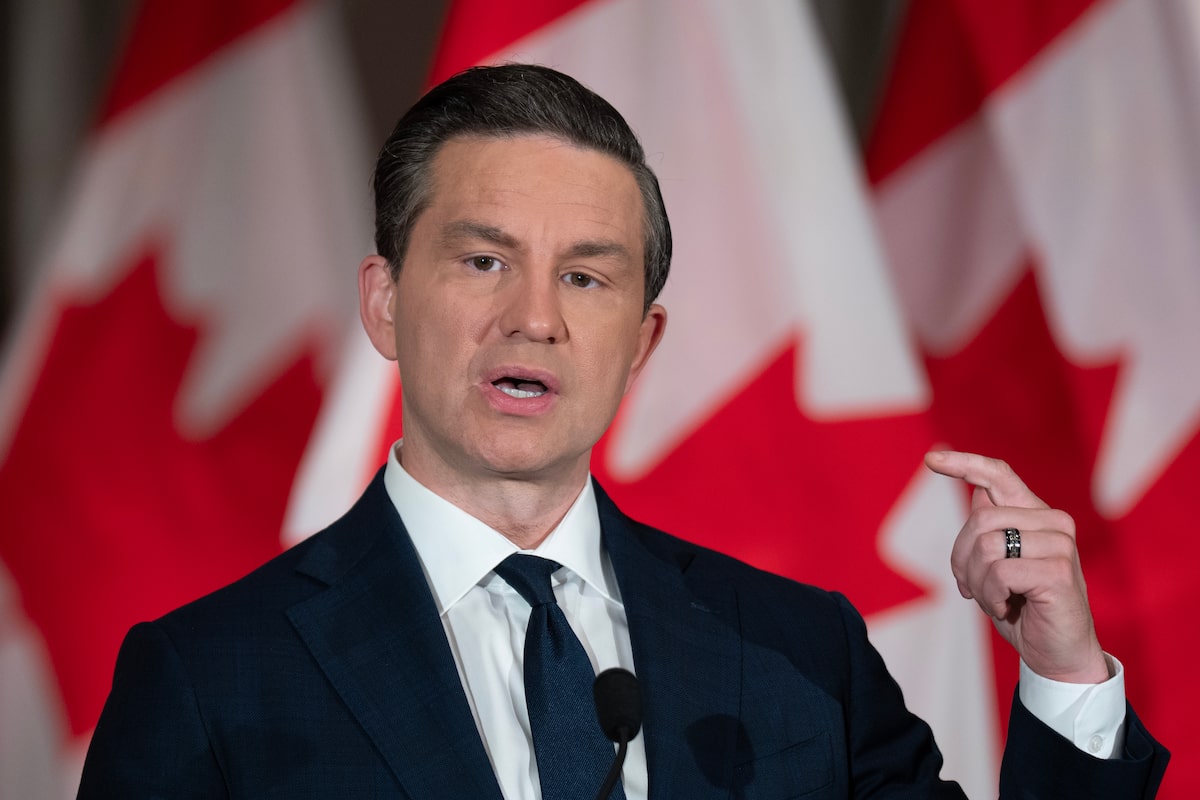
Conservative Leader Pierre Poilievre said Wednesday that Canada should respond to Beijing’s latest canola tariffs by cancelling a $1-billion federal loan to BC Ferries for the purchase of Chinese-made vessels.Adrian Wyld/The Canadian Press
Mark Carney said discussions are under way on supports for farmers facing a major setback after China hiked tariffs on canola products this week.
The Prime Minister made the comments after coming under criticism from Conservative Leader Pierre Poilievre for not publicly addressing the issue sooner.
Earlier Thursday, Mr. Poilievre accused Mr. Carney of showing weak leadership for not speaking out about Beijing’s increased tariffs since they were announced on Tuesday.
“I had my team check his Twitter account. He hasn’t tweeted a single thing about canola. Yet, he’s been able to tweet about International Cat Day. So isn’t that nice?” Mr. Poilievre told reporters in Saskatchewan Thursday morning.
“We need a Prime Minister who will actually stand up for all Canadians, including and especially our prairie producers.”
Canola industry asks Ottawa to curtail vegetable-oil imports after China imposes new trade barriers
You can’t fly sovereignty on foreign fuel
On Tuesday, Beijing had announced 75.8-per-cent duties on Canadian canola seed, which followed the imposition of 100-per-cent tariffs on canola oil and meal in March.
The move means all Canadian canola products are effectively barred from China.
Later Thursday, Mr. Carney did post on social media about the dispute, calling the duties unjustified, and saying that he’s spoken to Saskatchewan Premier Scott Moe about the issue.
“Premier Moe and I focused on a series of measures to support hard-working farmers who provide world-class food to Canadians and our trading partners throughout the world,” Mr. Carney’s post said.
He said he and the Premier agreed to engage with industry leaders “in the near term” to discuss the options.
The canola industry wants Ottawa to limit imports of used vegetable oils to shore up domestic demand, but Mr. Carney’s statement did not mention that request.
In imposing the canola tariffs, China’s Ministry of Commerce has argued that Canada’s canola sector has benefited from extensive government subsidies and preferential policies that distort markets, and that they launched their own anti-dumping probe.
“Canada does not dump canola. Canadian canola products meet the highest standards, and our inspection systems are robust,” Mr. Carney said.
“We will advance a constructive dialogue with Chinese officials to address our respective trade concerns, while diversifying our trade abroad and supporting our canola producers at home.”
The tariffs on canola are connected to the Liberal government’s decision last year to impose a tariff on Chinese-made electric vehicles and 25-per-cent tariffs on Chinese steel and aluminum.
Mr. Moe said Tuesday that he wants Mr. Carney to meet with the President of China to end the dispute.
“Our federal government cannot sacrifice a $43-billion canola industry, 200,000 jobs in that industry, that is largely based, in fairness, in Western Canada to protect a fledging electric-vehicle industry largely based in Eastern Canada.”
Alberta by-election where Poilievre is running highlights need for electoral reform, protesters say
Mr. Poilievre said Canada must look at ways it can penalize the Chinese government, reiterating his call for the government to cancel the Canada Infrastructure Bank’s $1-billion loan to BC Ferries for the purchase of Chinese-made vessels.
But he did not directly answer a question about whether he thinks the EV tariffs should be lifted.
Canada should use the revenue from the trade dispute to support affected Canadian sectors, he said.
“And that, of course, is mostly our canola producers,” he said.
“So, it’s time for the federal government to start treating the Prairies and Western Canada with the respect people here deserve. It’s time for a strong voice to stand up for the West.”
Mr. Poilievre lost his seat in the April general election and is now running in the Alberta riding of Battle River-Crowfoot. The vote in that by-election is set for Monday.
He was asked Thursday whether he can remain as leader of the party if his share of the vote in that election falls short of the nearly 83 per cent that the Conservative candidate, Damien Kurek, won in the April election.
He did not directly answer the question.
Mr. Poilievre also faces a leadership review at the party’s national convention in January.
With a report from Kate Helmore and Bill Curry