

Azerbaijan on Monday condemned Israel’s recognition of the Armenian genocide, calling it a “distortion of the historical facts,” and urged the government to reverse the move.
Israel formally recognized the 1915 Armenian genocide for the first time Sunday amid the collapse in its ties with Turkey, which denies that the World War I-era atrocities constitute a genocide.
Azerbaijan, which has fought multiple rounds of conflict with neighboring Armenia, takes the same position as Turkey.
However, unlike Ankara, Baku has maintained close relations with Israel and has been a key regional partner to Jerusalem in recent years. Israel, which is very reliant on Azerbaijani oil, is a major arms supplier to Baku.
“The decision by the Israeli government concerning the so-called ‘Armenian genocide’ is a matter of serious concern,” Baku’s Foreign Ministry said in a statement.
Get The Times of Israel’s Daily Edition
by email and never miss our top stories
By signing up, you agree to the terms
“The distortion of the historical facts surrounding the events of 1915, and the reduction of a complex historical issue to a political decision without a sound legal or scholarly basis, are unacceptable,” Baku said.
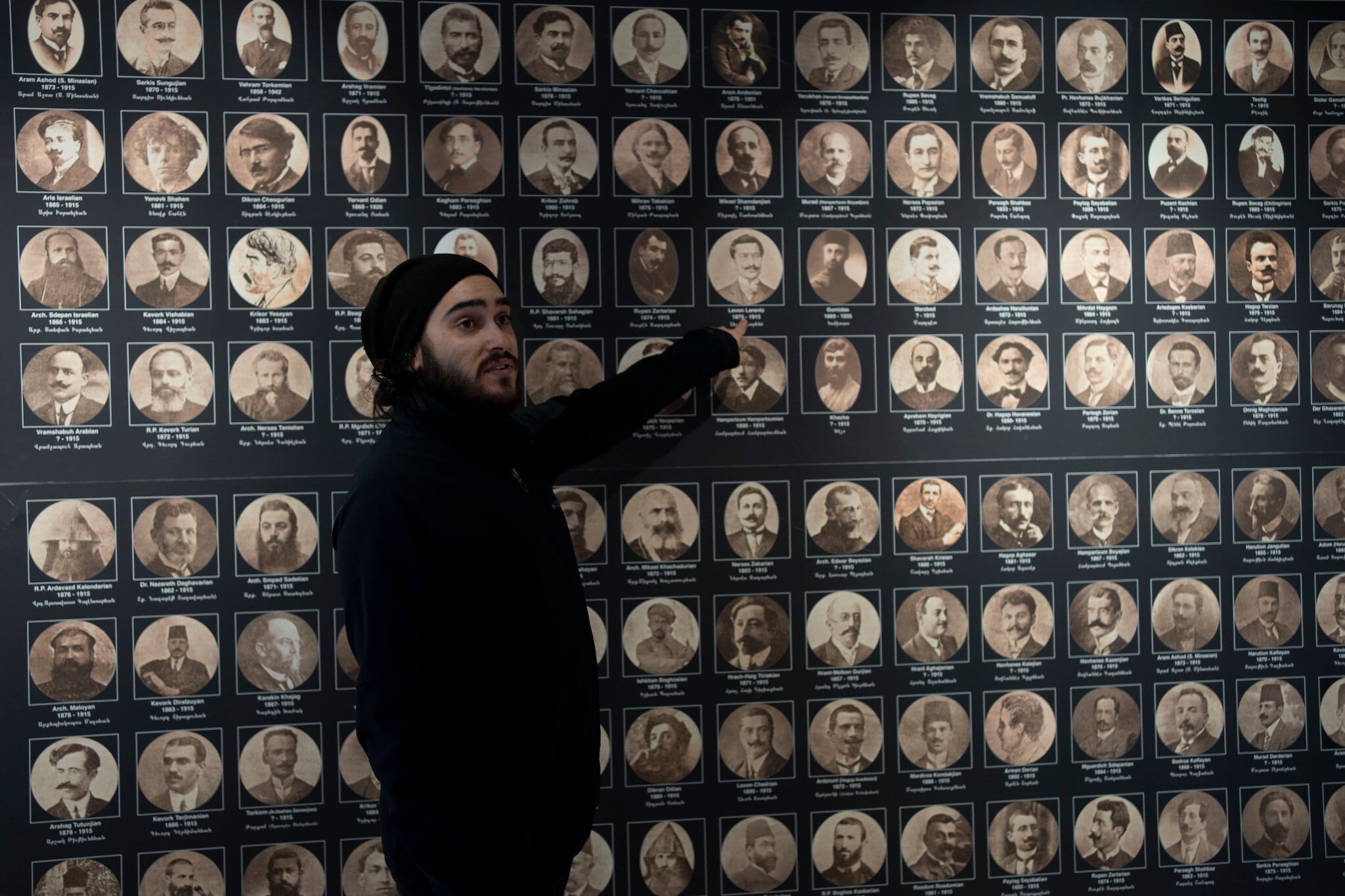
Tour guide Arek Kahkedjian gestures to a display on the Armenian genocide in the Armenian Museum in the Old City of Jerusalem, January 11, 2023. (AP Photo/ Maya Alleruzzo)
The statement added: “Such actions do not contribute to reconciliation or mutual understanding. Instead, they deepen existing divisions and undermine efforts to achieve lasting peace and stability in the region.”
“We call on the Israeli government to reconsider this decision,” it said.
The Israeli government voted Sunday to recognize the Armenian genocide in a move that was sure to antagonize Turkey, which accuses Israel of genocide in Gaza but fiercely denies the charge applies to the Ottoman Empire’s wholesale killing of Armenians during World War I.
Foreign Minister Gideon Sa’ar wrote on X after the bill passed unanimously that “it’s never too late to do the right thing.”
“Israel joins 32 countries that have fulfilled a moral duty by recognizing the historical truth, and rejecting attempts to deny it,” Sa’ar wrote.
In a bid to avoid tension with Turkey, Israel had long refrained from using the word “genocide” to refer to the campaign of massacres, imprisonment and forced deportation that the Ottoman Empire, Turkey’s forerunner, committed against Armenians in the empire’s final years.
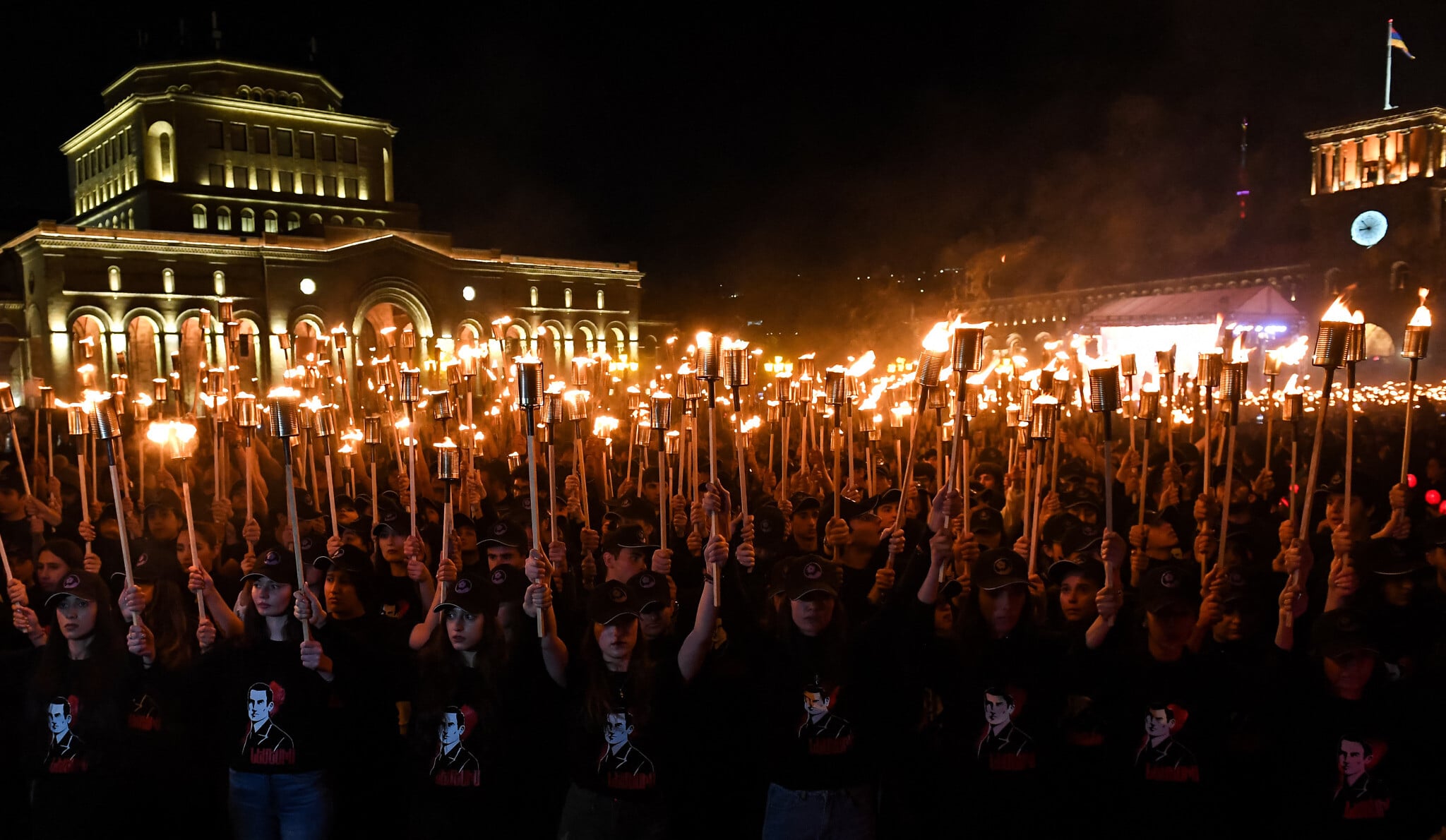
Armenians take part in the annual torch march on the eve of the Genocide Remembrance Day in Yerevan, on April 23, 2025. (KAREN MINASYAN / AFP)
Turkey accepts that many Armenians living in the Ottoman Empire were killed in clashes with Ottoman forces during World War I, but contests the figures and has long denied that the killings were systematically orchestrated and constitute a genocide.
Israel’s already strained ties with Turkey tanked after the Hamas terror group invaded southern Israel on October 7, 2023, sparking the war in Gaza. Turkish President Recep Tayyip Erdogan, who supports Hamas, has compared Israel’s actions to those of Nazi Germany, and all but cut his country’s once-robust trade ties with Israel. Israel fiercely denies the charge of genocide in Gaza.
Amid the rupture with Turkey, Prime Minister Benjamin Netanyahu said for the first time in August 2025 that he recognizes the Armenian genocide. Ankara accused him at the time of seeking “to exploit past tragedies for political motives.”
Asked at a press conference Saturday night if he supports the Armenian genocide recognition bill, Netanyahu said: “I certainly support it.”
Netanyahu, who is Israel’s longest-serving premier, said he had never tried to block recognition of the genocide, and declined to comment on whether there was concern about Turkey’s reaction to the move.
Agencies and Times of Israel staff contributed to this report.
We can’t do this work alone.

The war with Iran has been draining for all of us in Israel. But when I heard about a high casualty incident – ballistic missile impacts in Arad and Dimona that left nearly 200 people wounded – I drank a cup of coffee, packed a bag, and headed south.
There, I spoke with Shilgit, the head of an after-school program for underprivileged youth. Standing outside her destroyed center, Shilgit said it was a miracle that no children were hurt and spoke about the community coming together in the hours since.
As a Times of Israel reporter, I’m committed to telling stories of resilience like Shilgit’s. But my colleagues and I can’t do this alone. If you value work like this, please consider joining our reader support group, The Times of Israel Community. Your financial support is essential to keep real human reporting like this going.
— Stav Levaton, military reporter
Already a member? Sign in to stop seeing this
You’re a dedicated reader

That’s why we started the Times of Israel – to provide discerning readers like you with must-read coverage of Israel and the Jewish world.
So now we have a request. Unlike other news outlets, we haven’t put up a paywall. But as the journalism we do is costly, we invite readers for whom The Times of Israel has become important to help support our work by joining The Times of Israel Community.
For as little as $6 a month you can help support our quality journalism while enjoying The Times of Israel AD-FREE, as well as accessing exclusive content available only to Times of Israel Community members.
Thank you,
David Horovitz, Founding Editor of The Times of Israel