
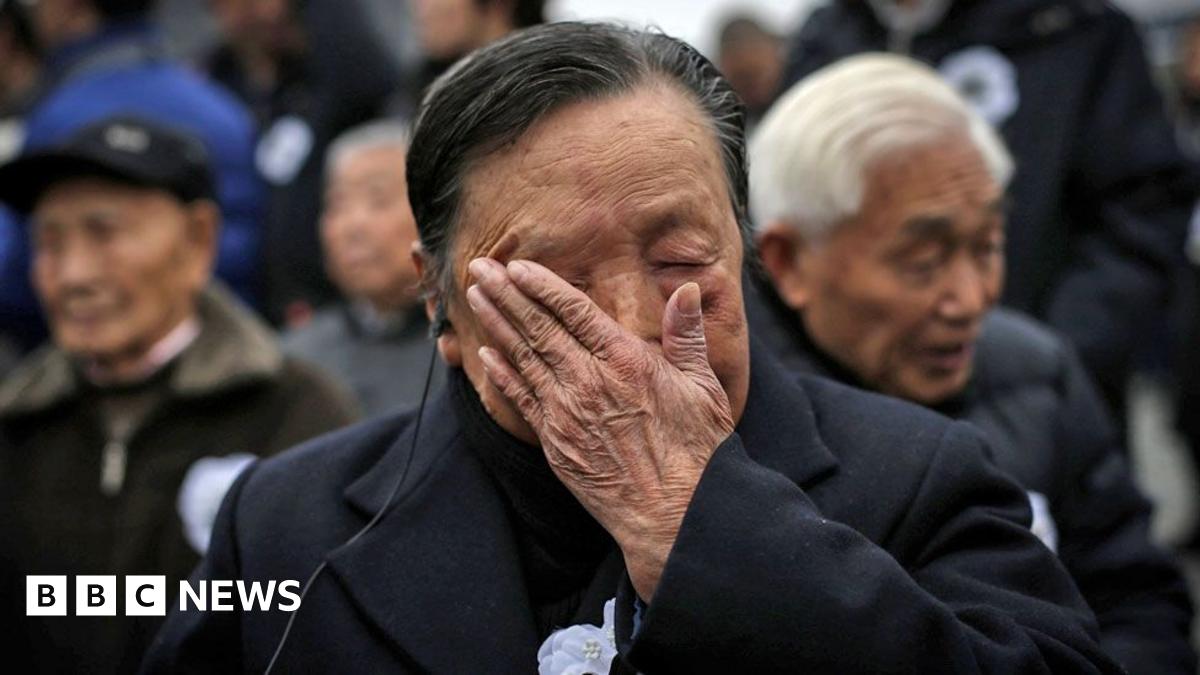
For China, Japan’s brutal military campaign and occupation are among the darkest chapters of its past – and the massacre in Nanjing, then the capital, an even deeper wound.
What has made it fester is the belief that Japan has never fully owned up to its atrocities in places it occupied – not just China, but also Korea, what was then Malaya, Philippines, Indonesia. One of the most painful points of contention involves “comfort women” – the approximately 200,000 women who were raped and forced to work in Japanese military brothels. To this day, the survivors are still fighting for an apology and compensation.
In his video, Kato seems to acknowledge that it’s not a subject of conversation in Japan: “Unfortunately these anti-Japanese war movies are not shown in Japan publicly, and Japanese people are not interested to watch them.”
When the Japanese Emperor announced on 15 August that he would surrender, his country had already paid a terrible cost – more than 100,000 had been killed in bombing raids on Tokyo, before two atom bombs devastated Hiroshima and Nagasaki.
Japan’s defeat, however, was welcomed in large parts of Asia, where the Imperial Japanese Army had claimed millions of lives. For them, 15 August carries both freedom and lingering trauma – in Korea the day is called ‘gwangbokjeol’, which translates to the return of light.
“While the military war has ended, the history war continues,” says Professor Gi-Wook Shin, of Stanford University, explaining the two sides remember those years differently, and those differences add to the tension. While the Chinese see Japanese aggression as a defining, and devastating, moment in their past, Japanese history focuses on its own victimhood – the destruction caused by the atom bombs and post-war recovery.
“People I know in Japan don’t really talk about it,” says a Chinese man who has been living in Japan for 15 years, and wished to remain anonymous.
“They see it as something in the past, and the country doesn’t really commemorate it – because they also view themselves as victims.”
He calls himself a patriot, but he says that hasn’t made things difficult for him personally because their reluctance to talk about it means they “avoid such sensitive topics”.
“Some believe the Japanese army went to help China build a new order – with conflicts occurring in that process. Of course, there are also those who acknowledge that it was, in fact, an invasion.”