
When an Israeli defense founder maps a U.S. entry, the pins go in the obvious places. Washington for the customer, Northern Virginia for the contracts, Silicon Valley for the money. That map is a decade out of date. The center of gravity in American defense technology has quietly moved to the Midwest, and the single most important place an Israeli counter-UAS, electronic-warfare, or autonomy company can land in 2026 is Ohio. Not because Ohio writes the checks, but because Ohio is where defense technology now gets validated, and then scaled.
Validation is the word that matters. Wright-Patterson Air Force Base, outside Dayton, is the largest single-site employer in the state, but the headcount is beside the point. Wright-Patt is home to the Air Force Research Laboratory, the service’s science-and-technology engine, and to the Air Force Life Cycle Management Center, which runs cradle-to-grave acquisition for nearly every Air Force aircraft, engine, munition, and electronic-warfare system. The National Air and Space Intelligence Center reads the adversary’s order of battle from the same campus. For a foreign company, this is the rarest adjacency in defense. The room where requirements are written sits beside the lab that decides whether your technology actually works, and an AFRL evaluation is a credential the entire U.S. acquisition system reads.
And there is somewhere to fly it. Forty minutes from Wright-Patt, Springfield-Beckley operates SkyVision, an air-traffic system for uncrewed aircraft, plus a 225-square-mile block of airspace cleared for beyond-visual-line-of-sight flight up to 18,000 feet. It is among the most permissive operational test ranges in the country, and it shares a flightline with MQ-9 Reaper operations. For drones, counter-drone interceptors, and autonomy stacks, that is the gap between a demo on a closed range and a U.S.-validated flight profile a program office will trust. Israel knows how to build the hardware. Ohio is where America agrees it works.
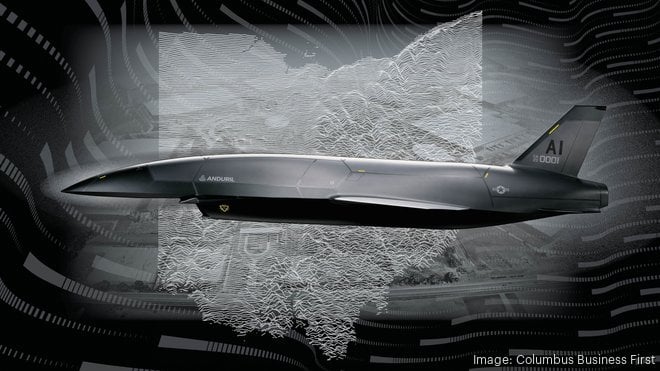
Then came the magnets. In barely two years, two companies have turned that validation cluster into a production base. Anduril broke ground in Pickaway County, south of Columbus, on Arsenal-1, a five-million-square-foot, $900-million-plus hyperscale weapons plant and the largest single job-creation project in Ohio’s history. It went from dirt to a live production line in about fourteen months, ahead of schedule. The first lines build Fury, the Air Force’s semi-autonomous “robotic wingman,” alongside the Roadrunner-M counter-drone interceptor and the Barracuda cruise-missile family. Forty minutes west, Joby Aviation is scaling electric vertical-takeoff manufacturing in Dayton, where it has just acquired a second 700,000-square-foot plant, turning the birthplace of aviation back into an aircraft factory.
These two are pulls in the precise sense, anchor tenants whose appetite drags an entire supply base into the state. And this is where the opportunity for Israel turns concrete. Anduril’s production model is deliberately open. Close to 90 percent of its hardware uses commercially available components, drawn from a network of thousands of suppliers, on a software-defined factory floor that re-tasks between Fury, Roadrunner, and Barracuda in days rather than years. That is not a legacy prime’s sealed bill of materials. It is a doorway. A company with a better seeker, a better datalink, a sharper EW payload, or a more capable autonomy module can be designed in, not locked out. The Israeli counter-UAS and electronic-warfare benches, the deepest in the world and hardened by a decade of live engagements, map almost exactly onto what these Ohio lines need next.
So the play is not to open a Washington office and lobby. It is to land in Ohio and partner. Validate the technology against AFRL and the Wright-Patt program community, fly it at Springfield-Beckley, and plug into the supply chains being built out right now by Anduril, Joby, and the established primes already operating in the state, among them GE Aerospace, L3Harris, Sierra Nevada, and General Dynamics. A subsystem designed into a Fury-class platform or a counter-drone interceptor is worth more than any number of meetings on the Potomac, because it becomes recurring revenue inside a program of record. The U.S. defense market does not reward the best slide deck. It rewards the company that is already in the airframe.
The cultural fit is the quiet accelerant. Ohio’s defense ecosystem prizes the same thing Israeli engineering does, delivery over narrative, hardware that flies over hardware that’s promised. Anduril’s fourteen-month sprint is a Midwestern story as much as a Silicon Valley one, the work of a skilled manufacturing base that can stand a line up fast and keep it running. That is the tempo Israeli operator-founders, many of them out of 8200 and the IDF’s technology units, already work at. They will recognize the place when they see it.
None of this asks Israel to abandon Washington. It asks Israeli founders to see that the Washington decision is increasingly validated in an Ohio lab, flown over an Ohio range, and built on an Ohio production line. That is why the framing should read Israel–Ohio, with Israeli capability arriving first, into the one ecosystem in America purpose-built to prove it and scale it. The companies that understand this before the rest of the field will not be landing in flyover country. They will be landing exactly where the next decade of allied defense production is being assembled, and they will have read the map first.
Will F. Simon is an expert in the Israeli automotive, defense and investment sectors and has worked for some of Israel’s top AutoTech companies – including Cognata, Foretellix, and Guardian Optical Technologies. Will splits his time between DC, Miami, and Israel and has dedicated his life and career to increasing Israeli security through regional cooperation and investment.