
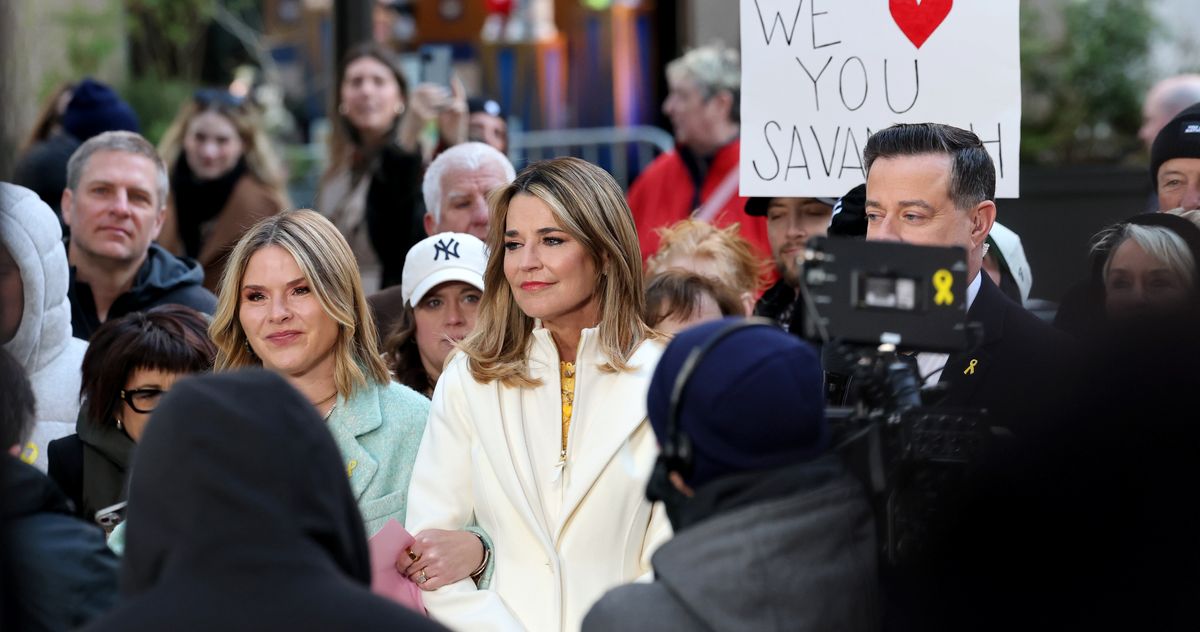
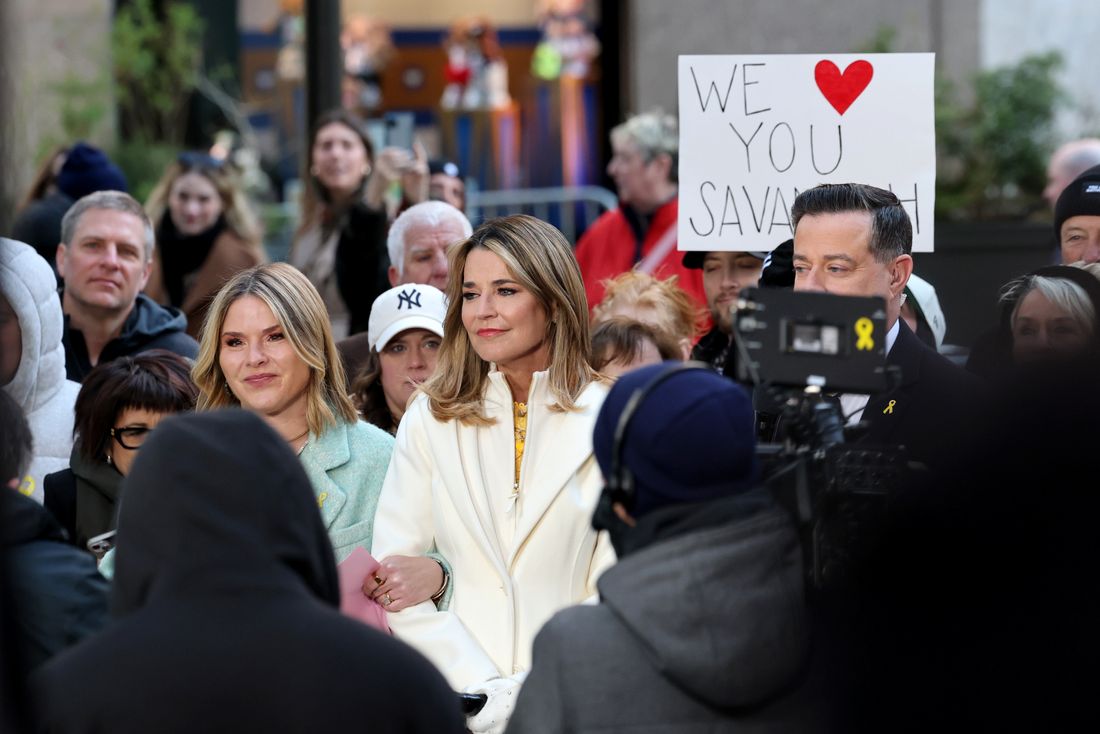
Savannah Guthrie with Jenna Bush Hager and Carson Daly on her first day back in April.
Photo: Luiz C. Ribeiro
The call came midafternoon on Sunday, February 1. Savannah Guthrie, the Today show co-anchor, and her husband, Mike Feldman, a public-relations executive, had just returned to their Brooklyn Heights townhouse from parallel weekends away: She and the kids, 9 and 11, had been at Today colleague Carson Daly’s Long Island home for a sleepover with his four children; Feldman had been on a tennis trip with friends, a Christmas gift from his wife. They were unpacking and debriefing when her sister, Annie, called from Tucson.
Guthrie knew immediately that something was wrong. “Is everything okay?” she asked.
Their mother, who had just gotten a shout-out on the Today show on her 84th birthday, usually spent Sundays with a group of friends, watching a livestream of the church service at Guthrie’s Manhattan congregation. Early that morning, one of those friends had called Annie to say Nancy hadn’t shown up and wasn’t answering her phone. Annie and her husband, Tommaso Cioni, drove the roughly ten minutes to Nancy’s sprawling brick ranch, ringed by cacti, in the Catalina Foothills neighborhood. All three Guthrie children had grown up there — Camron, the eldest, a former fighter pilot; Annie, a writer and jeweler; and Savannah, the youngest, now 54. Nancy had lived there for more than half a century.
When Annie and Tommaso arrived, the back doors were propped open; the family’s first thought was that paramedics must have come and entered that way. Nancy wasn’t in the house, or by the pool, or in the guesthouse. There was blood on the front doorstep. Their mother, Annie told Guthrie, was gone without her medication, purse, or phone — without her shoes. Annie had already called 911. Deputies from the Pima County sheriff’s department arrived while she was still on the phone with her sister.
Guthrie was supposed to travel to Milan early that week to host the opening ceremony of the Olympics; it would be her sixth time. She helmed Today’s first hours, the flagship spot, and she’d only just returned to the show following a three-week recovery from vocal-cord surgery. But by that evening, she was on a plane headed to Tucson and to Annie’s house. Feldman stayed behind with the kids.
At 8:46 p.m., the sheriff’s department posted a missing-persons bulletin on X. Nancy’s name and face were recognizable to the most devoted of the 3 million Today show viewers — she had appeared on the program more than a half-dozen times. For the next few days, the three siblings, Tommaso, and Annie and Tommaso’s 13-year-old son would rarely venture out. Inside the small home, they huddled with investigators from different agencies and sleeplessly waited by their phones.
Network and cable-news crews arrived at Nancy’s house on Monday. Then came the true-crime streamers, some of whom would film there off and on for months; by June, three would be arrested for nuisance violations reported by neighbors.
Generally speaking, according to a close source, the family welcomed the attention — the key to the case might come from anyone. Several people close to Guthrie and the Today show would tell me later that she and those around her were surprised by just how much the public seemed to care from the beginning. Tens of thousands of people tuned in to marathon livestreams; celebrities offered prayers. But the spotlight would at times take on a terrifying valence. On Guthrie’s third full day in Arizona, an independent journalist claimed that Tommaso, the last known person to see Nancy, was possibly “a prime suspect.” This was untrue, but it planted a seed, propagating baseless theories, and Tommaso was soon being followed when he left the house.
Guthrie began posting her own videos, wrenching appeals for her mother’s return, on her Instagram account that Wednesday. The source close to the family recalled the thinking, saying, “You’re a journalist, and you’re the center of the story. You can’t crawl under a rock or be private about it because it’s essential to getting your mother back.”
Within days, Annie’s house was overrun by reporters and swarmed by drones, and the Guthrie siblings fled. They left for a friend’s in the dark of night, holding hands as they rushed to a waiting car. By then a theory had spread on TikTok that Savannah was being punished by a pedophilic cabal for having interviewed six Epstein victims in 2019. As news from the investigation stalled, outlets of all kinds seemed to reach toward conspiracies, reduced to reporting on the “strange development” of pool cleaners arriving at the crime scene, which authorities had sealed, opened, and resealed again. But this was the Arizona heat, the source close to the family said; were they supposed to let the algae spread?
By the end of the siblings’ first week together, two purported ransom notes had been sent to local news stations in Arizona, and one had gone to TMZ. But the sheriff’s department and the FBI had not identified a suspect. Now, 21 weeks since Nancy Guthrie disappeared, the investigation has yielded little. It is known that her doorbell camera was disconnected by a masked person at 1:47 a.m. on February 1 and that another camera detected motion at 2:12 a.m. More ransom notes have been collected by the authorities. One led to the arrest of a man accused of sending a fake, who is now facing federal charges; of two, Guthrie has said “I tend to believe those are real.” In late June it was reported that one message claimed Nancy had died soon after she was taken.
Guthrie has appeared to be trapped in the kind of story the Today show covers in its first hour, when hard news is addressed before turning to lighter fare — celebrity interviews, pop-culture recaps, accounts of generosity among strangers culled from social media. The saga of Nancy and her children is in some respects the sort of human-interest drama where the show thrives: From the beginning, it was shocking, gripping, but its context was wholesome — an innocent victim, a loving family — and it held potential for lessons in the indomitability of the human spirit, a favored theme. Yet the particular unexplained cruelty of a kidnapped 84-year-old grandmother was foreign terrain; the unrelenting darkness, as the story reached on without resolution, stretched the credibility of what has become, in recent years, the show’s basic premise: that the world is good if you choose to see it.
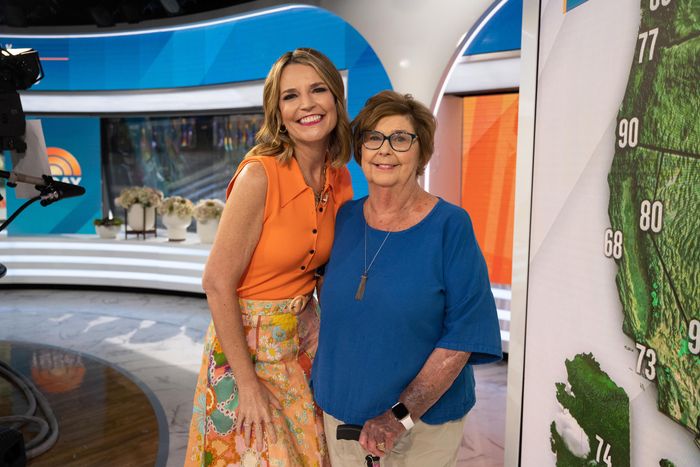
On set with Nancy in 2023.
Photo: Nathan Congleton/NBC/Getty Images
Today’s executive vice-president, Libby Leist, who’d worked alongside Guthrie since her White House reporter days, learned of Nancy’s disappearance by the afternoon of the first day. Several of the show’s on-air talent would see the news through push notifications on their phones when they woke early Monday morning, as they usually did, some at 3:45 a.m. “Nothing about it made any sense,” one said.
One on-air personality wondered if Nancy had been kidnapped for ransom, possibly by a cartel, though it was strange, they thought, that the attackers wouldn’t have targeted someone much wealthier — there were billionaires less than two hours away in Phoenix. “I hate to say it,” they said, but early on, given the national climate, they considered whether the disappearance could be related to Guthrie’s interrogation of Donald Trump at a town-hall interview back in 2020, one that had infuriated the president and his supporters.
At 7 a.m. that Monday, Craig Melvin, Guthrie’s co-anchor, was seated alongside Sheinelle Jones, usually a co-host of the show’s chattier fourth hour with Jenna Bush Hager and arguably the available anchor with the most hard-news experience. Only five months earlier, Jones had sat down with Guthrie to discuss the recent loss of her husband of nearly two decades, who died from glioblastoma at the age of 45. As the show began, Jones’s jaw visibly quivered.
“We want to get right to what is a deeply personal story for us,” Melvin said, and read a statement provided by Guthrie, which thanked the public for its support and law enforcement for its work and asked anyone with relevant information to contact the Pima County sheriff’s department. Melvin turned to national law-enforcement and intelligence correspondent Tom Winter, who’d been called back from vacation early to cover the story from the studio, and asked about the crime scene, which the sheriff had said was “very concerning.” Before answering, Winter took a beat, seeming to preempt criticism that the show was unduly focusing on its star’s mother. “You know, people go missing all the time in this country,” he said, “and it can be a frustrating process for families as they ask law enforcement to look and intervene.” He continued, “We are withholding some details, as we would do with any investigation,” ensuring it could go forward without interference.
But it was, of course, not like any other investigation. As would be said often on air over the coming weeks and months, many who would eventually cover the story were close with Guthrie; Jones ended that first opening segment speaking to her through the camera: “Sending our love, my friend.” Executives and colleagues who cared about Guthrie were eager to do what they could to help. She was also their standard-bearer. For months, the show had been neck and neck with Good Morning America, vying for first place in the ratings; they would now be working under unprecedented scrutiny. How could Today fairly cover the story given such clear and competing conflicts of interest? Without knowing where the reporting would lead, how could they protect Guthrie?
For the first few days, NBC journalists moved haltingly around these questions. According to show leadership, it was that first morning, in the control room, that news executives decided to send a reporter to Arizona right away. By that evening, Los Angeles–based NBC News correspondent Liz Kreutz had arrived in Tucson, but her remit was not entirely clear. For the first 24-to-48 hours, executives had to carefully consider what the show could and should cover. Would they go to Nancy’s house? According to NBC News leadership, a firewall between their own knowledge and that of the reporting teams was quickly established: The executives “knew a lot about the case separately, because Savannah’s our employee. And we couldn’t be in a position of feeding information to our reporters.”
NBC’s journalists were told to go find the story as they would in any other case, but the process was still fraught, the boundaries inherently unclear. “You’re the inside network,” said an on-air person, “but you want to be respectful of Savannah’s humanity.” At times, someone directly involved in the coverage conceded, such worries went too far. “In the first day or two,” they said, “we opted to protect our friend and colleague,” leaving out details and not trying to use Guthrie as a source to verify their reporting. “It took a couple of days to realize that we had to cover the story objectively. In hindsight, that may have been a mistake. We were overly deferential.” (A senior Today executive denied that NBC reporters would ever withhold any information.) An agent for various anchors said the staff was also unsure how they should discuss the case on air: “‘How are we talking on the show? Are we smiling in the next segment?’”
Hosts, correspondents, and producers felt Guthrie’s pain deeply; one called her position a “hellish purgatory.” Several in the on-camera ensemble were among Guthrie’s dearest friends, but even staffers who barely interacted with her, a junior employee said, could scarcely think of anything else in those early days. Televisions often played in the studio, usually tuned to NBC News; in the first days and weeks, whenever Nancy’s face flashed across the screen, everyone in the newsroom would stop, someone would turn up the volume, and they’d watch in disbelief.
A veteran Today show employee expressed particular concern about the younger staffers, who were weeping in the office: “People were walking around like zombies for days.” This person thought the show’s managers were too slow to reassure personnel — too slow to even acknowledge that many of them were devastated.
Much of the staff had worked in television news for decades, but they were shaken and tensions were high. Everyone understood that Nancy might have been targeted because of Guthrie’s prominence and role on the show. On-air talent wanted to know what it meant for the rest of them and their families. But there were no answers.
“The hosts were used to worrying about the safety of their young children,” Melvin told me, “but no one thinks about their parents.” Shortly after Nancy’s disappearance, the network decided to send security guards to the homes of several anchors, including, according to one source, Nightly News anchor Tom Llamas, Meet the Press host Kristen Welker, and Melvin.
As the days went on, executives and staff began to understand that Nancy would not be found quickly. Guthrie would not be going to the Olympics and neither would Melvin; they needed him in New York, a steady hand on the investigation. “It would have been totally bizarre for him to be in Milan and try to cover the story,” an NBC News source said. Insiders began to fear what Guthrie’s extended absence would mean for Today. Maybe she wouldn’t come back at all. “It would be like if the quarterback went down,” a source at the show told me. “‘Is this a career-ending injury?’”
The executive team called in Hoda Kotb, Guthrie’s former co-host and an NBC News veteran, who had retired about a year earlier and was seen by leadership as one of the best to ever sit in the chair. It would be an indefinite run, show management told her: “We don’t know how long this is going to go on.” If any of Today’s regular hosts, or any of its many correspondents and contributors, had seen Guthrie’s time away as an opportunity to move up, they would have to wait. “Feelings were hurt,” said one senior person. An agent insisted that Kotb’s arrival was actually for the best. It would have been inappropriate for their clients to be perceived as jockeying for position during such a tragedy; “You didn’t want to feed the speculation game.”
On Friday, February 6, Kotb was back at the table with Melvin, Jones, and Daly. She was somber, in black. Beside her, Daly, who typically wears the bewildered expression of a man who doesn’t understand what he’s doing there, sat stone-faced and bereft. “I was thinking, Who was first in the hospital room when Hope was sick? ” Kotb said, referring to her youngest daughter. It was Savannah. Guthrie had been the first on the plane when Daly’s mother and stepfather died just five weeks apart in 2017, she said; Guthrie had been there for Melvin when his brother passed away. She had sat by Jones’s dying husband in the hospital.
At the start of the hour, Kotb told the group she’d been “wandering around,” feeling heartbroken. She’d been asking herself, “Where do you go?”
When Guthrie was tapped to replace Ann Curry in 2012 and sit alongside Matt Lauer in the show’s prime hours, Today had been wracked by a now mostly forgotten dustup. Curry had been forced out; executives faulted her for feeble ratings and poor chemistry between the hosts, though it seemed to many that Lauer had bullied her. (He would later be accused, by others at NBC, of harassment and violent assault. Lauer has previously denied these allegations and didn’t respond to a request for comment.) According to a report in this magazine at the time, when Guthrie was promoted to fill the spot, she wept in the office of the president of NBC News, worried she’d be held responsible.
“For most of my life,” Guthrie writes in her 2024 book, Mostly What God Does: Reflections on Seeking and Finding His Love Everywhere, “I have been a textbook people-pleaser and peacemaker.” The Guthries were raised “not to brag, not to get ‘too big for your britches,’” and she was, by her own account, embarrassed by her ambition, far more open about her insecurities. When she first took her place at the big desk, viewership fell for a time, though the audience seemed to blame Lauer, whose favorability scores plummeted.
Guthrie had made her name as a hard-hitting White House correspondent at NBC News, but in Today’s early-morning hours, she nailed the required lighthearted banter, smiling in jewel-tone shifts, and seemed to mollify Lauer, who had been visibly aggravated by Curry’s presence. Brian Stelter, in his book Top of the Morning: Inside the Cutthroat World of Morning TV, writes that there were, however, “a few knocks” against Guthrie in the eyes of executives: She was 40 at the time but had no husband (she was divorced) and no children. She joked on air about how little she knew about cooking, reminding “moms at home,” Stelter writes, “how little she and they had in common.” In Mostly What God Does, Guthrie writes that she’d longed for a more traditional path but had been unlucky in love in younger years. By the time she was in the anchor chair, she was dating Feldman, but they wouldn’t be married until 2014, their two children born soon after that.
For the time being, her mother provided a path to relatability, a bit of warm, upstanding family life. On the phone, live on air, Nancy — kindly and no-nonsense — weighed in on whether there should be a kids’ table at Thanksgiving. On-camera from her home in Tucson, she demonstrated how to properly make a bed. She arrived on set to make fried chicken, spoon bread, green beans, and applesauce. For a Mother’s Day segment, she traveled with Guthrie and a crew to Australia, where Guthrie was born (her father, a mining engineer, had been stationed there).
On air, Guthrie often said that “the greatest gift” her mother gave her was her faith. Her Christianity also likely helped to round her edges for the Today audience. But no one who knows her doubts its sincerity. As a child, Savannah and her family attended a Baptist church multiple times a week, and Annie called God the sixth member of their family. Guthrie had always been close with her mother and two siblings, while the unquestioned head of the household was her father, who died at the age of 49 and who Guthrie writes could be “mercurial and terrifying.”
While in college at the University of Arizona, Guthrie lived at home to save money and keep her recently widowed mother company. After graduation, Nancy encouraged her to leave Tucson and take a TV-news job in Montana, which led to nine itinerant years in local news. In 1998, Guthrie decided to take the LSAT and was recruited to Georgetown Law, where her religious beliefs seem to have intensified. In Mostly What God Does, she writes, “I was certain I was being cursed by God or possibly haunted by a demon,” despite daily Bible study and faithful prayer. The book does not explain what she believes brought on this change, only that she became obsessed with the notion that she had sinned and that she could physically feel an evil spirit. “Sometimes I awoke in bed feeling a dark presence hovering over me,” she writes. “I could even hear it breathe — literally, the sound of nostrils flaring. I knew something was there, but I was too terrified to look, to come face-to-face with this ghastly presence. I just squeezed myself tighter into a fetal position, buried myself in my covers, and prayed.” What finally broke the spell, she recalls, was realizing that her God was one of love, not punishment.
When Guthrie took the Arizona State bar exam, she earned the highest score for her sitting, but she turned down a federal clerkship to try to go national as a TV-news reporter. At Court TV, she covered the Michael Jackson trial and Samuel Alito’s confirmation hearings, and within five years she jumped to NBC. In 2011, the Today show came calling.
The show’s culture, according to the people who know it best, has always been defined by its most senior anchor. From the late ’90s into the early aughts, it had been Katie Couric’s playful sparring with Lauer, her energy — at the time unfailingly described as “perky” — that inspired the tagline “America’s First Family.” When Couric departed in 2006, she writes in her memoir, Today transformed into “Matt’s show.” Lauer became the highest-paid news anchor in history and turned, in Couric’s words, “cocky and reckless, which changed the tone of the place.”
In the Curry-Lauer era, NBC executives allowed, and in some cases seem to have encouraged, a culture of sexism and hostility. The executive producer of the Today show at the time, Jim Bell, an ex–college-football player, seemed to mock Curry, directing staff to make a blooper reel of her on-air mistakes. On her last day, she choked back tears and apologized to the public. Guthrie was seated in the anchor chair minutes later, after the commercial break. It was her job to keep things running smoothly.
Her pay would be about one-eighth of Lauer’s widely known salary, and she seemed to understand that deference would help her succeed. “How much taller are you than Matt?” a viewer asked Guthrie, who is reportedly five-foot-ten, in an online Q&A in 2015. “I’ve noticed that you wear heels when Matt is off and flats when he is there.” She didn’t answer. In late November 2017, it fell to her and to Kotb, who moved up from the show’s boozy fourth hour, to tell viewers Lauer had been fired for inappropriate sexual behavior.
The two women, especially the incumbent Guthrie, were tasked with convincing viewers to buy into the show in its new configuration without making the recent past look like a lie. Judging by the ratings, it worked. They weren’t the first women to co-headline a morning show (Robin Roberts and Diane Sawyer had done it on Good Morning America back in 2005), but it was still considered novel to break with the pseudo husband-and-wife coupling. The new dynamic was a different type of familial — sisterly — and Kotb was twinkly, effervescent, often squeezing Guthrie’s hand. In 2022, Guthrie credited her with “saving” the show.
Under the pair, Today became more personal, more inspirational; the year after Guthrie published her book about faith, Kotb published one about finding joy. In her time, Curry had often griped about the mandate to cover weight loss and Halloween costumes alongside hard news, telling Newsweek in 2011, “I want more spinach and less sugar in this big meal we give viewers.” Guthrie, however, took to the sugar so seamlessly that political commentators were surprised by the vigorous Trump town-hall interview in 2020. With deceptively simple questions and seemingly genuine cheer, she pressed on the president’s obfuscations, at one point repeating a query seven times in a row. Slate called it Trump’s “toughest grilling in years.”
The change behind the scenes at Today was arguably even more dramatic. “Matt had backroom power. His fingerprints were on nothing, and he was in control of everything,” one show insider told me. Don Nash, who’d succeeded Bell as executive producer, left in 2018, soon after NBC began to review Lauer’s behavior. Now, new executives had to rebuild the show alongside the new anchors. Leist, who had been overseeing major news coverage at Today, was named executive producer, becoming the first woman to hold the position.
Current and former staff say the show became a far nicer place to work. It was under Guthrie and Kotb that many of the on-air personalities became real friends. “They all have the competition of a normal show,” a former contributor said, “but it’s not a put-on that they’re very close.” An on-air personality told me, “This group that’s over there is — and it’s not even close — the closest of any group that’s been there.” Guthrie and Jenna Bush Hager, who used to be next-door neighbors in Tribeca and long attended the same church, Good Shepherd in Gramercy Park, are godmothers to each other’s children. Guthrie has referred to Daly as her “bestie.”
Leist is also close with the top talent. Guthrie spent years trying to set her up on dates; Bush Hager eventually introduced her to her husband.
As for the co-stars, one source says that Guthrie was at times insecure next to Kotb, fretting privately that the crowds on the plaza outside the studio were happier to see her colleague. But the two spoke often of their early-morning talks in the makeup room, and their on-air affection was effusive. (Guthrie called Kotb her “soul sister”; Kotb joked they were a “couple.”)
In the fall of 2024, Kotb, who was then 60, announced she’d be stepping down. She said she wanted to spend more time with her family, though it was reported that the decision was at least in part due to a proposed salary cut. She was replaced by Melvin, who seemed to be Lauer’s antithesis — genial and respectful, including of Guthrie’s authority. “Clearly Matt had not treated Savannah well,” a person close to the show told me. (The source close to Guthrie disputed this.) “That couldn’t happen again.” The former contributor put it differently: “No one competes with Savannah. She’s the undisputed queen of the whole show.”
While she and Kotb together made the show kinder, Guthrie’s influence was explicitly Christian. According to the former contributor, NBC would rather lesser stars keep their personal views to themselves, but the company “was completely behind Savannah’s book about faith.” Today promoted the release of Mostly What God Does with a roundtable discussion of personal views on God featuring its most prominent hosts and an interview with Guthrie in front of an altar at St. Thomas Church on Fifth Avenue.
The past contributor said NBC colleagues and their sources in politics debated whether management’s support was calculated, a decision to appeal to Middle America or perhaps Republicans: “There was always an open question of, Does this not help them curry favor with conservatives?” A senior person at the show denied that their approach had anything to do with politics but affirmed that it was strategic — an effort to reach more religious Americans. “It is an audience that is underserved,” they said. “And we recognize it.” (A senior Today executive called both ideas “nonsense.”)
In the past two years, the rest of the Today “family” has followed suit, talking about God more and more. Last November, Dylan Dreyer, the meteorologist and co-host of the third hour of Today, professed her Christianity on air, saying, “I’ve relied on my faith more than anything … There is something really comforting about knowing that there is a higher power holding my hand every day.” In the lead-up to Christmas, Melvin, who grew up Baptist in South Carolina, brought his minister on air for a lengthy interview. One former high-level media executive said, “Lack of news and a lot of faith are the two hallmarks of the show.”
When she first published Mostly What God Does, Guthrie had said she was afraid of backlash and not just from people who found the Jesus talk unpalatable. She felt a sort of impostor syndrome in describing the importance of turning to religion in times of “deep crises, profound adversity.” “You might even wonder,” she wrote, “if I’ve really faced any adversity at all. What business do I have to weigh in on these topics? What are my suffering credentials?” It was, she said, a fair question.
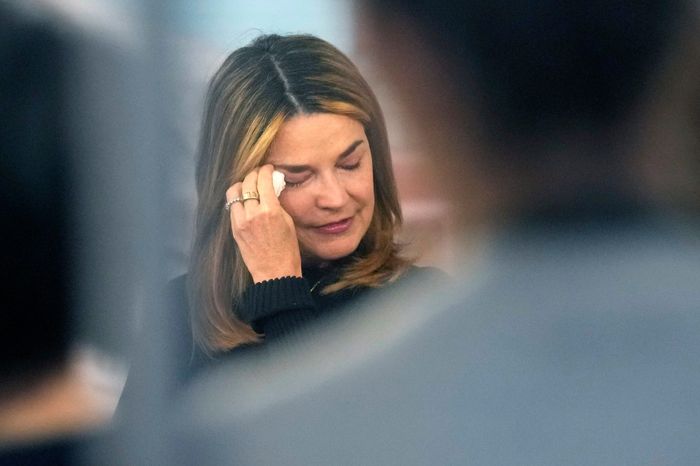
The first visit back to Today in March.
Photo: Charles Sykes/Invision/AP Photo
As February turned to March, and the Guthrie siblings marked one month since they’d spoken to their mother, updates about the story on Today became fewer and fewer; hosts and correspondents wore yellow ribbons in Nancy’s honor.
That the case in Arizona was stalled seemed to fuel conspiracy theories, gossip, and baseless commentary. Megyn Kelly had worked at the Today show for about a year — recruited from Fox News in 2017 and then fired in disgrace for defending blackface. From the beginning of the Guthrie saga, on her popular YouTube show and SiriusXM channel, she and a handful of frequent guests had filled the role of a sort of spiteful Greek chorus. Dozens of segments scrutinized the investigation and questioned the sincerity of many at Today. Kelly declared that the show’s “happy family” image was fake and forced, and she implied that its leadership held some blame for Nancy’s disappearance; the executives, she said, “really lean” on the anchors “to overshare.” “It’s not born out of nefarious intent,” she added. “They want the audience to feel like they know you. And I get that. But you have to be really careful.” As a Today host herself, Kelly acknowledged, she had in fact done an entire on-air series with her own mother, “Lessons From Linda.”
Show insiders watching Kelly were furious. They thought of her as subsidized by her massive NBC payout — a reported $30 million — and felt she was dining out on her experience at a place where she’d never really built relationships and failed to even perform well. At the same time, various executives and talent had become uneasy about just how much high-profile anchors tended to share about their personal lives. Several told me it had previously seemed harmless — success in the job simply depended on building intimacy with viewers. “There is a perception that if you’re not willing to share your life,” one insider said, “you shouldn’t be on that show,” and the expectation had intensified in recent years.
A source close to the family denied that Guthrie had ever been pressured to share details about her family; it had always been her choice. No one had imagined how wrong it could go. “You don’t make those decisions thinking something like this is going to happen,” they said. “Nothing like this ever has.” (The source also cautioned that the motive of Guthrie’s assailant or assailants is still unknown.)
Internally, Today executives acknowledged that the anchors’ personal lives had become a greater part of the show in recent years; exclusive interviews — previously the bread and butter of morning shows — have become less valuable with the rise of social media. A Today source said executives have recently begun giving more thought to the privacy of on-air employees.
Hosts and correspondents were second-guessing themselves all the time — what they posted online, what they talked about on air. “All of it,” one told me, “was fucking weird.”
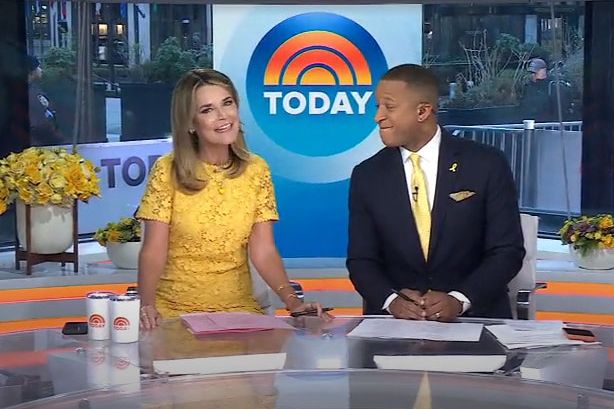
Guthrie’s return to the desk in April.
Photo: YouTube/NBC News
“The show doesn’t like to talk about things that are deep or complicated or sad,” a junior staffer said. “What it tries to do is make the world a two-dimensional, happy thing. Talking about anything sad spoils the fantasy.” When Nancy first disappeared, she said, “I couldn’t imagine Savannah coming back and being happy and laughing ever again.” A senior person on the show said that most everyone had felt the same: “There was a period of time where if you polled the newsroom, the majority would have told you they’d be stunned if she returned.”
Long before the current crisis, there had been rumors that Guthrie was thinking about moving on. Her contract, said to be worth $8 million to $20 million annually, has been reported to be up soon, and one person at Today said Guthrie previously suggested she might leave then: “You can’t do this show forever. At some point, you’ve made all the money you’re going to make, you’ve maxed that out.” Pay for anchors had hit a ceiling, and they knew cuts were coming. Over the past decade, morning-show audiences across the three major broadcast networks have shrunk by almost 50 percent. “All of these shows are going to face a reckoning on the salaries of these people,” said the former high-level network executive. “The ratings are not what they used to be, and salaries have not come down commensurately yet. It’s about to happen.”
Back in 2024, talking about Kotb’s impending exit, Guthrie had sounded a bit wistful. “Hoda and I have had this discussion for years and years,” she told a reporter. “We’re basically in the same phase of life … We have these little kids that we both feel so lucky that we got to have later in life.” (The source close to Guthrie and another close to the show denied she’d considered leaving in recent years.)
In the early days of her mother’s disappearance, Guthrie barely thought about work or how she might eventually handle her return. When the media newsletter Status reported, just two weeks after Nancy’s likely kidnapping, that “a majority of TV veterans” interviewed “expressed doubts” that Guthrie would ever go back to Today, she was surprised and dismayed. As the case dragged on without resolution, the question became harder to avoid. According to the source close to her, Guthrie worried about her ability to hold it together on air and whether the dark cloud around the story could somehow harm the show.
It was a month after her mother went missing that she decided to return to her family in New York. Her kids needed her. Guthrie’s friends on Today had helped provide some semblance of normalcy for the children while she was away and while their father made frequent trips to Arizona: weekend sleepovers at the Bush Hagers’ in Connecticut; a last-minute visit with the Dalys when Feldman needed to stay longer in Tucson. But it was time for Guthrie to go home. On the airplane back, she would later say, she looked out the window at the desert and wondered if her mother was out there.
The fact that the story had slipped from the daily headlines made it easier for Guthrie to imagine returning to the show. It seemed less likely she would have to stand by in the studio as her colleagues covered her family’s crisis. She first arrived back for a short visit, on March 5 at 9:30 a.m., mid-broadcast. As word spread among staff, the various teams streamed into the glass-walled Studio 1A in plain view of tourists and paparazzi. It was the biggest space available — Guthrie had wanted to be sure to include the crew, some of whom had been operating the cameras in front of her for 15 years — and she was ready for the public to know she was back; it was better, the people around her reasoned, to be photographed there than at a school drop-off. (Later, Megyn Kelly would accuse the show of staging the gathering so TMZ could capture it.)
Over the month of February, the old public image of Guthrie — warm yet poised, self-deprecating — had given way to the Guthrie seen in her video appeals, a woman in desperate pain, forced to beg. Now, she stood before roughly a hundred colleagues, dressed in what appeared to be the same black long-sleeved knit top and jeans she’d worn in the videos, looking pale, trying and failing to keep her composure. “If you saw her face, this is somebody that was entirely broken. Broken and shattered,” one person said. Her colleagues wept. Guthrie thanked them for their prayers — she had felt them, she said. She’d seen the yellow ribbons and the people leaving flowers at her mother’s home. She hadn’t known, she told them, how much people cared.
“I don’t know how to come back,” she said, “but I don’t know how not to. You’re my family. And I would like to try.”
When Guthrie finished speaking, Dreyer, who had worked with her for 14 years, led everyone in a prayer. And then, as in a receiving line at a wake, all of the colleagues in attendance gathered in single file and took their turn with Guthrie, hugging her and speaking quietly. Kotb stood by protectively.
Show executives and Guthrie agreed the next step in her return would be taping an interview with Kotb. She would talk about what she’d been through in a supportive setting and then by the time she was back in the anchor chair, she would have already said her piece. In mid-March, the two women filmed the spot in a suite at the JW Marriott Essex House at the southern edge of Central Park. They sat on a dusty-pink velvet sectional and wept, holding hands once again. Kotb’s questions were open-ended, gentle, speaking from the perspective of a close friend, referring to Nancy as “your mommy.” Guthrie, in turn, was utterly vulnerable, at times self-lacerating. She said, “It is too much to bear to think that I brought this to her bedside, that it’s because of me.” She had been, until that moment, holding herself quite still; at this she broke. “And I just say, ‘I’m so sorry, Mommy. I’m so sorry. I’m sorry.’ To my sister and my brother and my kids and my nephew and Tommy, my brother-in-law … I’m so sorry if it is me.”
She vowed not to fall apart, not to let the perpetrators “take my children’s mother from them,” whether the agony was over or not. And she would go back to the show. “I think it’s part of my purpose right now,” she said. “I want to smile, and when I do, it will be real. And my joy will be my protest.”
Back on set, Kotb announced the date of Guthrie’s return: April 6. Roker noted how “wonderful” it was, how “symbolic,” that Guthrie would arrive again “after Easter and the resurrection, the rising.”
When the day came, Guthrie’s greatest concern was to keep from breaking down on air, and it was “Savannah’s idea,” a senior staffer told me, that they would all say as little as possible about her absence. A person close to the show said everyone acknowledged that “most viewers were not tuning in to have a séance about her missing mom.”
Melvin, in a yellow tie, and Guthrie, in a yellow lace shift dress, opened the hour with reports of a potential peace plan with Iran. Melvin patted her hand and said, “It is good to have you back at home,” but the anchors kept it brisk; she didn’t cry until about an hour and a half in, when she and other hosts greeted well-wishers on the plaza.
In her interview with Kotb, Guthrie had spoken of her mother in the present tense. She recounted seeing the footage of the masked person, seeming to echo her description of the demonic presence she’d written about, years before, hovering over her while she tried to sleep. “I can’t imagine,” she said, “that that is who she saw standing over her bed.”
She recalled a dialogue she’d had with God early in the catastrophe, as she tormented herself, wracked with uncertainty. She told God she could handle anything except not knowing. “I have to know,” she told Kotb in a jagged whisper. “And I heard a voice, and it said, ‘You do know where she is. She’s with me.’”
Her words took on new meaning on June 23, when NBC News reported, as other outlets had in days prior, that the second ransom note, from February, stated that Nancy had died. ABC News said the message also claimed she had been buried. On Today that morning, Guthrie slipped out of view for the show’s segment on the note. Afterward, Guthrie, in black, was flanked by her colleagues. “I love you guys and I love this place,” she said. “This is unusual and unprecedented to say the least, to be sitting here. I don’t have any comment on this story, and I’m not involved in our coverage, but I can’t pretend I’m not here.” She wiped away tears and said the family was in agony, that they would not be able to find peace unless someone came forward with more information.
Since she returned to the show, there has been no more talk of Guthrie leaving, insiders say, and she has thrown herself back into the distractions of work. In rare moments, you can glimpse the light-hearted enthusiasm she used to bring to the job, dressing up for Halloween as a Dallas Cowboys Cheerleader or as “6-7.” But Guthrie has taken on a visible fragility. A colleague told me simply, “She is not okay.” In early June, Guthrie sat across from Bush Hager — she was filling in on the show’s fourth hour — and said as much herself: “I cry every morning on the way to work, and I cry every morning on the way home.”
One day, a couple of weeks after she came back, Guthrie was out on the plaza when a little girl quietly handed her a note. It said, “I bet you miss your mommy.” And then it was time for a cooking segment.
Thank you for subscribing and supporting our journalism.
If you prefer to read in print, you can also find this article in the June 29, 2026, issue of
New York Magazine.
Want more stories like this one? Subscribe now
to support our journalism and get unlimited access to our coverage.
If you prefer to read in print, you can also find this article in the June 29, 2026, issue of
New York Magazine.