There’s a possibility inflation could go over 3% before the end of this year, Westpac NZ senior economist Satish Ranchhod says.
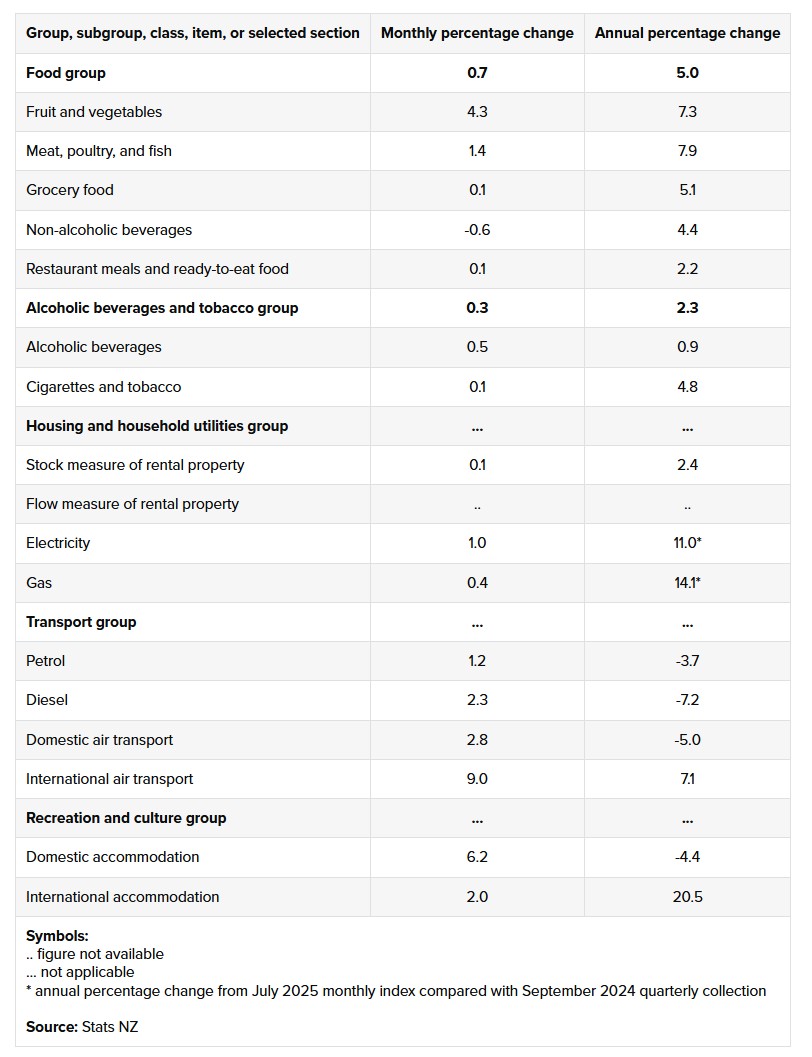
This comes as food prices continue to rise – jumping 5% in the 12 months to July, according to figures from Statistics New Zealand’s Selected Prices Indexes (SPI).
This tops the previous 4.6% increase in the 12 months to June, which at the time, was the biggest annual rise since December 2023.
The SPI is a monthly series that features 45% of the contributors to the quarterly Consumers Price Index (CPI) – New Zealand’s official measure of consumer inflation.
The SPI includes monthly data on things like food, alcoholic beverages and tobacco, rental housing, utilities, transport and accommodation services. It’s a good early guide to what inflation is doing.
Ranchhod says July’s figures were firmer than expected, reinforcing “the picture of a lift in near-term inflation pressures”.
“We’ve been forecasting that inflation would rise back up to 3% in the final quarters of this year. Today’s result suggest that it could rise even higher.”
“Some of that is due to volatile items like international transport,” Ranchhod says. “But we’re also seeing firmness in other areas, like energy costs, which is unlikely to reverse.”
Food
Grocery food was up 5.1% and contributed the most to the annual increase in food prices.
The price increase for grocery food was due to higher prices for milk, butter and cheese. The average price for milk was $4.70 per two litres – this is up 16% annually while butter per 500 grams was at $8.59 and up 42.2% annually.
The average price for cheese was $13.01 per 1 kilogram block, up 29.5% annually.
These average prices reflect the cheapest available option for each.
Statistics New Zealand’s prices and deflators spokesperson Nicola Growden says “in the 12 months to July, milk prices contributed more to the increase in overall food prices than any other food item”.
“The price for two litres of milk has increased 33.9% since July 2020.”
All five food groups recorded higher prices when compared to this time last year, Growden says.
The groups include fruit and vegetables, non-alcoholic beverages, restaurant meals and ready-to-eat food, grocery food, and meat, poultry and fish.
Meat, poultry and fish prices increased 7.9% and was the next largest contributor to the annual increase in food prices.
This was driven by higher prices for beef steak which was up 24.6% and beef mince, up 19.3%.
Fruits and vegetables rose 7.3%, restaurant and ready-to-eat food increased 2.2% and non-alcoholic beverages went up 4.4%.
Alcoholic beverages, which Statistics New Zealand counts separately from the food group, went up 0.9% while cigarettes and tobacco increased by 4.8%.
Rent prices
Growden says rent prices are still increasing but at the slowest rate since 2011.
Rent prices went up 2.4% in the 12 months to July. This follows a 2.6% increase in the 12 months to June 2025.
Utilities like electricity and gas saw annual percentage increases of 11% and 14.1% – Statistics New Zealand points out this from the July 2025 monthly index compared with September 2024 quarterly collection.
Transport
Petrol decreased by 3.7% and diesel also saw a dip of 7.2%.
When it came to domestic air transport, there was a 5% decrease while international air transport went up 7.1%.
From July, Statistics New Zealand has expanded the number of international routes it includes in this data for places like Australia, North America and Asia.
Alongside this, domestic accommodation went down 4.4% while international accommodation increased to 20.5%.
Inflation
In July, annual inflation increased to 2.7% from 2.5% in March.
Despite the slight increase, economists at the time agreed the annual inflation rate was softer than their expectations.
While it’s also within the Reserve Bank’s targeted 1% to 3% range, the Reserve Bank has previously said inflation was likely to approach the top of this range in the June and September quarters.
With the latest inflation rate a touch below what economists had predicted and following the unemployment rate rising from 5.1% to 5.2%, this paves the way for the Reserve Bank to make a cut to the Official Cash Rate (OCR) of 25 basis points to 3% in August and a further cut this year.
The Reserve Bank has made six consecutive cuts to the OCR from August last year, but then held tight on 3.25% in the last review in July.
Here is the detailed SPI information as supplied by Statistics New Zealand: