
Renewed attacks between Iran and the United States have injected fresh uncertainty into the calculations of shipowners weighing whether to free stranded vessels.
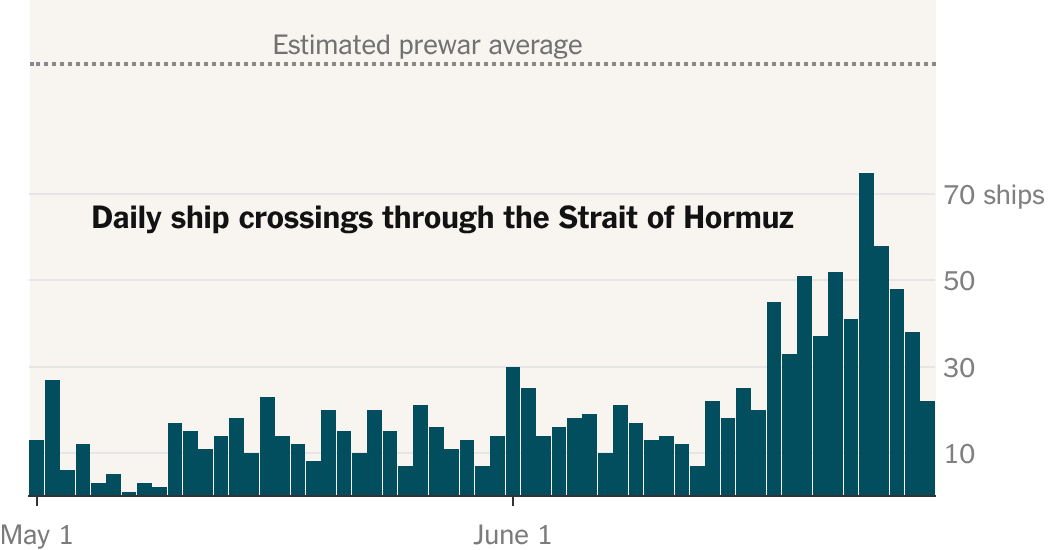
Traffic through the Strait of Hormuz dropped significantly over the weekend, as a four-day exchange of attacks between Iran and the United States left some shipowners deciding it was too risky to pass through. Now, Iranian and U.S. officials have said they would hold talks on Tuesday. But the recent outbursts of violence underscored how closely tied any sustained resumption of shipping is to a cessation in the conflict.
Before the attacks, shipping traffic through the strait had risen to its highest levels since March 1, days after the start of the war. Many of the ships were taking a U.S.-backed route that bypassed Iranian waters.
But on Thursday, Iran reiterated a demand that ships use its waters and obtain permits to go in or out of the strait, warning that other routes were “unacceptable and extremely dangerous.” Later in the day, Iranian forces attacked a container ship that was transiting via Omani waters on the other side of the Persian Gulf. The United States conducted retaliatory strikes.
Iran attacked a second ship, a Panama-flagged tanker called the Kiku, with a drone on Saturday, according to the U.S. Central Command. By Monday, the United States and Iran had agreed to halt their attacks and allow vessels to move freely, according to a U.S. official.
Despite the risks over the weekend, 22 ships passed through the strait on Sunday, down from 38 on Saturday, according to data from Kpler, a maritime tracking firm. On Wednesday, 74 ships went through.
CMA CGM, a French shipping company, transited the strait through Iranian waters, according to the data from Kpler.
CMA CGM did not comment on its decision to send the ship through Iranian waters. In a statement on Sunday, the company said that it was pleased to announce that its ship passed through the strait that morning. “This transit marks an important milestone in a regional context that remains complex and requires constant vigilance,” the company said. The ship’s transit in Iranian waters was reported earlier by The Maritime Executive.
Rebecca Gerdes, an analyst from Kpler, said that the CMA CGM vessel was one of a small number of European container ships to take the Iranian route with their location trackers on.
While the ship exited safely, major carriers are unlikely to attempt to send large container ships into the Persian Gulf anytime soon, Ms. Gerdes said.
“Once times are calm for a while, and vessels are going in and out smoothly, we may see some of the major carriers bring vessels back in,” she said. “It’s just too risky.”
A plan announced last week by the International Maritime Organization to evacuate some 600 ships and 11,000 seafarers stranded in the strait remained on pause on Monday. The agency had helped get some 115 vessels out before it suspended the program on Thursday.
In an interview on Monday, Arsenio Dominguez, the secretary-general of the I.M.O., said the agency would need assurances from the Iranian government, including the Islamic Revolutionary Guards Corps, that no vessels would be targeted and that both the Omani route and the Iranian route could be used.
“Once those guarantees are back onto the table that the vessels are not going to be attacked, then we’ll resume the evacuations,” Mr. Dominguez said.
On Sunday, Iran’s foreign minister, Abbas Araghchi, had warned against trying to bypass Iranian waters.
“Any attempt to adopt new or separate arrangements from those currently being pursued by the Islamic Republic will only lead to further complications, delays in reopening the Strait of Hormuz, and an increase in tensions,” he said in a news conference.
Peter Eavis contributed reporting from New York.