
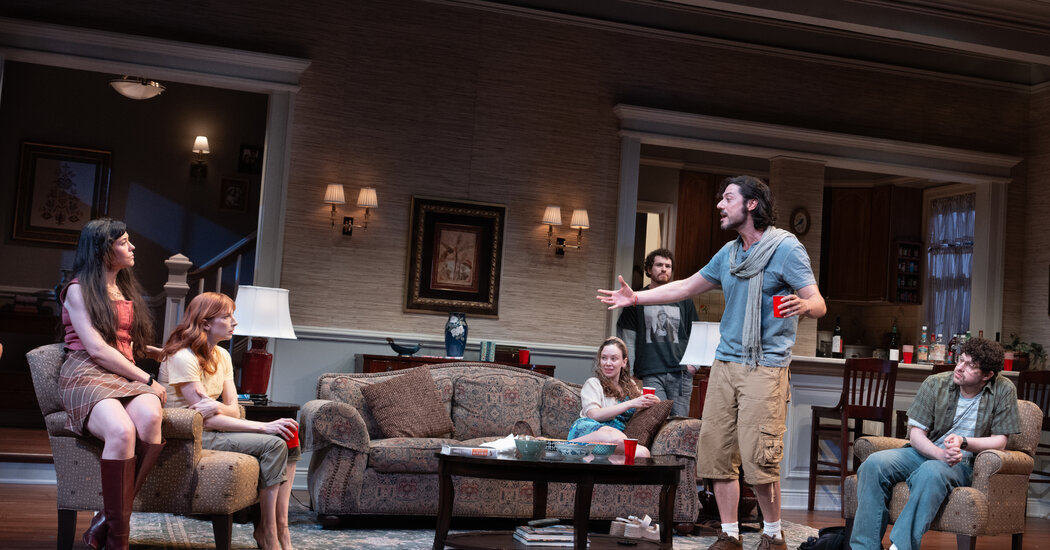
Again Spector beautifully orchestrates his complex dialogue, which includes both tart, percussive comedy and a certain pianissimo melancholy. Here, though, his thematic ambitions have been multiplied and deepened.
Birthright Israel is depicted as one part heritage tour, one part keg party. In the first act (called “Two Jews, Three Opinions”) the take-charge Chaya (Zoë Winters) has invited the other five over to her parents’ home, where she and Izzy gossip about all the binge drinking and hooking up that the Americans squeezed into a week and a half.
The play teaches the audience a glossary too: The fervent Alona (Molly Ranson) is considering making aliyah (moving to Israel), and, in worrying about her, the others decide they are one another’s mishpucha, by which they mean “extended family.” (Definitions are important: Nearly 20 years later, this mishpucha will fight over the word “genocide.”)
Most are from tradition-keeping Jewish households — there’s an odd bro out, Emerson (Nate Mann), who’s only celebrated Passover once — but Spector gives each of them a tempestuous, quasi-romantic relationship with their faith and with Israel. This sensation of volatile yearning pervades: Noah (Eli Gelb) adores Chaya unrequitedly, and everyone seems enchanted by the group’s true seeker, Lev (Hale Appleman). In Act I, Lev arrives after having disappeared in Israel, mid trip. He walked away from Birthright to look for an unmediated Israel, and Spector’s own big-r Romantic tendencies align with Lev’s roving, curious spirit.
In a company of rigorously realistic performances, Appleman plays Lev as a man who hears other music: He’s a tall, willowy guy, and he sort of drifts when he walks. Spector is sparing with Lev’s presence throughout, since both the play and the characters regard him as a moral authority. (Emerson’s late-breaking quotations of rabbinical wisdom cannot compete, though Chaya’s chatty mother, played with sweet ditziness by Liz Larsen, does have her own wisdom to offer.)