
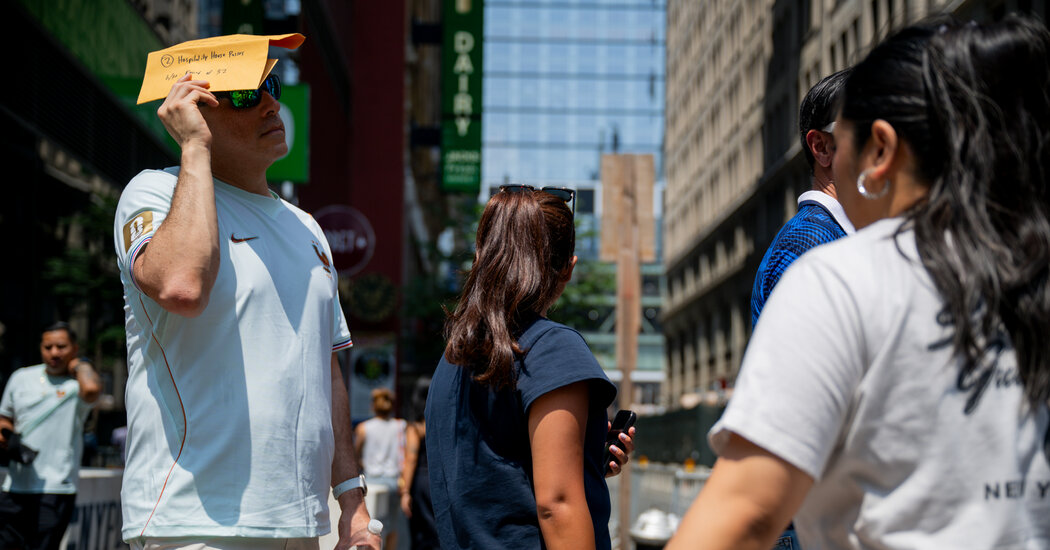
A heat wave is expected to settle over New York City this week, as city officials grapple with how to keep construction workers, street vendors and others who work outdoors safe as summers in the city grow warmer.
By Wednesday, according to National Weather Service forecasts, highs could jump to 97 degrees. By Thursday, the temperature is expected to hit 100 degrees, climbing as high as 102 in the Bronx. Friday could deliver a similar three-digit scorcher, followed by a sweltering Independence Day holiday weekend with a chance of storms.
The last time there were back-to-back days with temperatures surpassing 100 degrees was in 2011, according to the National Weather Service. Con Edison, a utility that serves most of New York and parts of Westchester County, has activated its emergency response center.
“This is Texas hot, which we don’t usually see here, so it’s serious,” said Carolyn Olson, assistant commissioner for environmental surveillance and policy at the New York City Department of Health and Mental Hygiene.
It’s also more humid in New York, which could push the heat index, or “feels like” temperatures, to as high as 112 degrees this week, Mayor Zohran Mamdani said in a news conference on Tuesday. The most important thing New Yorkers could do starting Wednesday, he and leaders of city departments said multiple times, was to stay indoors, in air-conditioning, and to check on fellow New Yorkers.
On Monday, Mr. Mamdani ordered what City Hall called an “unprecedented, historic heat emergency plan.” Libraries, senior centers and other air-conditioned spaces were designated as cooling centers that will be open to residents seeking refuge from sweltering homes. City agencies also prepared to set up outdoor cooling stations, with misting fans in areas where outdoor workers, including street vendors and food delivery workers, gather regularly.
City Hall said that most large public pools would be open for an extra hour, until 8 p.m., and encouraged adults to borrow a spray cap from the nearest firehouse to turn the fire hydrant on their block into a sprinkler for children to play in.
Last week, Mr. Mamdani signed an executive order aimed at protecting people who are vulnerable to the heat, including about 93,000 people who work outside as street vendors, delivery workers and day laborers. Hundreds of thousands of others work as police officers and firefighters, maintenance and repair workers, and in many other jobs that put them under the sun for long periods.
On Tuesday, the mayor stressed to employers that workers should not face consequences for putting safety first. “Workers cannot cool down when they have quotas to meet,” he said. “They cannot go into a cooling center when they are on the clock.”
The order instructs city agencies to examine how to strengthen workplace protections. The Department of Buildings, for instance, will review regulations to see if new safety requirements are needed to protect construction workers from heat exhaustion. The Health Department will study workers’ compensation claims to search for patterns linked to heat.
At a news conference announcing the mayor’s executive order last week, John Mosquera, who works at LaGuardia Airport, described loading bags onto a plane during a 10-hour shift on a scorching day last summer. He started seeing stars. “I lost consciousness and just laid in the belly of the plane from how hot it was,” Mr. Mosquera said.
Someone woke him up, he said. “I had a short break and some water and was sent right back to work,” Mr. Mosquera recalled. “Nobody should collapse from heat on a job and then expect it to just keep going.”
The mayor’s executive order also requires city agencies to develop plans to prevent heat-related illnesses among municipal employees who work inside and outside.
This week in New York, a high-pressure system called a heat dome, which can span up to 1,000 miles, is to blame for creating and containing the heat. Beyond New York City, temperatures in Washington and Philadelphia could climb past 100 degrees. Scorching days are expected across the Midwest, too.
In New York, city officials anticipate heat that could rival — or even surpass — last year’s heat wave, which peaked on June 24, 2025, when the city logged its hottest day in 15 years. Central Park reached 99 degrees, and Kennedy International Airport in Queens hit 102.
“We’re staring down what could be the second-hottest day in New York City history in over a decade,” Mr. Mamdani said.
New York City’s power grid should remain reliable this week, according to a recent report by the New York Independent System Operator, which manages the state’s flow of electricity. Projected peak demand for this summer remains well short of New York’s record peak, which was 13 years ago.
Kevin Lanahan, senior vice president for external affairs at the corporation, said that officials had been documenting declining energy supplies amid increasing demand.
Energy experts said they were concerned about both transmission lines being overloaded and aging power plants. There was a sudden decline in electricity reserves during last summer’s June heat spike, when several older fossil-fuel plants failed, but officials used power resources from the Midwest to meet the demand.
The system strain that occurred on that day happened at night, when energy demand shot up instead of down, which was unusual, Mr. Lanahan said.
David Stark, a meteorologist with the National Weather Service, warned that on Thursday night, temperatures might not dip past the mid-80s, which could both strain the grid again and prove perilous for some New Yorkers who do not have air-conditioning.
“Just as dangerous as the daytime highs, there will sadly be little relief overnight,” said Christina Farrell, the commissioner of the New York City Emergency Management Department. “That means the heat builds on itself day after day, and the body never really gets a real chance to recover.”
The city’s cooling centers will operate during the day only, when the heat will peak, although a few, like one at the Jacob K. Javits Convention Center, will be open until 11 p.m. The centers and their hours can be found on the city’s Cool Options Map or by calling 311. Homeless shelter intake rules will also be relaxed because of the heat. Separately, eight drop-in centers offering cool air and meals overnight — they are distinct from the cooling centers — will be available. Overnight cooling options, besides emergency rooms, are scarce in the city.
Much of New York’s housing stock is old and tends to retain heat, meaning that the temperature indoors can be higher than outdoors, and many customers struggle to pay for air-conditioning, according to the nonprofit Public Utility Law Project. A recent city report on heat-related deaths said that heat-exacerbated deaths at and above 82 degrees started to increase about a decade ago.
On average, seven people in New York City die each summer because of heat alone. Last year, 21 such deaths were reported, with 19 of them attributed to the June heat wave.
It’s not just the days of record heat that worry public health officials. More days are in the high 80s and low 90s than in past decades. The number of days each summer with highs over 86 degrees have more than doubled during the last 50 years, rising to an average of 32 days from 14 days, according to the city Health Department.
Although thunderstorms are forecast for the weekend, the rain is not expected to bring much relief: Temperatures in the 90s are forecast until Monday.
“We cannot emphasize enough how important it is to stay safe, how important it is to take this heat seriously,” Mr. Mamdani said.