
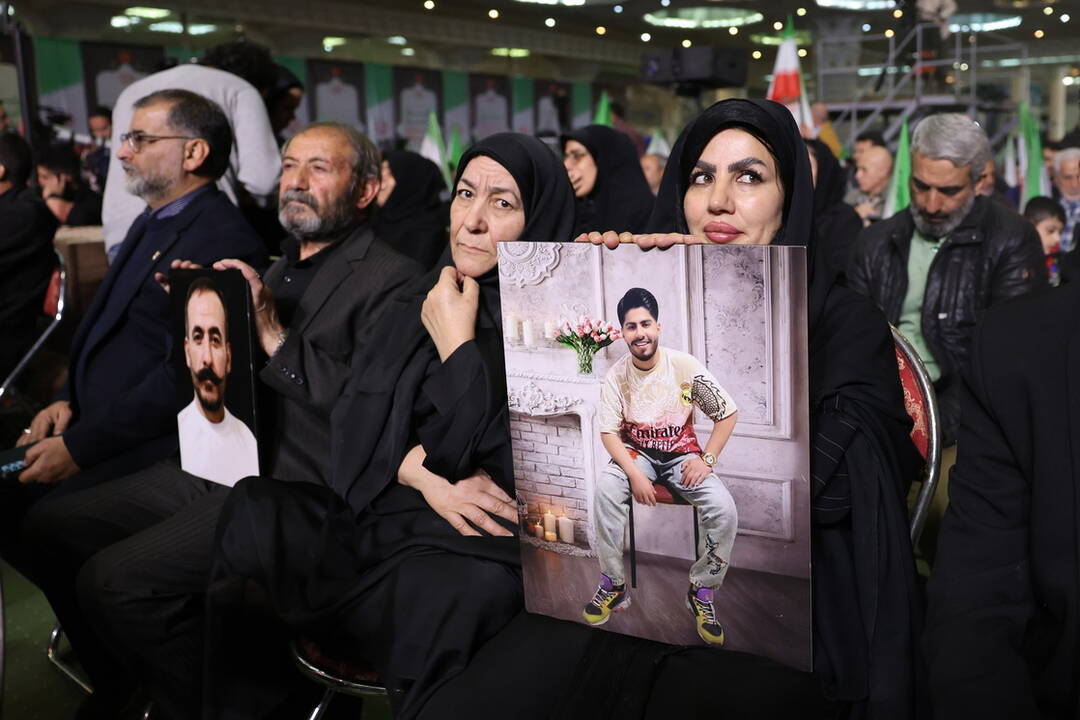
An initial deal struck between the US and Iran, aimed at de-escalating tensions and paving the way for further talks, fails to address human rights issues, an issue that worries Mai Sato, the UN rights expert on Iran.
Five months since tens of thousands of Iranians were killed in anti-government protests, and a war launched by the United States and Israel, has compounded Iran’s human rights concerns. Government repression has continued, including the execution of state critics, while air strikes on civilian sites, displacement and galloping inflation have added to the toll exacted on the population.
Yet a recent memorandum of understanding concluded between Washington and Tehran aimed at ending the war and which sets the ground work for further negotiations, fail to mention human rights, a point that hasn’t been missed by rights defenders.
Earlier this month, Mai Sato, UN special rapporteur on Iran, led thirteen other rights experts to issue a statement which welcomed the signing of the 14-point document, but said its failure to address human rights made it “incomplete”.
At a press briefing last week, when asked if human rights had been part of negotiations ahead of the protocol’s signing, Ali Bahreini, Tehran’s ambassador to the UN in Geneva said the US would have been badly positioned to discuss rights. “It is an entity which has tried its new and very sophisticated weapons on Iranians,” he said, underscoring US attacks on civilian sites such as a school in Minab, killing more than 150 civilians and a sports complex in Lamerd, where 21 people died.
Later this year, Sato will be reporting on these and other human rights violations in Iran to the UN General Assembly. She spoke with Geneva Solutions last Friday about the ongoing situation in the country and why the formulation of the MoU is worrying.
What has the human rights situation been in Iran since the start of the war, and since talks between Washington and Tehran resumed?
The toll of the war has been severe on multiple fronts: thousands of civilians killed, air strikes hitting schools, hospitals, religious and cultural sites, and residential areas, and millions internally displaced. But that’s not the full picture. Before, during, and now into the ceasefire, Iranian authorities have been cracking down on dissent, with thousands detained, tortured, and executed. At least 156 people have been executed since the war began. Meanwhile, I’ve been receiving reports of soaring food inflation, combined with widespread delays in wage payments and unemployment. The damage spans civil, political, social, economic, and cultural rights alike.
However, the two-page MoU between the US and Iran fails to mention human rights…
This is a serious concern. As I stated in the public statement I led, together with other mandate holders, the MoU as it currently stands focuses almost entirely on military withdrawal, the reopening of the Strait of Hormuz, and nuclear commitments. There is a mention of a reconstruction fund, but beyond that, the Iranian people are barely visible in the framework. It serves geopolitical interests while leaving the Iranian people behind.
What are the risks with regard to this omission?
The human rights situation was already critical before the war, especially since the nationwide protests. An MoU, and the final agreement, that doesn’t address the human rights situation risks simply reverting to how things were before or worse enabling further repression through a continued lack of accountability. That’s what’s particularly alarming about the MoU.
Are you surprised that human rights have not been mentioned in the deal?
I’m not exactly surprised based on the reporting on the negotiations. There were some early references to human rights at the start of the war by President Trump, though it’s unclear how much it reflected genuine sustained concern, and it disappeared altogether a few weeks in. While I’m not surprised, it doesn’t mean I’m not concerned. I feel the need to point that out, in the hope that the final agreement could include clauses that address the human rights situation in the country.
Beyond the violations committed during the war, what human rights concerns do you have looking ahead, and what would you like to see addressed in concrete terms?
The war started soon after the crackdown on the nationwide protests that began at the end of December 2025, when the Iranian people spoke up and asked for fundamental change – and I think that should not be forgotten. In concrete terms, I’d like to see a moratorium on executions, the release of those arbitrarily detained, and a guarantee of open internet access, and protection of civic space.
What contact have you had with Iranian authorities since the start of the war?
Since I began my mandate in August 2024, I’ve had continued engagement with the Iranian authorities, mostly via the permanent mission of the Islamic Republic of Iran in Geneva, and we have maintained contact.
Do you perceive an interest on behalf of Iranian authorities to engage with you?
Yes. My mandate is to report on the human rights situation in the Islamic Republic of Iran, and in that sense, it doesn’t matter who the perpetrator is – sometimes it’s the Iranian authorities, sometimes it’s other states, and for this war, the US and Israel. So naturally, the Iranian authorities would be keen for me to highlight the human rights impact of the war or the impact of sanctions before that. They’re considerably less enthusiastic, though, about alleged violations committed by Iranian authorities themselves.
Have you reached out to US authorities regarding human rights violations committed during the war, and how have they responded?
I have indeed reached out, but haven’t received a response.
As you mentioned, the establishment of a reconstruction fund in the MoU, may be the only mention that may imply a move on human rights. How could this be used to eventually improve human rights in Iran?
What’s interesting is that it’s being framed as a reconstruction fund. The words restitution or reparation aren’t used. Still, the fund could serve a similar purpose in practice: it could help alleviate some economic hardship, provide reparation for victims and their families, and support the reconstruction of civilian infrastructure that’s been destroyed. It’s worth noting, though, that not all of the economic hardship stems from the war or sanctions; domestic policy decisions have also played a part.