
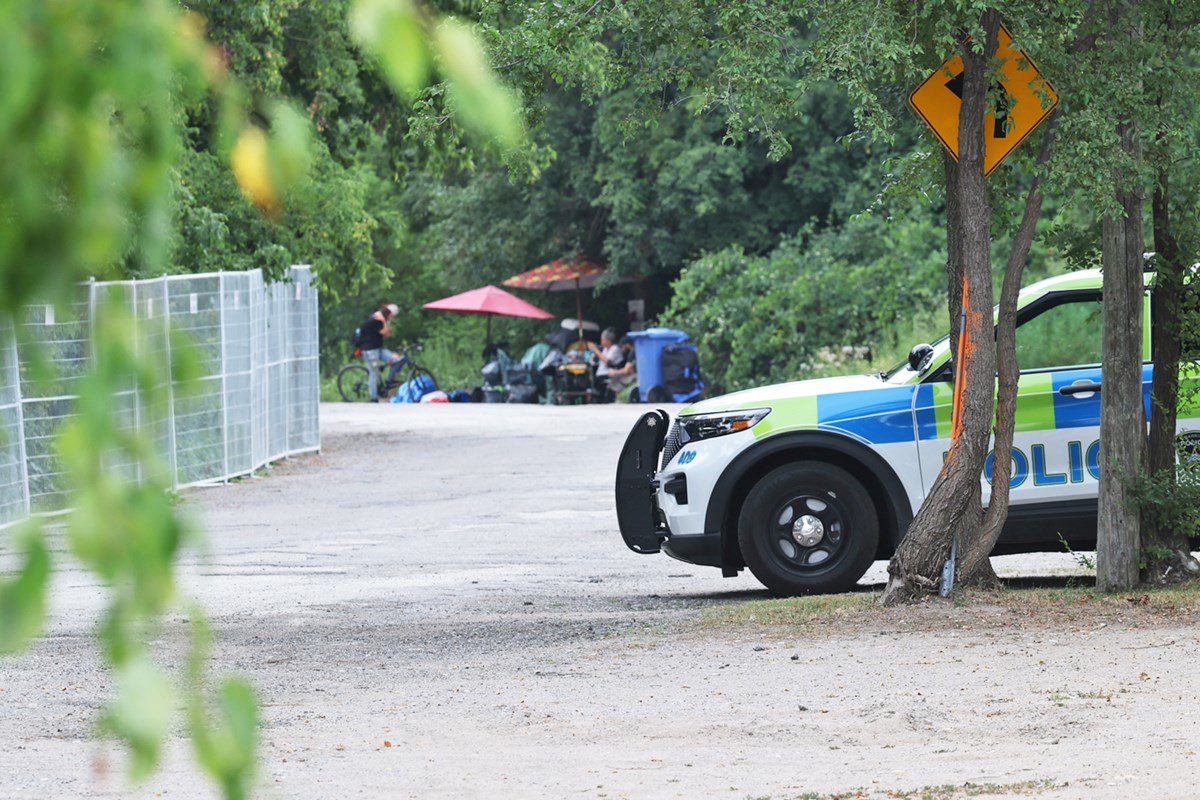
‘The idea that we can let it go from one tent in any location to 20 or 50 or 100 is, quite frankly, the lesson that needs to be learned by the county, by the city,’ says mayor
A homeless encampment under lockdown by Barrie officials after police completed what turned out to be a double-murder investigation over the past week will remain closed for months and will cost millions to clean up, according to city council.
Barrie city council held its executive committee meeting Wednesday evening, which lasted about an hour, with questions and answers back and forth on the issue.
When asked about the cost of the cleanup of the encampment spanning Victoria, Anne and John streets in Barrie, Michael Prowse, the city’s CAO, said a “ballpark” figure would be in the “millions of dollars.”
“How do we prevent something like this from happening in the future?” asked Bryn Hamilton, Ward 10 councillor. “There are other encampments across the city. It’s unacceptable on many, many fronts.”
Hamilton said she was “floored” when she saw photos of the site in its current state.
“I hope there is a lesson learned here,” she added. “Why did we let this go? Why did the county let this go?”
Prowse said the city was aware of these homeless sites and their overall conditions.
“The challenge for the city … when we deal with an encampment, because of both legislation and rules of the courts, one of the first things we need to be able to confirm if there is adequate housing available through our service manager — that being the county,” he said.
Prowse said city council has been in discussions with the county, and the issue is “not new.”
Prowse believes the Victoria Street encampment housed as many as 100 people at the time of the site’s closure.
“The first bridge we would have to cross is we have to confirm with (the county) that we would have upwards of 100 rooms that are appropriate and adequate for those individuals before we can move them out of an encampment,” he explained.
“That has been a dead-end for the city as (the county) has been unable to provide and confirm that housing … that is the bridge we could not cross,” Prowse said.
Things changed, Prowse said, when the police investigation required them to “control the property and move out the individuals that were in the property.
“They do that through their own purposes — they don’t ask for rooms and they don’t ask the city’s permission,” he said. “We were served with a search warrant, they closed off the site and they conducted their investigation — and some of that work is still ongoing.”
Robert Ladouceur has been charged in the deaths and dismemberment of two men in the Victoria Street encampment investigation, according to Barrie police on Thursday afternoon.
The victims named by police are 45-year-old William ‘Blake’ Robinson and 41-year-old David Cheesequay.
Prowse said police turned the property back to the city vacant, but in “terrible condition,” last Friday.
“As owners of the property, we have public safety concerns, and with the site being vacant, that presented to us both a window and a challenge, because the former tenants would surely move back into the site and reoccupy the site without us being able to clean it up,” he said.
The city reached out to agencies such as the Ministry of the Environment (MOE) and the local health unit. Prowse said the MOE showed up at the site; the health unit did not.
The Victoria Street site was deemed “unsafe for human beings”, which effectively triggered an “emergency” with the county, Prowse explained to city councillors.
“That emergency unlocks additional funding and abilities, I believe, through the county, so they were able to cobble together … I think they had at least 60-odd rooms that they could confirm for the city,” he said.
The beds are located within Barrie, according to Prowse, and it’s “a very complex and fluid situation.”
Prowse said as of Wednesday, only six individuals had utilized the available rooms.
“We are required by law to create a support system and expand it and invest in it, but the reality – for a hundred good reasons, I’m sure, for these individuals who are unhoused — they are not able or willing to move into it,” he said.
“If there was 100 people on this site — we’ve accounted for, effectively, six. There are 94 people who are living rough, living in the streets, who have simply migrated because of the work going on at the site,” Prowse added.
“It’s just very complex and very challenging,” he added. “I think we’ve already learned lessons from it.”
Prowse said the cleanup will “probably be going on for months.”
Mayor Alex Nuttall said the problem or the solution both incorporate Charter rights and freedoms.
“Freedom of mobility is one of those Charter rights and freedoms,” he said.
“We, as a body, can look after our land … but what we can’t do is legislate an end to homelessness. It’s a very, very difficult line to walk properly where you’re abiding by the provincial regulations and laws, and doing what we know is the right thing to do, because of various interpretations of those charter rights and those laws via the judiciary,” said Nuttall.
“What is really important is, how did we let it get here? We didn’t. We actually inherited this — and there is more down that route,” Nuttall said.
Nuttall did not specify who or what the council inherited the issue from.
“The idea that we can let it go from one tent in any location to 20 or 50 or 100 is, quite frankly, the lesson that needs to be learned by the county, by the city,” he said.
Nuttall stressed both the city and the county need to work together, “so it doesn’t happen again.”