

Russia and China are to pay their respects to Ali Khamenei, Iran’s former supreme leader, at his state funeral, which began on Thursday in Tehran.
Dmitri Medvedev, the former Russian president, and He Wei, a senior Chinese Communist Party official, were due to join the crowds walking past Khamenei’s Iranian flag-draped casket at Tehran’s Grand Mosalla complex on Friday.
Several Iran-aligned militias from Iraq, as well as the Taliban, will also pass through the prayer hall, where Khamenei gave many addresses, as part of the ceremony.
The former supreme leader’s casket was topped by a black turban and black-and-white checked scarf similar to one he often wore, and which is associated with Iran’s Basij paramilitary force.
Also in attendance as the multi-day ceremonies began was Ahmad Vahidi, the head of Iran’s Islamic Revolutionary Guard Corps (IRGC), who emerged for the funeral after months in hiding.
Vahidi was photographed with his hands on Khamenei’s coffin as Iran prepared for several days of mourning.
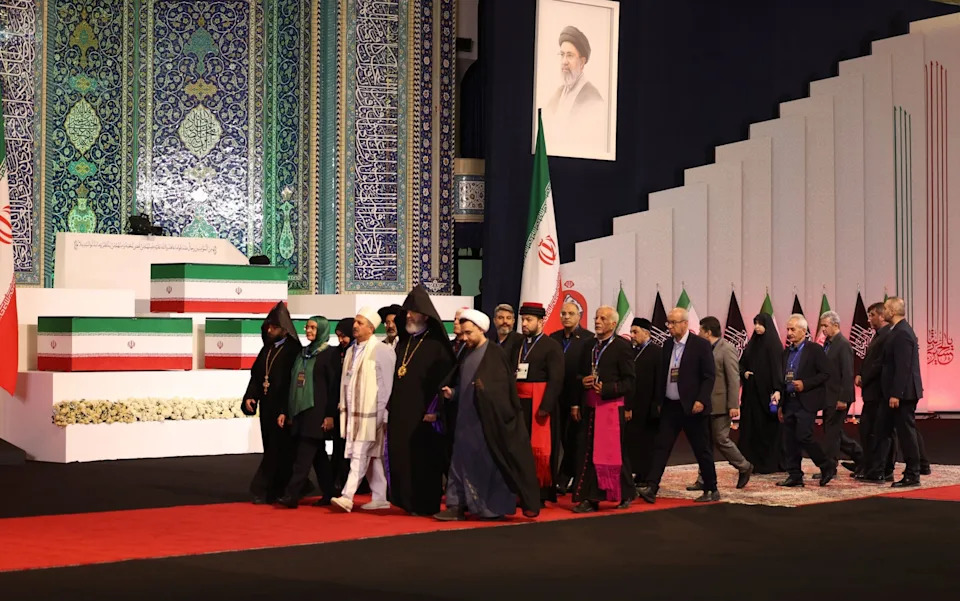
Religious leaders pay their respects alongside the coffin of Ali Khamenei and those of a number of other people killed alongside him in an air strike on his home on the first day of the war – Abedin Taherkanareh/EPA Shutterstock
It was the IRGC chief’s first public appearance since Feb 8, three weeks before the assassination of the 86-year-old supreme leader on Feb 28, the day that US and Israeli strikes began the war in the Middle East.
Khamenei’s public funeral was delayed at the height of the war and has only gone ahead as Iran and the US observe a fragile ceasefire after signing a preliminary deal to halt the conflict.
Observers say the occasion could expose some of the regime’s most senior figures and proxy leaders to unprecedented scrutiny.
Despite US warnings against actions that could derail ongoing negotiations with Tehran, Israeli officials have continued to signal that military options remain on the table.
On Tuesday, Israel Katz, Israel’s defence minister, warned of what he described as a possible “blue and white operation in Iran”.
He said: “If Iran fires missiles at Israel, Israel will strike Iran with force. There is no equation we will accept in which Iran fires at Israel. This has also been made clear to the Americans.
“The IDF is just waiting for it and is on alert. There are targets. It could happen within two days. My directive to the IDF is to prepare for a blue and white operation in Iran.”
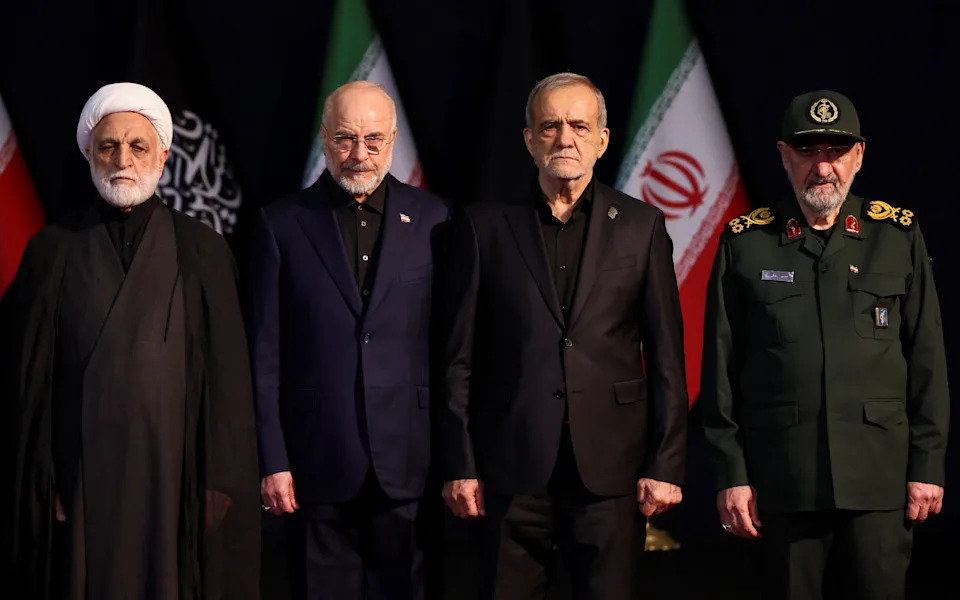
Members of the Tehran regime, including Masoud Pezeshkian, the president, second right, and Mohammad Baqer Qalibaf, the parliament’s speaker, second left, attend the ceremonies on Friday – Majid Asgaripour/WANA via Reuters
The former head of the Quds Force, which oversees the IRGC’s overseas operations, Vahidi replaced Mohammad Pakpour as the head of the IRGC after Pakpour died in the same strike that killed Khamenei.
The United States has sanctioned the 67-year-old for his role in international terrorism, including helping build up the Houthis in Yemen, Hezbollah in Lebanon and Hamas in Gaza, as well as for weapons proliferation and the suppression of civilian protests.
His presence demonstrates why the funeral itself may prove just as significant as any military response for Israeli intelligence services.
Ronen Solomon, an intelligence expert and Iran specialist, said the gathering represented a major intelligence-gathering opportunity because every senior official attending would leave an intelligence “signature”.
“It’s a gold mine,” he said, adding that even without military action, the funeral would help Israel expand its target bank.
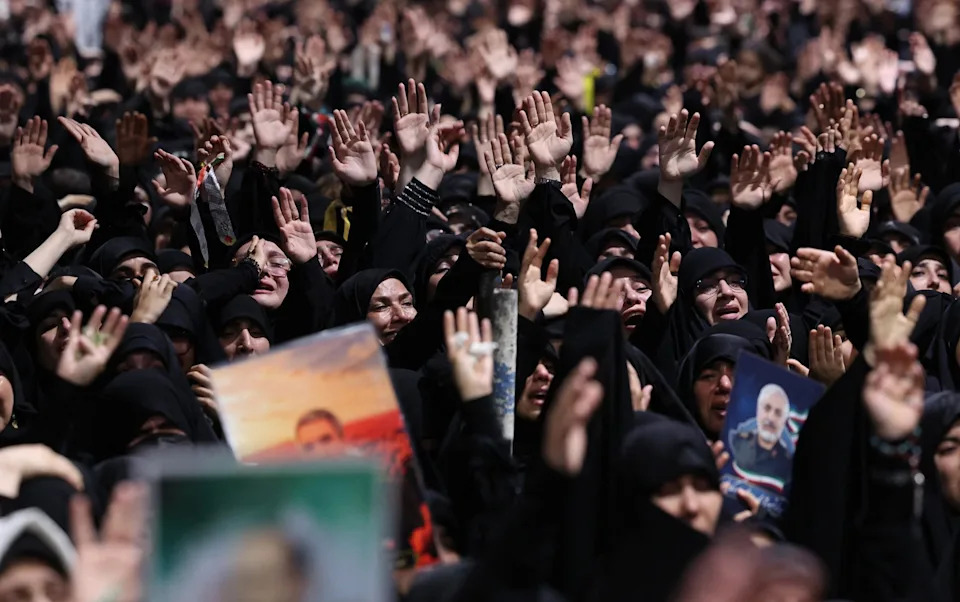
A crowd of mourners gathers around the coffin during the ceremonies. Israeli intelligence is expected to be monitoring those in attendance closely – Iran Supreme Leader’s Office/AFP via Getty Images
Opposition groups within Iran may also take advantage of the funeral, with or without Israeli support, he said.
But for Israel, the immediate focus is likely to be Mojtaba Khamenei, who replaced his father as supreme leader and who has also not been seen in public since the older Khamenei’s death.
“We still don’t know how incapacitated he is from the assassination attempt,” Mr Solomon said, referring to injuries the younger Khamenei sustained in the Feb 28 strikes.
A second Israeli security source told The Telegraph that it was not only Iran’s leadership that should be concerned.
Pointing out that Ismail Haniyeh, the political chief of Hamas, was killed while attending the inauguration of Iran’s new president in Tehran in 2024, he said the funeral could also draw other significant targets for Israel, including senior Hezbollah figures.
‘No hiding place for terrorists’
“Israel has made it clear that there is no hiding place for terrorists, all the way back to the Munich Olympics where Mossad tracked down multiple leaders of Black September,” he said.
Eleven members of Israel’s Olympic team were murdered by Palestinian terrorists at the 1972 Munich Games, triggering a years-long Mossad operation against those involved.
“That same message was clear when Haniyeh was killed in Tehran, a place he had frequently visited and felt immune,” the source said.
Mr Solomon agreed, saying representatives of Iran’s proxies, including Esmail Qaani, the head of the Quds Force, had to attend the funeral.
“The paradox of the Iranians and their octopus tentacles is that they are forced to appear at this event because of their spiritual-religious ideology, and in doing so, they expose themselves after months of avoidance. Some of them will be only half-present, under cover identities,” he said.
“It’s also likely that even Mojtaba won’t look like the person we knew, due to the injury and his recovery.”
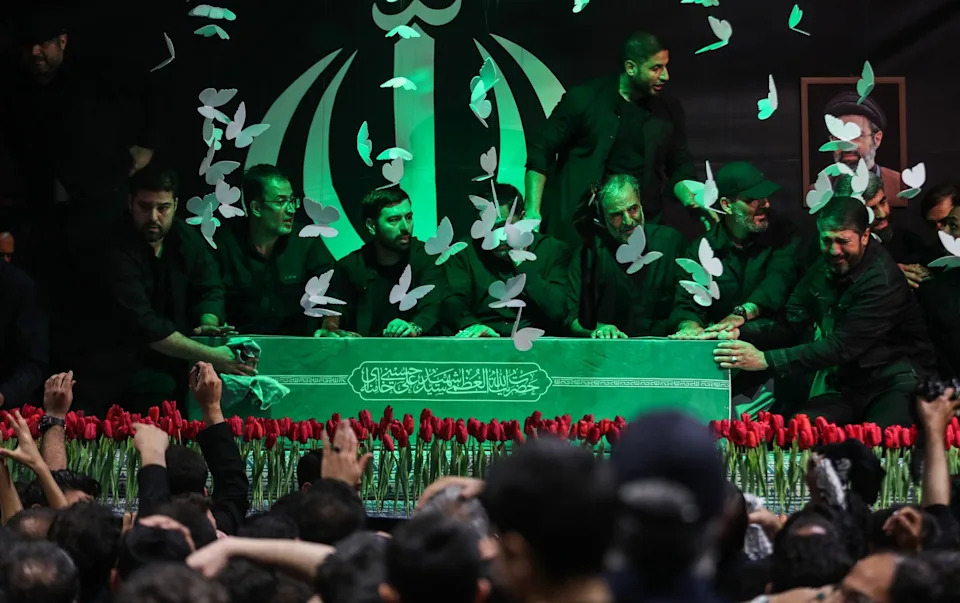
The coffin of Ali Khamenei is surrounded by people as the ceremonies, scheduled to last until July 9 across Iran, begin in Tehran – Iranian President’s Press Office/Anadolu via Getty Images
Concerns that Israel could use high-profile diplomatic gatherings to target senior Iranian officials are not new.
According to The New York Times, US officials feared Israel might attempt to assassinate Abbas Araghchi, the Iranian foreign minister, and Mohammad Bagher Ghalibaf, the speaker of its parliament, during nuclear negotiations earlier this year.
The newspaper reported that Washington was so concerned that it asked regional countries to quietly warn Tehran, and that Israeli and US officials later removed both men from potential target lists to allow diplomacy to continue.
Iranian officials nevertheless sought assurances through Pakistani and Qatari intermediaries that Israel would not target the negotiators during overseas meetings.