
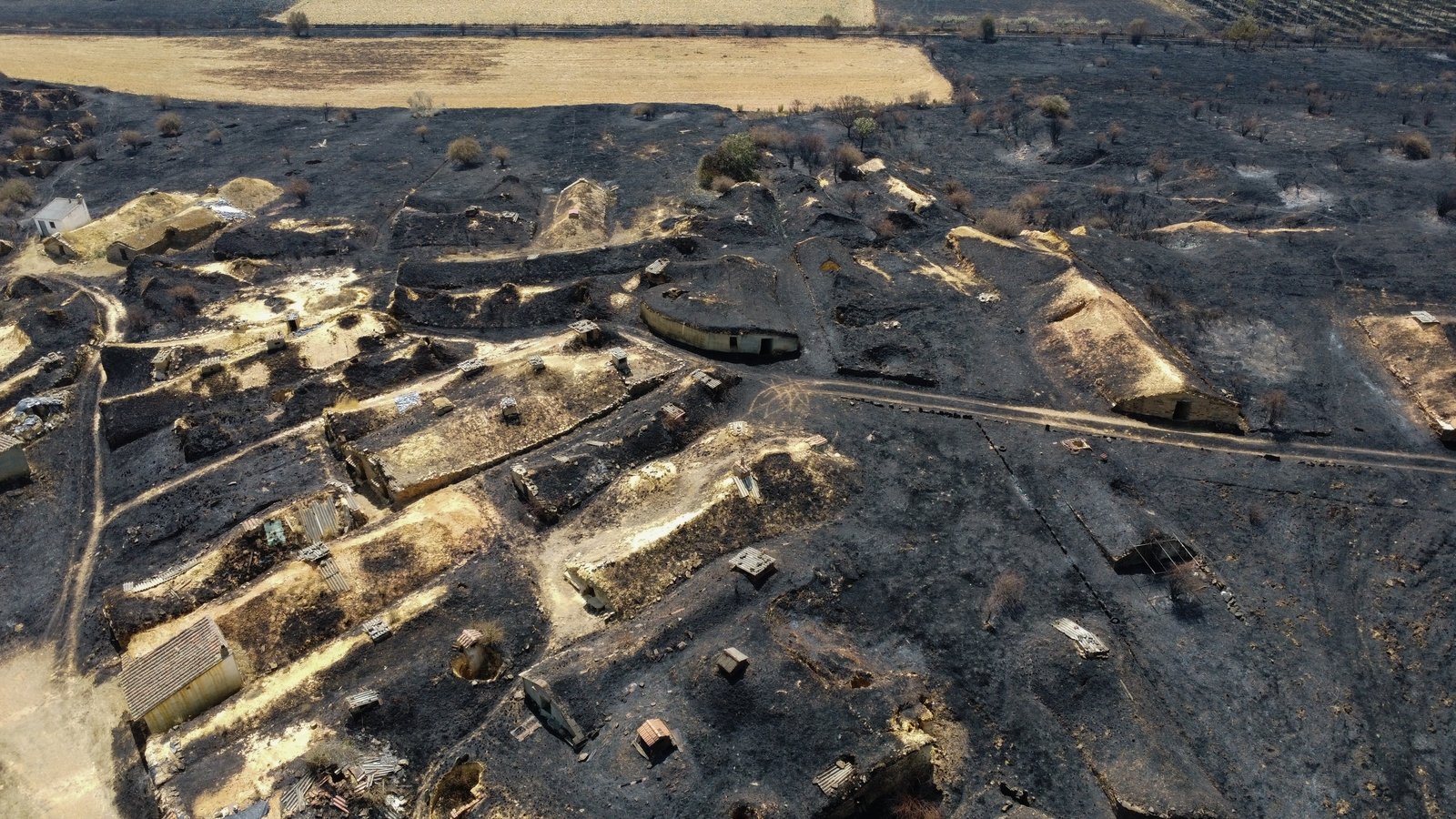
All of Spain is on heatwave alert while the weather agency warned that much of the country is at “very high to extreme risk” from wildfires.
The situation has improved for several other southern European nations, but Greece is still fighting fires on one Aegean island.
Much of Spain has already endured nearly two weeks of high temperatures.
The searing heat has spread to the northwestern region of Cantabria which had so far been spared.
Temperatures there are forecast to pass 40C, said Aemet, the national weather agency.
The risk of fires over the weekend and into Monday is “very high or extreme in most of the country”, it added.
In Portugal, one person – the former mayor of the eastern town of Planta – died while fighting a fire there, President Marcelo Rebelo de Sousa announced.
He added that he had cut short his holidays and returned to the presidential palace to oversee the crisis.
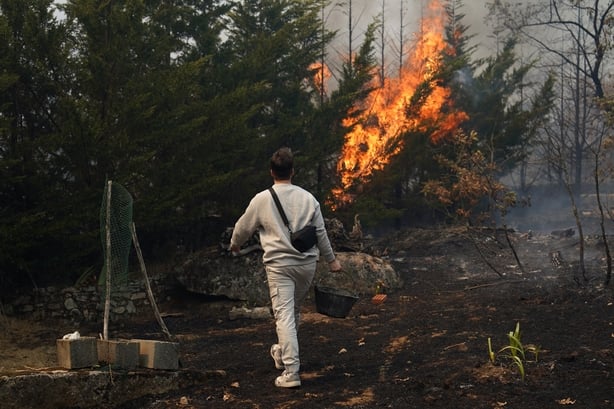
A man attempts to put out a fire in northwestern Spain
Spain has endured a devastating season of fires, with 157,501 hectares reduced to ashes since the start of the year, according to the European Forest Fire Information System (EFFIS).
Yet that figure is still well short of 2022, when more than 306,000 hectares went up in smoke.
Three people have died during the fires, including two young volunteers in their 30s who lost their lives trying to put out a blaze in the Castile and Leon area.
France has sent two water-bombing planes to help try to douse the flames in the northwestern region, where a dozen fires are still raging.
The railway line between Madrid and the northwestern region of Galicia remains closed as well as ten main roads in the country.
Marco Raton works on a farm in Sesnandez de Tabara near one of the fires in Castile and Leon that forced several thousand people to flee their homes.
The 35-year-old said that he and his friends did not think twice when they saw the flames approach and grabbed “everything we had – backpacks, fire bats and garden hoses – put on appropriate clothing and went over to help”.
“As soon as we arrived, we started seeing burned people being evacuated, a car on fire, a burning tractor, warehouses, garages,” he said, adding that he felt “helpless”.
Mr Raton said he thought there was “nothing left to burn” after devastating fires in the same region in 2022, but he was convinced that “this will continue to happen to us year after year”.
Mayor of Ferreruela Angel Roman said he believed that fire breaks should be established around the villages.
“The countryside, if it’s clean, can stop the fire,” he added.
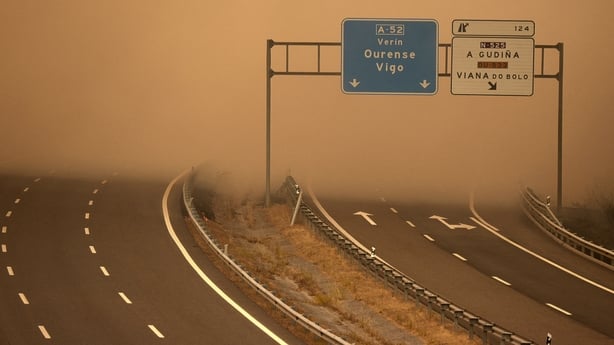
A main road closed as a result of the fires
Spanish Prime Minister Pedro Sanchez’s Socialist PSOE party and the conservative PP have clashed in recent days over the crisis, with regional administrations normally tasked with putting out forest fires.
The central government only intervenes in major incidents and can call on an emergency military unit, which has been in high demand as reinforcement.
The PP accuses the government of having cut the number of air assets, something the PSOE has denied, accusing some opposition leaders of staying on holiday while their regions burned.
Elsewhere in southern Europe, lower temperatures and reduced wind are helping to improve the situation in Greece and the Balkans, where rain is forecast.
Firefighters remain in Patras, Greece’s third-largest city, due to “scattered” fires and are on the look-out if any reignite.
The most active is still on the Mediterranean island of Chios, in the northeastern Aegean Sea, where eight aircraft have been deployed to try to douse the flames.
The risk of fire remains high in the Attica region that includes the capital, Athens, and the southern Pelopponese peninsula, the Civil Protection agency warned.
In Albania, initial government estimates said that thousands of cattle had been killed and 40 homes destroyed in just three days of wildfires.