
Unlock the Editor’s Digest for free
Roula Khalaf, Editor of the FT, selects her favourite stories in this weekly newsletter.
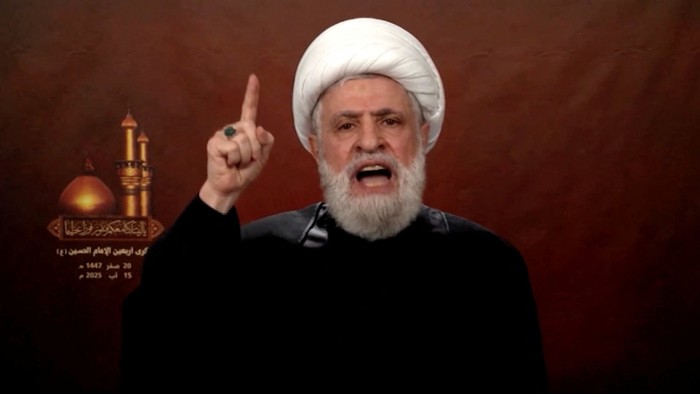
Hizbollah’s leader Naim Qassem has warned civil conflict could break out in Lebanon if its government presses ahead with a divisive US-sponsored plan to remove weapons from the Shia militant group.
The Lebanese government would hold “full responsibility for any sectarian strife” that might occur, Qassem said in a televised speech on Friday.
In pursuing disarmament, the Lebanese government had made a “dangerous decision” that violated the country’s compact of sectarian coexistence, Qassem said.
The government would be “responsible for any internal explosion or any destruction of Lebanon”, he added.
Qassem’s warning, which marked an escalation in Hizbollah’s rhetoric, comes after the Lebanese cabinet earlier this month told the army to create a plan in which the militant group would disarm by the end of the year.
That plan, which comes in the wake of Hizbollah’s bruising war with Israel last year, is to be presented to the government at the end of August.
The cabinet also ratified the objectives of a road map put forward by US special envoy Tom Barrack for Hizbollah’s disarmament, though the government’s Shia ministers walked out.
Lebanese prime minister Nawaf Salam called Qassem’s comments a “veiled threat of civil war”, which he said was “completely unacceptable”.
The Lebanese government has not yet expressed a willingness to take Hizbollah’s weapons by force, while attempts to negotiate have stalled. But its leaders are under mounting international pressure to make progress in disarming the Iran-backed militant group, with aid from US and Arab donors to rebuild the country contingent on achieving that goal.
Hizbollah — which was born in the 1980s to fight an Israeli invasion and occupation during Lebanon’s civil war — has remained defiant, saying its weapons are necessary to defend the country.
Despite a US-brokered ceasefire last November, Israel has held on to pockets of Lebanese territory and conducted hundreds of air strikes across the country.
Qassem cautioned the government against involving the Lebanese army in its disarmament plans. “Don’t drag the army into sectarian strife,” he said. “Its leadership and administration don’t want to go down this path.”
In the aftermath of the cabinet decisions, some of Hizbollah’s domestic critics feared a repeat of May 2008, when armed members of the group occupied Beirut’s streets in protest at government efforts to curb its power.
Qassem said Hizbollah and its allied Shia party Amal had decided to “postpone” street protests because “there is still room for discussion or amendments before we reach the confrontation that no one wants, but which we will partake in if imposed. We are ready for it.”
Hizbollah “will not give up its weapons”, he insisted.
Lebanon’s president Joseph Aoun told a senior Iranian official in Beirut this week that his country rejected all forms of foreign interference and recent statements by Iranian officials that Hizbollah would not disarm.