
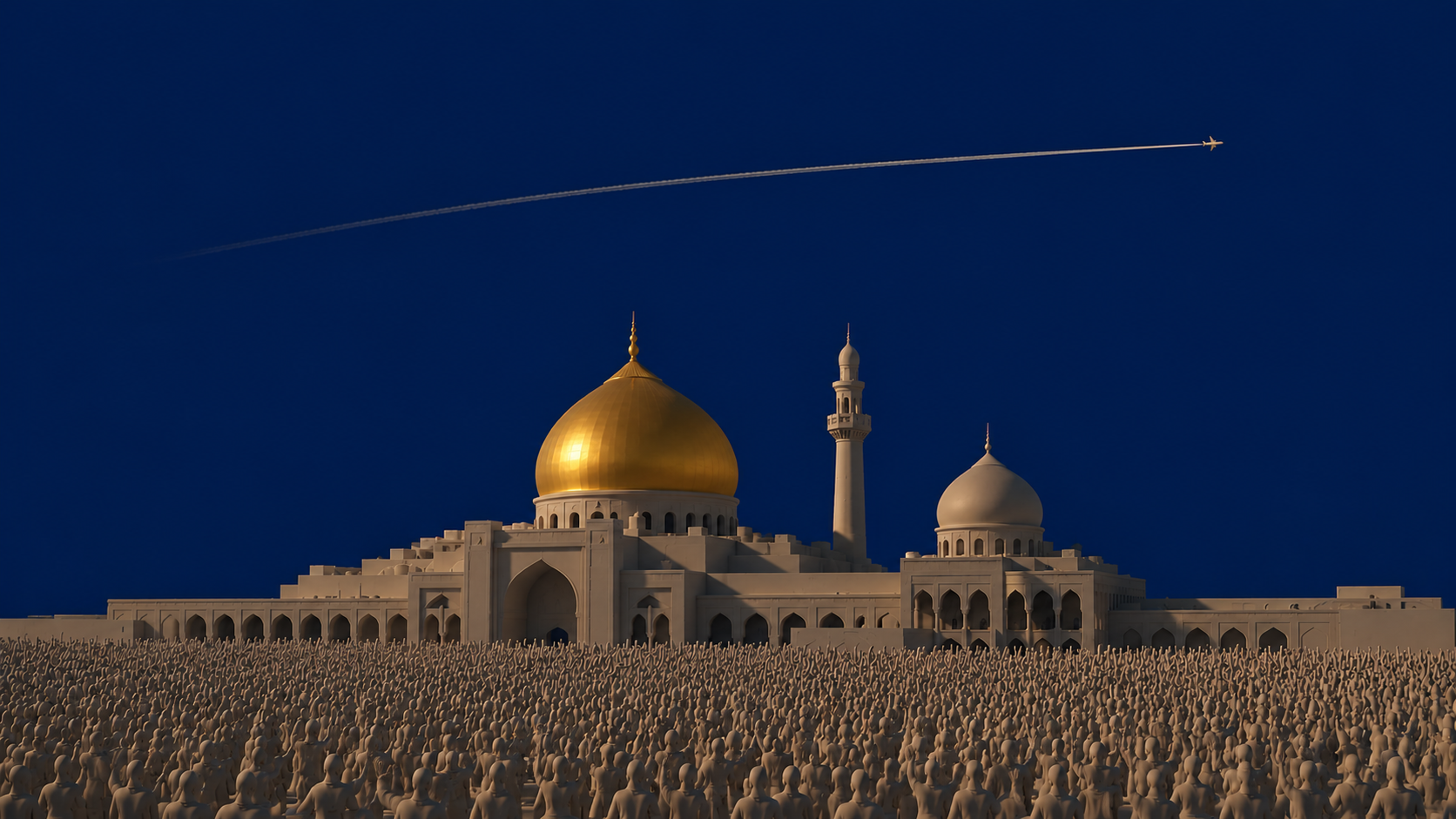
On February 28, on the first day of the war, a joint United States and Israeli strike killed Ali Khamenei in his Tehran compound. He was 86, and had ruled Iran for thirty-seven years. His son Mojtaba, later named to succeed him, was gravely wounded.
The burial was set for March. The war pushed it back four months. It begins now, and it will last six days.
From July 4 to July 9, Iran will stage the largest state funeral in its history. Ceremonies move across five cities and two countries: Tehran first, then Qom, then the Iraqi shrine cities of Najaf and Karbala, and finally Mashhad, where Khamenei was born and where he will be buried beside the shrine of the Eighth Imam. Officials expect fifteen to twenty million mourners across the week. The last gathering of this scale was the funeral of Ayatollah Ruhollah Khomeini in 1989, remembered for its chaos.
President Masoud Pezeshkian, parliament speaker Mohammad Bagher Ghalibaf, foreign minister Abbas Araghchi, judiciary chief Gholam-Hossein Mohseni-Ejei. General Ahmad Vahidi, the new commander of the Revolutionary Guard, appeared beside the casket for the first time in months. More than a hundred countries were invited.
Russia sent Medvedev, Pakistan its prime minister and army chief, the Taliban its foreign minister, China a senior parliamentary figure. From the region came Iraq, Lebanon, Saudi Arabia, Qatar, and Oman. Europe was not invited, and Tehran said why: it backed the campaign. Indirect talks with Washington are set to resume on July 11, the nuclear file among them.
One man will not be there. Mojtaba Khamenei has reportedly been barred from the funeral by his own government, which fears Israel would use the occasion to kill him.
What Israel Can Reach
Iran did not empty the successor’s place by accident. Hiding Mojtaba is an admission, and it rests on what the regime already saw: Khamenei was reached and killed by a precise strike on his compound on the first morning of the war. Its air defenses did little then and are weaker now. The sky is, in practice, open.
The ground offers no more cover. The Mossad’s capacity to operate inside Iran is a matter of long record, not speculation.
And the air has a recent rehearsal. On February 23, 2025, as Hezbollah buried Nasrallah before a crowd estimated in the hundreds of thousands at Beirut’s Camille Chamoun Sports City Stadium, four Israeli jets, two F-15Is and two F-35Is, flew in tight formation low over the mourners. No fire. Presence alone, and a message.
Whether Israel can reach them is settled. Whether it would is not.
The Reasons to Act
There are reasons Israel would want to act, and they are not trivial.
The first is removal. Larijani and Kharazi are already dead. Ghalibaf and Araghchi are the men who replaced them. Kill this second rank too, and Iran loses the last minds able to sit across from Washington without losing control of the table, just as its chosen successor hides.
The second is demonstration. A strike would show that Israel enters the country at will, and that its air defenses are a fiction. Force displayed, weakness exposed, in a single stroke.
Action need not mean bringing everything down. It cannot, in fact. The funeral hosts foreign delegations, and even a surgical strike on the Iranian leaders would endanger the guests of honor beside them, killing or wounding citizens of powers Israel cannot afford to touch.
What remains is narrower and quieter. Something that stains the ceremony rather than levels it, that punctures the solemnity of a day of national mourning. A mark left on the event itself. It would enter the histories of both countries, as the low pass over Nasrallah’s coffin already has.
The Reach Is the Danger
The larger the act, the wider its reach, and the reach is the danger.
A funeral of this kind is not only Iran’s. It gathers delegations from powers that have no part in the war, some of them nuclear, one of them the mediator of the very truce now in force. Anything broad enough to strike the Iranian leadership would risk striking them too.
The first cost falls on Washington. The agreement belongs to the American president, and he has already shown he will defend it against his own ally. In early June, when Netanyahu moved to strike Beirut and the escalation threatened the diplomatic track, Trump called him crazy, reminded him who had kept him out of prison, and forced the operation to a halt.
On the eve of the funeral he made the hierarchy plainer still. Netanyahu had asked to come to the White House, Trump said, and would be received within the week, because the Israeli leader “knows who the boss is.” A blow struck now, over the president’s deal, would turn the ally into the saboteur.
The second falls across the room. Every foreign delegation present is a wire Israel would not want to cut, and a wide strike severs several at once, turning a quarrel with Iran into a quarrel with its allies.
In 1914, a single gunman in Sarajevo killed the heir to the Austro-Hungarian throne. Within weeks, a web of alliances had turned that one death into a world war. The danger is rarely the act itself. It is the machinery the act sets in motion.
Voices Over the Coffin
By the opening day, the main actors had already spoken.
From Mount Rushmore, marking the American semiquincentennial, Trump said Iran was desperate to settle and that Washington had granted it a week’s pause for the funeral out of generosity. In a separate interview, speaking of the leadership assembled in one place, he was blunter. He remarked that they were all gathered together, that a single strike could remove them all, and that the only reason not to was that it would leave no one to negotiate with.
From Istanbul, beside Pakistani officials, Erdogan said he was watching Israeli attempts to blow up the American-Iranian deal.
Inside Tehran, the chants were of vengeance. Mourners beat their chests and swore Trump would not sleep easy. Ghalibaf urged the nation to carry its demand for revenge to the world.
The negotiators return to the table on July 11. The burial is on the 9th. The talks resume two days after the last coffin is lowered.
The Closed Door
Which leaves Israel, and a choice only Israel can see.
The temptation is real, and it will not come again. Never again will the surviving leadership stand so exposed, so concentrated, so scheduled, gathered in the open across six days in cities whose maps are published in advance. A window like this does not reopen.
But Iran is not Hezbollah. Beirut was cheap. By February 2025, Hezbollah was a broken force: its leadership decapitated, its ranks gutted by the pager attack, most of its missile arsenal destroyed. Humiliating it cost Israel nothing. Mashhad is different. The funeral is full of representatives from other countries. And Trump has already stopped Israel once. The flyover that humiliated in Beirut would start a fire in Mashhad. Every option now carries a price, and the price runs through Washington.
So Israel can reach them. The harder question is whether reaching them gains it anything.
Maybe the decision is still open. Maybe it was made long ago, behind a closed door, and the quiet is all we get to see.
Israel restrained itself at Nasrallah’s funeral. Will it at Khamenei’s?
Céleo Ramírez is an ophthalmologist and scientific researcher based in San Pedro Sula, Honduras where he devotes most of his time to his clinical and surgical practice. In his spare time he writes scientific opinion articles which has led him to publish some of his perspectives on public health in prestigious journals such as The Lancet and The International Journal of Infectious Diseases. Dr. Céleo Ramírez is also a permanent member of the Sigma Xi Scientific Honor Society, one of the oldest and most prestigious in the world, of which more than 200 Nobel Prize winners have been members, including Albert Einstein, Enrico Fermi, Linus Pauling, Francis Crick and James Watson.
He is also the author of two books on the ethical and human dimensions of artificial intelligence: Algorithmic Psychopathy: The Dark Secret of Artificial Intelligence, endorsed by Dr. David L. Charney, M.D., psychiatrist, founder of the National Office for Intelligence Reconciliation (NOIR), and advisor on U.S. intelligence security, and AI Displacement: 12 Human Stories of Job Loss in the Age of AI. Both are available on Amazon.