
Normal text sizeLarger text sizeVery large text size
Apprentice electrician Dylan D’Emanuele is a young man whose world has just opened up. It’s only mid-afternoon and the 22-year-old is physically drained from a day’s work on site in Brunswick, but he is cheery and hopeful.
For the first time, he can see a bright future, thanks to the recent support of employment organisation Youth Projects and the lifelong love (and occasional hectoring) of his grandmother, who raised him from infancy.
“I’m just really tired, sure. But am I excited about the future? Yes, I am. It’s been like a long-time dream come true for me,” D’Emanuele says.
After he completed year 12 at Taylors Lakes Secondary College, D’Emanuele sought work in a trade. The experience was crushing.
He estimates he spent 100 days cold-calling electricians and being rejected – even being told to “f— off”.
“That really stunted me,” he says. “I was like, ‘maybe it’s not them, maybe it’s me’. Just that rejection – it does get to you, it makes you feel like you’re worthless.”
A youth employment agency paired him with a tradesperson, but it was a punishing experience. D’Emanuele had to make a daily round trip of more than 150 kilometres to Clyde North. He says he was paid a flat weekly rate of $600, but made to work unpaid overtime and given minimal guidance.
“Just a stereotypical tradie, not really showing me the ropes, yelling at me,” he says of his former employer.
D’Emanuele feels grateful that he was eventually connected with Youth Projects, which assists youths aged 16 to 24 who have experienced long-term unemployment or who have disengaged from education.
The organisation began working in Melbourne’s west in 2022, with a caseload of about 520 young people, which has ballooned to 1900.
Over coming months, The Age is strengthening its focus on Melbourne’s booming west, with a special series examining the positives and challenges the region faces. In October, our reporters will moderate a West of Melbourne Economic Development Alliance (WoMEDA) summit to discuss a vision for the western suburbs’ success. The alliance of university, industry, community and local government experts works to unlock the west’s economic potential.
Employment data for Melbourne’s west presents a troubling contradiction. Overall, the situation is getting healthier.
In the year to June 2025, the west’s unemployment rate fell from 6.2 per cent to 5.6 per cent, bucking a statewide trend in which Victoria’s jobless rate rose minimally, from 4.5 to 4.6 per cent.
But for younger people, the picture is not encouraging. The youth unemployment rate rose from 11.5 per cent to 14 per cent. Statewide, it also ticked upwards, but not so sharply – from 9.9 to 10.5 per cent.
The widening gap suggests young workers in Melbourne’s west are vulnerable, WoMEDA said in a report on economic conditions in the region.
“In tight labour market conditions, employers are more willing to look to them to address their shortages. As conditions ease, younger-aged workers are some of the first to be let go,” the report said.
It’s a vulnerability Chris Lacey sees first-hand, every day.
Lacey is general manager of programs at west suburban youth support organisation the Les Twentyman Foundation.
“We’re trying to get young people to 12 weeks of consistently showing up every day, which really means that we can say, ‘well, that’s now a sustainable job’,” Lacey says.
It’s a bar made higher by the paucity of local career opportunities, and the fact that long commutes can be the difference between success and failure.
“If we can find a kid a job, but it’s an hour and a half each way because they need to get two trains and a bus to get to work, then we’re not setting that kid up for success,” Lacey says. “That’s a real challenge for us at the moment.”
In the outer west, many first-time local job opportunities are in construction, on greenfield housing estates that can only be reached by driving.
Loading
“There are not even buses in these places. You’re trying to get a 17-year-old out to a worksite out the back of Melton somewhere.”
For Lacey, the west’s high youth unemployment rate reflects the relative dearth of investment in local infrastructure.
Unless something changes, the influx of families into Melbourne’s western growth corridors will raise a lost generation of unemployed teens, he says.
“We’ve been told that Sunshine is going to be another CBD, that all these jobs are going to flow through, but it just hasn’t happened, so where’s the investment?
“We’ve got people living in the outskirts of Melbourne. We’re building these new suburbs. What are we doing to create a sustainable environment where people can get to work in a reasonable amount of time?”
Young people in the west are eager for skilled work. University of Melbourne data shows the number of enrolled students from Wyndham rose by 15 per cent in the five years to 2024, with the most popular courses being bachelors of science, arts, commerce and biomedicine.
A spokesman for the state government said it was delivering targeted employment and training to help young people enter the workforce, including building two new TAFE campuses in Melton and Sunbury that will open in 2028.
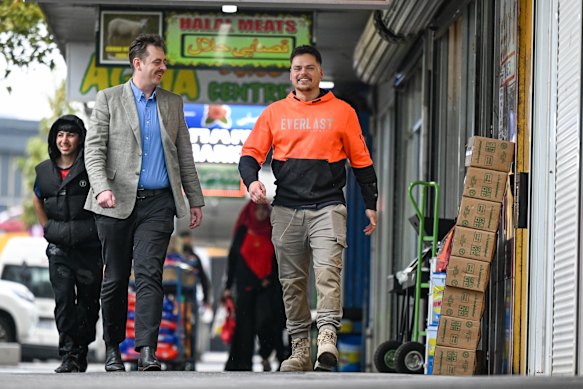
Youth Projects chief executive Trent Miller with Dylan D’Emanuele. The organisation helped Dylan get a job where he is thriving.Credit: Joe Armao
But Youth Projects chief executive Trent Miller says research has found that it is taking longer for young people to gain a foothold in today’s jobs market.
“What we know is that young people are always going to start out in lower-skilled jobs,” Miller says.
“It’s taking them longer to climb the career ladder. It takes around 2½ years for a young person to find full-time work after they’ve finished education. And there’s about one in five young people who are working that want more work and simply can’t find it.”
On a satellite image, Melbourne’s west is dominated by a vast industrial precinct – Australia’s largest – stretching from the coastal wetlands of Altona across several suburbs to Caroline Springs.
But the image doesn’t tell the changing story of employment in the region.
Melbourne’s west is experiencing an extraordinary rise in its professional workforce, while traditional sources of employment in manufacturing and logistics languish.
In August 2017, slightly more than 60,000 professionals called the western suburbs home. By August last year, the figure had surged to about 120,000.
The rise in the number of professionals in the west is part of a turnaround in the region’s fortunes, WoMEDA says.
For WoMEDA chair Professor Peter Dawkins, this burgeoning, highly skilled, high-salary professional class is an extraordinary success story, with one large caveat.
“The big problem is, if people want to be employed … [there’s] the increasing need for them to travel out of the region,” he says.
Today, one in five workers in the west is in manufacturing or logistics, but those sectors are forecast to fall into proportional decline by 2034, contributing a forecast 6000 out of 66,000 expected new jobs.
The WoMEDA report’s lead author, Janine Dixon, director of Victoria University’s Centre of Policy Studies, says the industrial mega-precinct in the west’s geographic heart cements the region’s reputation for manufacturing and logistics, but also amplifies the commuting issues felt by residents who must cross it.
Major distribution centres, including Amazon, Australia Post and start-up Shiperoo, have established in the west, but the rise of automation means this sector is not the jobs driver it once was.
“It’s good for the owners … and in terms of being able to receive consumer goods, it’s good for all of Melbourne, but it’s not what we’re aiming for,” Dixon says.
Likewise, manufacturing is not the mass employer it used to be, she says.
“Manufacturing over the years has shifted from a lot of production-line jobs into design management, professional services, engineering … it used to be known as ‘dirty, dumb and dangerous’, but it’s not that any more.”
Lyka Smith is the kind of business WoMEDA is keen to see more of. The company’s biomedical engineers make 3D-printed titanium implants for complex jaw and facial surgeries needed by specialists operating in Victorian hospitals.

Andrew Wenhlowskyj and Anthony Tran, of 3D printing start-up Lyka Smith, part of a new breed of businesses setting up in Melbourne’s west. Credit: Justin McManus
While surgeons once had to wait about six weeks for parts to be made and shipped from overseas, operations manager Andrew Wenhlowskyj says the turnaround is now barely a week.
The company was founded in Point Cook in 2017 before moving into a purpose-built facility in Altona North with 16 printers and 19 staff, about half of whom live in the region. Wenhlowskyj says being based in the west has been beneficial.
“[It] gives us fast access to major hospitals, regional centres and a strong local workforce. There’s a growing base of professionals living in the west, many of whom have moved here with families and want meaningful, high-skill work closer to home,” he says.
Loading
Wenhlowskyj’s commute from Williams Landing takes just 15 minutes. He encourages other business owners to set aside legacy thinking about the “industrial west”.
“We’re proof that it works … and if you set up here, you’re giving people a chance to work closer to home, which is a huge win for them and their families. It also just makes business sense – shorter commutes, more loyalty, better work-life balance.”
The West of Melbourne Summit, presented by WoMEDA with The Age, will be held on October 22-23. For details go to womeda.com.au
Start the day with a summary of the day’s most important and interesting stories, analysis and insights. Sign up for our Morning Edition newsletter.